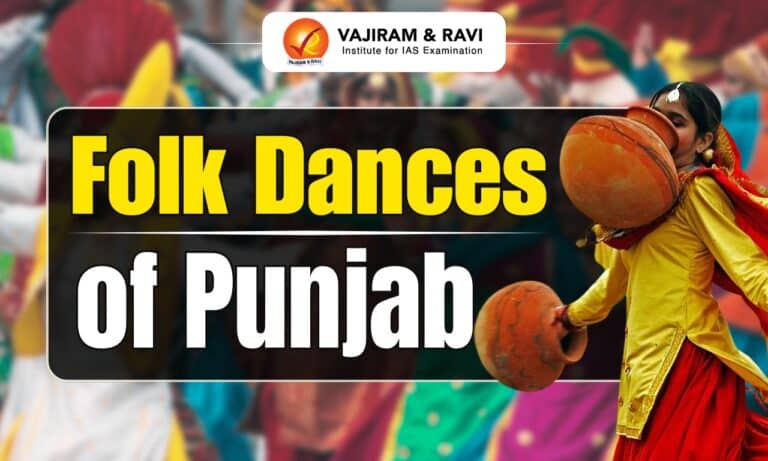
Folk dances of Punjab reflect the lively spirit, strong traditions, and joyful lifestyle of the people of the region. These dances are an important part of social and cultural life and are often performed during festivals, harvest seasons, and celebrations. Known for their energetic movements, rhythmic beats, and colorful attire, they express happiness, enthusiasm, and community bonding. Each dance form represents different aspects of Punjabi culture and adds to its rich and vibrant heritage.
Famous Folk Dances of Punjab
The famous folk dances of Punjab showcase the vibrant and energetic cultural heritage of the region. These dances are an important part of traditional life and are widely performed during festivals, harvest celebrations, and special occasions. Known for their lively movements, rhythmic music, and colorful costumes, they reflect the joy and enthusiasm of the people. Some of the well-known folk dances of Punjab are discussed below.
Bhangra
- Bhangra is the most iconic and widely recognized folk dance of Punjab, representing the spirit of joy, strength, and celebration in Punjabi culture.
- It originated as a seasonal harvest dance, especially during Vaisakhi, when farmers celebrated the successful harvesting of wheat crops and expressed gratitude for prosperity.
- The dance is characterized by high-energy movements such as leaps, kicks, shoulder shrugs, and rhythmic clapping, which reflect enthusiasm and physical vigor.
- The main musical instrument is the dhol, supported by chimta, algoza (double flute), and iktara, creating a strong rhythmic base.
- Songs known as boliyan are sung alongside the dance, highlighting themes of love, bravery, rural life, and social relationships.
- Over time, Bhangra has transformed into a global cultural phenomenon, influencing international music and dance forms, especially in the Punjabi diaspora.
- The traditional attire like bright kurta, lungi/chaadra, phulkari, and colorful turbans adds vibrancy and identity to the performance.
- Today, Bhangra is not only performed during festivals but also in competitions, stage performances, and global cultural events.
Giddha
- Giddha is the traditional folk dance of Punjabi women, often considered the female counterpart of Bhangra, combining grace with liveliness.
- It is performed during festivals like Teej, Lohri, and weddings, especially in pre-wedding ceremonies.
- Women form a circle, clap in rhythm, and perform expressive movements while singing boliyan, which are often improvised and humorous.
- The dance acts as a medium of expression, reflecting women’s experiences, emotions, social conditions, and cultural values.
- A special type called Viyahula Giddha is performed during marriages, focusing on rituals, relationships, and celebrations.
- There are no rigid rules or choreography, making it a spontaneous and participatory dance form.
- Giddha plays an important role in preserving oral traditions and folk literature of Punjab.
Malwai Giddha
- Malwai Giddha is a male-oriented version of Giddha, popular in the Malwa region of Punjab.
- It is more energetic, dramatic, and theatrical, often including humor, mimicry, and social satire.
- Performers use instruments like chimta, dholaki, and algoza, and sometimes include spoken dialogues and skits.
- The dance reflects rural Punjabi life, traditions, and social issues, making it both entertaining and informative.
- It is commonly performed by young men, especially during cultural festivals and fairs.
- The emphasis is on expression, coordination, and audience engagement, rather than strict choreography.
Jhumar
- Jhumar is a traditional dance from the Sandalbar region, known for its slow, rhythmic, and graceful movements.
- It is performed mainly by men, though women also participate in some variations.
- The dance involves circular formations, gentle swaying, and synchronized steps, creating a calm and elegant atmosphere.
- It is commonly performed during weddings, harvest celebrations, and social gatherings.
- The music is soft and melodious, often accompanied by dhol and folk singing, emphasizing rhythm over speed.
- Jhumar represents unity, harmony, and collective celebration in Punjabi society.
Sammi
- Sammi is a traditional women’s dance, originating from the tribal belts of Punjab, especially in rural areas.
- It is a slow and expressive dance, performed in a circular formation with coordinated hand movements and gestures.
- The dance often tells emotional stories of love, separation, and longing, especially linked to migration, war, or social hardships.
- It reflects the emotional depth and resilience of Punjabi women, expressed through subtle facial expressions and body language.
- The dancers wear bright traditional attire with ornaments, adding grace and elegance to the performance.
- Sammi is also considered a narrative dance form, preserving folk stories and cultural memory.
Kikli
- Kikli is a playful and energetic dance, mainly performed by young girls, and is also seen as a traditional game.
- Two girls stand facing each other, hold hands in a crossed manner, and spin rapidly while balancing on their toes.
- The speed of spinning gradually increases, requiring coordination, balance, and strength.
- While performing, they sing songs related to family, relationships, and everyday life experiences.
- It represents joy, innocence, friendship, and bonding among young girls.
- Kikli is commonly seen during festivals and informal gatherings, especially in rural Punjab.
Jago
- Jago is a pre-wedding folk dance and ritual, performed mainly by women during night-time celebrations.
- Women carry a decorated earthen pot (gaggar) with lit oil lamps or candles on their heads.
- They move in a procession through the village or neighborhood, singing and dancing to invite people to join the celebration.
- It symbolizes joy, prosperity, and blessings for the bride and groom.
- Jago also strengthens community participation and social bonding, making weddings a collective celebration.
Luddi
- Luddi is a high-energy dance performed by men, often to celebrate victory, success, or achievement.
- It includes vigorous movements, jumps, and expressive gestures, performed to fast dhol beats.
- The dance reflects confidence, pride, and celebration of accomplishments.
Gatka
- Gatka is a martial art-based dance form, deeply associated with Sikh history and warrior traditions.
- It involves sword fighting, stick movements, and combat techniques, performed in a rhythmic and artistic manner.
- It represents discipline, courage, self-defense, and spiritual strength.
- Gatka is often showcased during religious festivals like Gurpurabs and processions.
Dhamaal
- Dhamaal is a lively and energetic dance, performed during religious and festive occasions.
- It includes jumping, spinning, and synchronized movements, creating a joyful and vibrant environment.
- The strong beats of the dhol enhance the intensity and excitement of the dance.
Jugni
- Jugni is a folk performance combining singing and dancing, often used as a medium of storytelling and expression.
- It reflects a wide range of emotions like joy, sorrow, satire, and social commentary.
- Jugni songs often highlight cultural values, traditions, and contemporary social issues.
Folk Dances of Punjab Cultural Significance
- Punjabi folk dances are rooted in the agricultural cycle, with forms like Bhangra and Jhumar celebrating harvest, prosperity, and festivals like Vaisakhi.
- They reflect gender roles and social identity, where Giddha represents women’s expression, while Bhangra and Malwai Giddha showcase male energy and strength.
- Dances like Giddha, Sammi, and Jugni act as carriers of oral tradition, preserving stories, emotions, and social values through songs and movements.
- Group performances such as Jago, Kikli, and Jindua promote community bonding, unity, and collective celebration during social occasions.
- Martial forms like Gatka highlight Punjab’s warrior tradition and spiritual values, emphasizing courage and discipline.
- Globally popular dances like Bhangra and Giddha represent Punjabi identity worldwide, promoting cultural pride among the diaspora.


 Last updated on Oct, 2026
→ UPSC 2027 Notification will be released on 13 January 2027 at upsconline.nic.in.
→ Check Nobel Prize 2026 Winners List here.
→ Download PIB PRiSM Monthly Magazine 2026 here.
→ Check UPSC Monthly Current Affairs Magazine The Recitals here.
→ Check out the latest UPSC Syllabus here.
→ Download UPSC Model Answers for Mains 2026
→ UPSC Mains Question Paper 2026 is out now for Essay & GS Paper 1, 2, 3 & 4.
→ UPSC Calendar 2027 has been released.
→ Enroll in Vajiram & Ravi’s UPSC Mains Test Series 2027 for structured answer writing practice, expert evaluation, and exam-oriented feedback.
→ Join Vajiram & Ravi’s UPSC Mentorship Program 2027 for personalized guidance, strategy planning, and one-to-one support from experienced mentors.
→ Go through the UPSC Mains Previous Year Papers to enhance your preparation.
→ UPSC has released UPSC Toppers List 2025 with the Civil Services final result on its official website.
→ Also check Best UPSC Coaching in India
Folk Dances of Punjab FAQs
Q1. What are the most famous folk dances of Punjab?+
Q2. What is Bhangra and why is it important?+
Q3. How is Giddha different from Bhangra?+
Q4. What is the cultural significance of Punjabi folk dances?+
Q5. Which Punjabi folk dance is related to weddings?+
Q6. What is Gatka in Punjab?+
Q7. What is Kikli and who performs it?+
Q8. What role do Punjabi folk dances play in festivals?+
Tags: art and culture art and culture notes folk dances of punjab