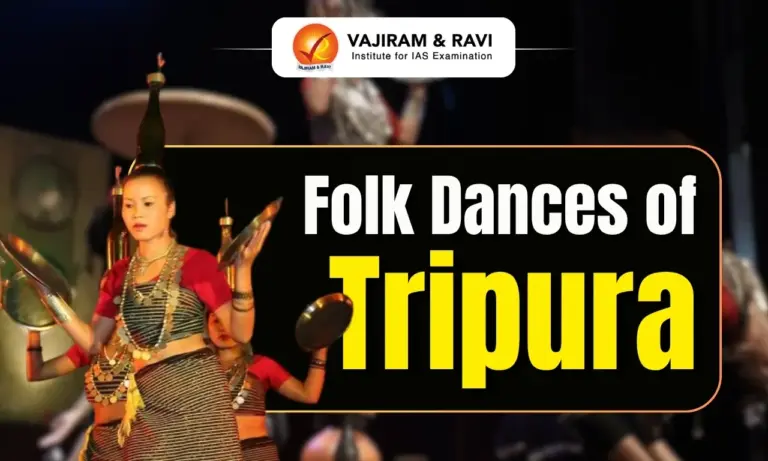
Folk Dances of Tripura reflect the State’s rich tribal heritage and close relationship with nature, Jhum (shifting) cultivation, seasons, festivals and community life. Tripura has 19 tribal communities, including the Tripuri, Reang, Jamatia, Chakma, Halam, Lusai, Garo and Mog, along with Bengali and Manipuri communities, each with its own dance traditions. For many communities, dance is more than entertainment; it is an important part of agricultural rituals, harvest celebrations, New Year festivals, weddings and religious occasions.
Major Folk Dances of Tripura
Major folk dances of Tripura include Hozagiri, Garia, Lebang Boomani, Bizu, Hai-Hak, Wangala, Cheraw, Jhum Dance and Sangrai. Each is associated with a particular community, festival, season or agricultural occasion.
Hozagiri
Hozagiri (also called Hodaigiri) is the most famous and distinctive folk dance of Tripura, performed by women of the Reang (Bru) community.
- It is performed only by women and young girls, in groups of about six to eight members.
- Dancers balance on top of an earthen pitcher, with a bottle on the head and a lighted earthen lamp (diya)balanced on the hand.
- Only the lower body – waist, hips and legs – moves rhythmically, while the upper body and hands remain remarkably still, creating a wave-like motion.
- It is traditionally performed during the Hojagiri festival, held on a full moon night, and is linked to the worship of Goddess Lakshmi (Mainuma/Maikhlungmo) for a good harvest of paddy and other crops.
- Accompanying instruments include the Khamb (drum), bamboo flute and bamboo cymbals.
- Satyaram Reang, the community’s leading exponent, received the Sangeet Natak Akademi Award (1986) and the Padma Shri (2021) for popularising Hozagiri nationally and internationally.
Garia (Goria)
Garia is a devotional folk dance performed by the Tripuri and Jamatia communities, closely tied to Jhum cultivation.
- It is performed during Garia Puja, celebrated on the seventh day of the Bengali month of Baishakh (mid-April), just after the sowing of Jhum crops.
- The festival worships Garia, the deity of livestock, prosperity and good harvest, represented by a sacred bamboo pole decorated with flowers and rice beer (zu).
- The dance is performed by both men and women, and celebrations continue for about seven days.
- It marks the beginning of the agricultural cycle, symbolising hope for a prosperous farming season.
Lebang Boomani
Lebang Boomani is a playful, nature-linked folk dance of the Tripuri community, performed after the Garia Puja, while awaiting the monsoon.
- The dance imitates the catching of “Lebang” — a colourful insect (green cicada/grasshopper) that visits hill slopes at this time of year.
- Men create a rhythmic clacking sound using two bamboo chips (clappers), which attracts the insects.
- Women move gracefully across the hill slopes, mimicking the act of catching the insects, sometimes waving colourful scarves.
- It reflects the community’s close observation of nature and the agricultural calendar.
Bizu (Bizhu)
Bizu is the New Year dance of the Chakma community, performed during the Bizu festival.
- Bizu marks the end of the Bengali calendar year (Chaitra Sankranti) and the welcoming of the new year, generally around mid-April.
- The festival spans three days — Phool Bizu (floral offerings), Mul Bizu (main day, with traditional dance and songs), and Gotche Potche Bizu (honouring elders).
- The dance is performed by both men and women, accompanied by instruments such as the Dhol, Baajhi, Hengrang and Dhulak.
- It symbolises renewal, happiness and community bonding.
Hai-Hak
Hai-Hak is a harvest dance performed by the Halam (Molsom) community.
- It is performed at the end of the Jhum harvesting season, to invoke the blessings of Goddess Lakshmi.
- It is described as a “welcome dance”, reflecting gratitude for a successful harvest.
- Both male and female members participate, and the dance is known for its graceful, coordinated rhythm.
Wangala
Wangala is the harvest thanksgiving dance of the Garo community of Tripura.
- It is performed as part of the “first rice-eating” ceremony, held after a successful Jhum harvest.
- The community head (Sangnakma) visits homes and performs a ritual cutting of a pumpkin as part of the worship.
- The dance is accompanied by traditional drumming and is a communal thanksgiving to nature.
Cheraw (Bamboo Dance)
Cheraw, popularly known as the Bamboo Dance, is traditionally a Mizo dance, also performed in Tripura by the Lusai (Lushai)/Darlong communities.
- Male dancers sit facing each other, rhythmically clapping pairs of horizontal bamboo staves together and apart.
- Female dancers step gracefully in and out of the moving bamboo poles in time with the beat.
- It requires precision, agility and coordination, and is considered one of the oldest dance traditions of the region.
Jhum Dance
Jhum Dance is a “working dance” performed at the Jhum cultivation field itself.
- It depicts the daily activities of shifting cultivation — clearing forests, sowing seeds, and other farm labour.
- It is performed to lighten the burden of hard labour and motivate workers, often accompanied by folk songs.
- It directly reflects the lifestyle, mode of cultivation and traditions of Tripura’s tribal communities.
Sangrai
Sangrai is performed by the Mog (Marma) community, a Buddhist tribal group of Tripura.
- It is performed during the Sangrai festival, marking the New Year according to the Buddhist/Chaitra calendar.
- Dancers move around a decorated bamboo pole representing the deity, accompanied by bamboo flutes, drums and gongs.
- It is a dance of thanksgiving and prayer for good harvests, health and prosperity.
Also Read: Folk Dances of Nagaland
Other Folk Dances of Tripura
Beyond the major forms above, Tripura has several community-specific dances that add to its cultural diversity:
- Maimita – performed by the Tripuri community, associated with agricultural and seasonal celebrations.
- Masak Sumani – another Tripuri community dance form.
- Tangbiti – performed by the Tripura and Noatia tribes, depicting daily life in the Jhum fields, using props like the Langa (bamboo basket) and Da (Tripuri knife).
- Welcome Dance – performed by the Lusai community to greet guests.
- Chimithang, Padisha and Abhangma – dances of the Mog community.
- Dhamail – a group dance of Bengali women, performed at weddings and festive occasions, marked by clapping and rhythmic stepping rather than instruments.
- Gajan and Rabindra dances – performed by the Bengali community during religious and cultural occasions.
- Basanta Rash and Pung Chalam – dances of the Manipuri community settled in Tripura.


Cultural Significance of Folk Dances of Tripura
The folk dances of Tripura show how tribal culture is closely connected with agriculture, nature, festivals and community life.
- Agricultural cycle: Garia, Lebang Boomani, Jhum Dance, Hai-Hak and Wangala are closely linked with different stages of Jhum cultivation and harvest.
- Tribal identity: Different communities preserve distinct traditions, such as Hozagiri-Reang, Bizu-Chakma, Hai-Hak-Halam, Wangala-Garo and Sangrai-Mog.
- Nature and environment: Lebang Boomani and Jhum Dance reflect the close observation of nature and agricultural surroundings.
- Religious traditions: Garia, Hozagiri, Hai-Hak, Wangala and Sangrai combine dance with worship, thanksgiving and prayers.
- Community participation: Many dances involve men and women performing together, strengthening social bonds and collective identity.
- Cultural preservation: These dances preserve traditional songs, customs, beliefs and community knowledge and pass them from one generation to the next.
- National recognition: Hozagiri has gained wider recognition through the work of performers such as Satyaram Reang, who received the Padma Shri in 2021.

 Last updated on Oct, 2026
→ UPSC 2027 Notification will be released on 13 January 2027 at upsconline.nic.in.
→ Check Nobel Prize 2026 Winners List here.
→ Download PIB PRiSM Monthly Magazine 2026 here.
→ Check UPSC Monthly Current Affairs Magazine The Recitals here.
→ Check out the latest UPSC Syllabus here.
→ Download UPSC Model Answers for Mains 2026
→ UPSC Mains Question Paper 2026 is out now for Essay & GS Paper 1, 2, 3 & 4.
→ UPSC Calendar 2027 has been released.
→ Enroll in Vajiram & Ravi’s UPSC Mains Test Series 2027 for structured answer writing practice, expert evaluation, and exam-oriented feedback.
→ Join Vajiram & Ravi’s UPSC Mentorship Program 2027 for personalized guidance, strategy planning, and one-to-one support from experienced mentors.
→ Go through the UPSC Mains Previous Year Papers to enhance your preparation.
→ UPSC has released UPSC Toppers List 2025 with the Civil Services final result on its official website.
→ Also check Best UPSC Coaching in India
Folk Dances of Tripura FAQs
Q1. What are the major folk dances of Tripura? +
Q2. Which folk dance of Tripura is associated with Jhum cultivation's sowing season?+
Q3. Which folk dance of Tripura is linked to the Chakma community's New Year? +
Q4. Which folk dance of Tripura involves catching insects?+
Q5. Which folk dance of Tripura is also associated with Mizoram? +
Tags: folk dances of tripura