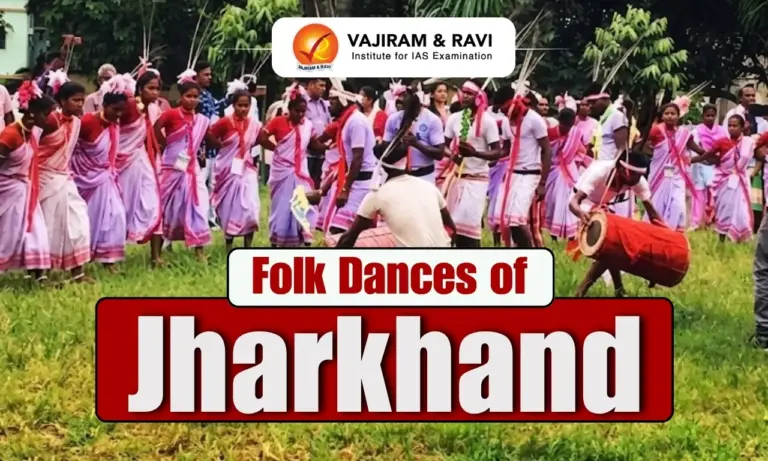
Folk Dances of Jharkhand are traditional community dances passed down through generations and closely linked with local customs, festivals and everyday life. They reflect the State’s rich tribal heritage and close relationship with nature, agriculture, seasons, community life and martial traditions. They are commonly performed during religious rituals, harvest celebrations, marriages and seasonal festivals.
Jharkhand has 32 recognised Scheduled Tribes, including the Santhal, Munda, Oraon, Ho and Bhumij. Their diverse traditions make folk dances an important part of the State’s intangible cultural heritage.
Also Read: Folk Dances of West Bengal
Major Folk Dances of Jharkhand
Major folk dances of Jharkhand include Chhau, Jhumair, Mardana Jhumair, Janani Jhumair, Karma, Sarhul, Paika, Domkach, Fagua, Firkal, Mundari, Santali and Tusu. Each is associated with particular communities, festivals, seasons or social occasions.
Chhau
Chhau is a prominent folk dance of Jharkhand, combining martial movements, folk traditions, acrobatics and dance-drama.
- It portrays stories from the Ramayana and Mahabharata, along with local folklore, nature and other themes.
- It has three regional styles – Seraikela Chhau of Jharkhand, Purulia Chhau of West Bengal and Mayurbhanj Chhau of Odisha.
- The Chhau dance tradition, covering all three regional styles, was inscribed on UNESCO’s Representative List of the Intangible Cultural Heritage of Humanity in 2010.
Jhumair
Jhumair is a popular folk dance of Jharkhand, particularly associated with the Chota Nagpur Plateau and Nagpuri cultural region. It is performed during festivals, seasonal celebrations and agricultural occasions and is also found in parts of neighbouring West Bengal and Odisha.
- Dancers usually perform in lines or circles, often holding hands and moving rhythmically together.
- It is accompanied by instruments such as the Mandar, Dhol, Nagara, Dhak, Bansi (flute) and Shehnai.
- Mardana Jhumair (Mardani Jhumar) is the male form, characterised by more vigorous movements; men may wear ghungroo and sometimes carry a sword.
- Janani Jhumair is the women-centric form, in which women perform graceful, coordinated movements while holding hands; it is traditionally associated with festivals such as Karam and Jitiya.
Overall, Jhumair reflects the importance of agriculture, seasonal celebrations and community participation in the cultural life of Jharkhand.
Karma / Karam
Karma or Karam is a traditional folk dance of Jharkhand performed during the Karam festival, which is dedicated to Karam Devta, associated with power, youth and youthfulness.
- The Karam tree is central to the festival. Villagers traditionally bring its branches from the forest to the village after performing rituals.
- Unmarried girls traditionally play an important role in carrying the sacred Karam branches, accompanied by songs and dancing.
- The dance is performed around the Karam branches with energetic movements and rhythmic drum beats.
- It reflects the close relationship between nature, community life, seasonal traditions and tribal beliefs.
Sarhul
Sarhul Sarhul is a ritual dance performed during the Sarhul festival, which marks the tribal New Year and the blossoming of the Sal tree.
- Women wear white sarees with red borders and dance to mark the advent of spring.
- Sal flowers are offered to the village deity as symbols of protection and brotherhood.
- It is central to the Munda, Oraon and Ho communities and is closely tied to the Sarna faith of nature worship.
- In the Kolhan region the same festival is known as “Baa Porob”.
Paika
Paika is a Nagpuri ceremonial martial dance performed by men. Dancers wear ghungroo and perform holding a sword and shield, accompanied by Nagara, Dhak and Shehnai. It was traditionally performed by Paikas, a class of foot-soldiers, to welcome important guests or during religious processions, reflecting the martial history of the Chota Nagpur region.
Domkach
Domkach is a folk dance closely associated with marriage celebrations.
- It is performed during weddings and related ceremonies.
- Traditionally, it is performed by women from the groom’s side.
- The performance combines singing, dancing, humour and social interaction.
- It provides an opportunity for members of the wedding party and community to participate in the celebrations.
- It reflects family relationships, social bonding and community participation.
Fagua
Fagua Fagua is a folk dance performed by both men and women during the festival of Fagua (Holi). It marks the arrival of spring through colourful, playful group performances.
Firkal
Firkal is a martial folk dance associated with the Bhumij community.
- It reflects traditional hunting and combat practices.
- Performers use traditional weapons such as bows, arrows, swords and shields.
- The dance combines physical skill, coordinated movements and martial display.
- It reflects the importance of hunting, self-defence and warrior traditions in the cultural history of the Bhumij community.
Mundari
Mundari is a folk dance associated with the Munda community and is particularly connected with marriage celebrations.
- It is performed to celebrate newly married couples.
- It forms part of the community’s social and cultural celebrations.
- The dance expresses joy, community participation and cultural identity.
- It also reflects the wider connection of Munda traditions with agriculture, festivals and community life.
Santali
Santhali is a traditional folk dance of the Santhal community, one of the major tribal communities of Jharkhand. It is a group dance performed mainly during festivals, social gatherings and community celebrations.
- Both men and women participate, often dancing together in coordinated formations.
- Dancers perform rhythmic movements accompanied by traditional songs and percussion instruments.
- Women often dance in a line while holding hands, creating a strong sense of unity and collective participation.
- The dance reflects the Santhal community’s close connection with nature, social life and cultural traditions.
Tusu
Tusu is a folk tradition associated with Tusu Parab, an important harvest festival.
- It is mainly celebrated in January.
- The tradition is particularly associated with unmarried girls.
- It is linked with the harvest of paddy and rice.
- A decorated pyramidal structure known as a Chaudal is prepared.
- The Chaudal is carried in a procession accompanied by songs and dancing.
- At the end of the celebration, it is taken towards and immersed in a water body.
Other Folk Dances of Jharkhand
Jharkhand has a much wider range of community and regional folk dances. These include Dasai, Rinjha, Kaathi, Dahar, Maghe, Nachni, Barao, Chhangu Nritya, Hunta, Lahasuya, Jhitka and Danga, and Ghora Naach, among others.
Also Read: Folk Dances of Uttar Pradesh


Cultural Significance of Folk Dances of Jharkhand
The folk dances of Jharkhand are closely linked with the State’s tribal identity, nature, agriculture, festivals and community life.
- Nature worship: Traditions such as Sarhul and Karma reflect reverence for the Sal and Karam trees.
- Agricultural life: Jhumair and Tusu are closely associated with harvests, seasons and the agricultural cycle.
- Tribal identity: Dances such as Firkal, Mundari and Santali preserve the distinct cultural identity of the Bhumij, Munda and Santhal communities.
- Martial heritage: Chhau, Paika and Firkal preserve elements of traditional warfare, hunting and martial skills.
- Social bonding: Group dances bring communities together during festivals, weddings and social gatherings, strengthening collective participation.
- Gender roles: Mardana and Janani Jhumair represent distinct male and female forms of community dance traditions.
- Oral heritage: Folk songs, dances and rituals help preserve local languages, beliefs, traditional knowledge and collective memory.
- Living heritage: Regular performances during festivals, rituals and community occasions ensure the continued transmission of these traditions across generations.

 Last updated on Oct, 2026
→ UPSC 2027 Notification will be released on 13 January 2027 at upsconline.nic.in.
→ Check Nobel Prize 2026 Winners List here.
→ Download PIB PRiSM Monthly Magazine 2026 here.
→ Check UPSC Monthly Current Affairs Magazine The Recitals here.
→ Check out the latest UPSC Syllabus here.
→ Download UPSC Model Answers for Mains 2026
→ UPSC Mains Question Paper 2026 is out now for Essay & GS Paper 1, 2, 3 & 4.
→ UPSC Calendar 2027 has been released.
→ Enroll in Vajiram & Ravi’s UPSC Mains Test Series 2027 for structured answer writing practice, expert evaluation, and exam-oriented feedback.
→ Join Vajiram & Ravi’s UPSC Mentorship Program 2027 for personalized guidance, strategy planning, and one-to-one support from experienced mentors.
→ Go through the UPSC Mains Previous Year Papers to enhance your preparation.
→ UPSC has released UPSC Toppers List 2025 with the Civil Services final result on its official website.
→ Also check Best UPSC Coaching in India
Folk Dances of Jharkhand FAQs
Q1. What are the major folk dances of Jharkhand?+
Q2. Which folk dance of Jharkhand has UNESCO recognition?+
Q3. Which Jharkhand festival is associated with the Sal tree?+
Q4. Which Jharkhand folk dance is associated with the Bhumij community?+
Q5. Which Jharkhand folk dance is associated with marriage?+
Q6. Which Jharkhand festival is associated with unmarried girls and the harvest?+
Tags: folk dances of jharkhand