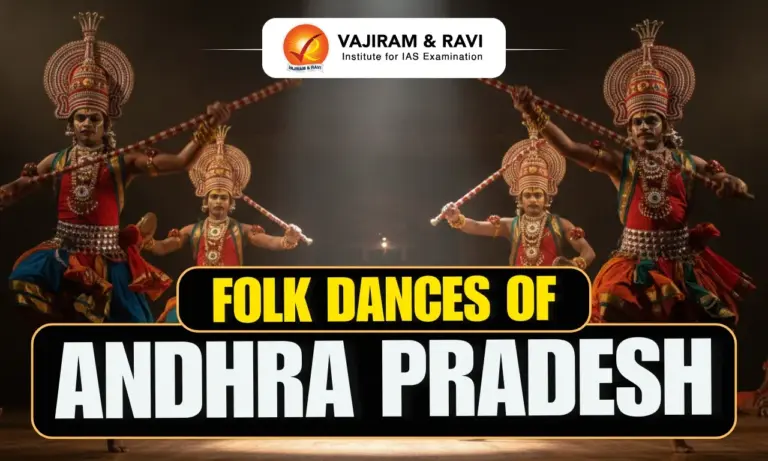
Folk Dances of Andhra Pradesh reflect the state’s religious beliefs, tribal traditions, village life, festivals, harvest practices and oral heritage. These performances use colourful costumes, rhythmic movements, percussion instruments, sticks, masks, drums and storytelling. Important forms include Kolattam, Veeranatyam, Tappeta Gullu, Lambadi, Dhimsa, Butta Bommalu, Burra Katha, Dappu, Dommarata and Gangireddulu, each carrying a distinct cultural meaning.
Folk Dances of Andhra Pradesh
Folk Dances of Andhra Pradesh developed mainly around community life, religious practices, festivals, harvests and tribal customs. They preserve local traditions through dance, music, costumes, instruments, storytelling and collective participation. Some forms are performed mainly by men, while others involve women or both genders. Their regional distribution also varies from coastal districts and rural areas to the forested and hilly regions of the state.
Features of Folk Dance in Andhra Pradesh
The key features of the Folk Dances of Andhra Pradesh has been listed below:
- Folk tradition and identity: Folk Dances of Andhra Pradesh preserve oral traditions and community memory. Their costumes, instruments, movements, stories and occasions provide insight into the social and cultural life of different communities.
- Regional diversity: Coastal districts, rural settlements, forest regions and hilly areas have developed distinct performance traditions. Srikakulam, Vizianagaram, Visakhapatnam, East Godavari and the Araku Valley feature prominently in these traditions.
- Musical instruments: Folk Dances of Andhra Pradesh use diverse instruments such as Dappu, Veeranam, Tappeta, Mori, Kiridi, Tudumu, Jodukommulu, Tambura, Dolu and Tasha. Their rhythms shape the movement and atmosphere.
- Cultural significance: These performances connect religious worship, agriculture, festivals, tribal life, storytelling and rural celebrations. Their continued practice helps preserve Andhra Pradesh’s living cultural heritage across generations.


List of Folk Dances of Andhra Pradesh
The following folk and tribal performance traditions show the cultural diversity, social practices, religious beliefs and artistic heritage of Andhra Pradesh.
Kolattam
- Kolattam is a popular stick dance also called Kolannalu or Kolkolannalu.
- Dancers form inner and outer circles and rhythmically strike decorated sticks with partners during village festivals.
Veeranatyam
- Veeranatyam, meaning the “dance of the brave,” is an ancient Shaivite tradition associated with Veerabhadra.
- It is performed by Veerabhadriya performers, particularly around Draksharamam in East Godavari.
- The main percussion instrument is Veeranam, or war drum.
- Other instruments include Tambura, Soolam, Dolu and Tasha, which support the vigorous movements and religious expression.
Tappeta Gullu
- Tappeta Gullu is a devotional male dance associated mainly with Srikakulam, Vizianagaram and Visakhapatnam.
- It was traditionally performed to invoke Gangamma, the deity associated with rain.
- Performers generally number around 15 to 20.
- They wear drums around their necks and ankle bells while displaying energetic movements, strong rhythm and demanding acrobatic skills.
Lambadi
- Lambadi is a tribal dance associated with the Banjara or Lambadi community.
- It reflects harvesting, planting, sowing, festivals and community life among a traditionally semi nomadic population.
- Women usually perform Lambadi while men provide musical support.
- Dancers wear long skirts and blouses decorated with mirrors and beadwork, along with ivory bangles and brass anklets.
Dhimsa
- Dhimsa is a tribal dance associated with the Valmiki, Bagata, Khond and Kotia communities of the Araku Valley and surrounding hilly areas of Visakhapatnam.
- Around 15 to 20 women can form a linked chain and move in a snake like pattern.
- Male performers support them using instruments such as Mori, Kiridi, Tudumu, Dappu and Jodukommulu.
- Dhimsa has several forms, including Boda Dimsa, Gunderi Dimsa or Usku Dimsa, God Beta Dimsa, Kunda Dimsa, Bhag Dimsa, Natikari Dimsa, Poster Tola Dimsa and Baya Dimsa.
- Dhimsa strengthens friendship and fraternity between villages.
- Performances occur during weddings, festivals and Chaitra celebrations, particularly during March and April.
Butta Bommalu
- Butta Bommalu is a folk dance associated with Tanuku.
- Its name means basket toys and performers wear large lightweight figures made using materials such as dry grass, bamboo, wood husk and cow dung.
- The masks or figures can represent Lord Krishna, Lord Rama, Lord Shiva and Lord Hanuman.
- Usually 4 to 8 performers use graceful movements with Dappu rhythms.
Dappu
- Dappu is a percussion based folk performance using a goat skin drum played with sticks.
- Dancers wear ankle bells and perform to rhythmic patterns created by percussion and other instruments.
- Dappu performances are associated with processions, festivals, marriages and jatakas.
- The tradition is particularly linked with Nizamabad and uses colourful costumes, make up, cymbals, tabla and harmonium.
Dommarata
- Dommarata is a historic group dance involving men and women.
- Women perform rhythmic steps while male performers balance bamboo or other wooden sticks during coordinated movements.
- Dommarata represents rural teamwork and physical coordination.
- In recent years, cultural ballet groups have also presented this traditional performance on organised stages.
Gangireddulu
- Gangireddulu is closely associated with Sankranti, the major harvest festival of Andhra Pradesh.
- Men travel from house to house with specially decorated bulls as part of this centuries old tradition.
- The bulls are decorated with colourful sarees, flowers around their horns and anklets.
- Performers also wear distinctive traditional attire, making the presentation an important part of Sankranti celebrations.
Peacock Dance
- The Peacock Dance is performed by Khond or Samanla communities living in hilly areas of Visakhapatnam and Srikakulam.
- It is traditionally associated with weddings and festivals.
- Dancers wear white dhotis and grass made turbans decorated with colourful cloth.
- Peacock feathers are tied behind the waist, creating a tail like appearance during bending movements.
Kommu Koya
- Kommu Koya is a tribal celebration associated with Koya communities living in forest regions.
- A group of about 20 men and women participates, with a large cow hide drum providing the main rhythm.
Garagallu
- Garagallu is among the traditional folk performance forms associated with Andhra Pradesh.
- It represents the wider regional tradition in which dance, rhythm, community participation and local cultural practices are closely connected.
Puli Dance
- Puli Dance is a traditional folk performance using the tiger as its central visual theme.
- It belongs to the colourful performance traditions that use costumes, body presentation, movement and rhythm to entertain communities.
Maragallu Dance
- Maragallu Dance is included among the traditional folk performance forms of Andhra Pradesh.
- Like other rural traditions, it reflects the state’s wider heritage of community based dance and cultural expression.
Keelugurralu
- Keelugurralu is a traditional folk performance of Andhra Pradesh.
- Its presentation uses horse like forms as a major visual element and demonstrates the state’s use of props and costumes in folk entertainment.
Pagativeshalu
- Pagativeshalu is a traditional performance tradition associated with Andhra folk culture.
- It forms part of the broader heritage of village based artistic practices that combine acting, movement, expression and community entertainment.
Mahankali Natyam
- Mahankali Natyam is a traditional devotional performance associated with regional religious practices.
- It reflects the connection between folk performance, worship, local festivals and community traditions in Andhra Pradesh.

 Last updated on Oct, 2026
→ UPSC 2027 Notification will be released on 13 January 2027 at upsconline.nic.in.
→ Check Nobel Prize 2026 Winners List here.
→ Download PIB PRiSM Monthly Magazine 2026 here.
→ Check UPSC Monthly Current Affairs Magazine The Recitals here.
→ Check out the latest UPSC Syllabus here.
→ Download UPSC Model Answers for Mains 2026
→ UPSC Mains Question Paper 2026 is out now for Essay & GS Paper 1, 2, 3 & 4.
→ UPSC Calendar 2027 has been released.
→ Enroll in Vajiram & Ravi’s UPSC Mains Test Series 2027 for structured answer writing practice, expert evaluation, and exam-oriented feedback.
→ Join Vajiram & Ravi’s UPSC Mentorship Program 2027 for personalized guidance, strategy planning, and one-to-one support from experienced mentors.
→ Go through the UPSC Mains Previous Year Papers to enhance your preparation.
→ UPSC has released UPSC Toppers List 2025 with the Civil Services final result on its official website.
→ Also check Best UPSC Coaching in India
Folk Dances of Andhra Pradesh FAQs
Q1. What is the most famous Folk Dance of Andhra Pradesh?+
Q2. Which Folk Dance of Andhra Pradesh is known as the dance of the brave?+
Q3. Which folk dance is associated with the tribal communities of Araku Valley?+
Q4. Which Folk Dance of Andhra Pradesh is associated with the rain god?+
Q5. What is Burra Katha in Andhra Pradesh?+
Tags: folk dances folk dances of andhra pradesh folk dances of india