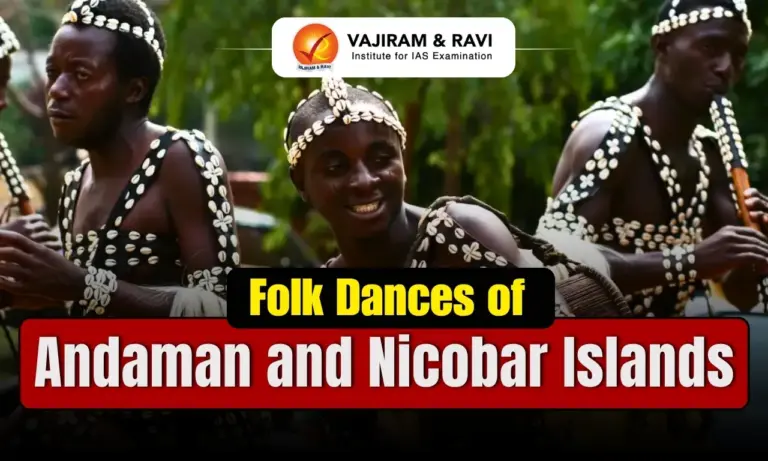
Folk dances of the Andaman and Nicobar Islands reflect the Union Territory’s distinctive tribal heritage, community life and cultural diversity. The most clearly documented traditional dance is the Nicobarese dance, while the Karen Bamboo Dance represents the cultural tradition of the Karen community settled in the Islands. Traditional song and dance also form part of the cultural life of indigenous Andamanese communities.
Major Folk Dances of Andaman and Nicobar Islands
Major folk dances and traditional dance forms of the Andaman and Nicobar Islands include Nicobarese Dance and Karen Bamboo Dance, along with traditional dance practices of indigenous communities. These forms are mainly associated with community celebrations, traditional ceremonies and cultural identity.
Nicobarese Dance
Nicobarese Dance is a traditional folk dance of the Nicobarese community, particularly associated with the Nicobar Islands.
- It is a circular group dance performed in or near the houses of the community.
- A leader guides the dancers through a repetitive rhythm, while dancers move together in coordinated steps.
- The dancers move from side to side and jump together, creating a synchronised group performance.
- Singing is an important part of the tradition, with participants performing together in a coordinated manner.
- The dance is closely connected with Nicobarese community life, traditional ceremonies and social gatherings.
Also Read: Folk Dances of Puducherry
Karen Bamboo Dance
Karen Bamboo Dance is a traditional dance associated with the Karen community, which has its roots in Myanmar and settled in the Andaman Islands during the British period.
- The dance is performed using bamboo poles, which are rhythmically moved or clapped together.
- Dancers move in and out between the bamboo poles, requiring coordination, agility and precise timing.
- It represents the cultural identity and traditional heritage of the Karen community in the Islands.
- The Karen community is particularly associated with Webi village in Mayabunder, North and Middle Andaman.
Settler-Community Dances (Island Tourism Festival Traditions)
With the arrival of migrants from mainland India – Bengali, Tamil, Telugu, Malayali and Ranchi (Oraon/Munda-origin) communities – the Islands’ dance culture expanded to include forms carried over from the mainland and adapted locally:
- Bengali settlers perform dances tied to Basanta Utsav (spring festival) traditions.
- Tamil settlers perform Kavadi Attam, a devotional dance associated with Lord Murugan.
- Ranchi settlers (originally brought as forest labourers from present-day Jharkhand) carry forward dance traditions with roots in Chhotanagpur folk culture.
These, along with tribal and Karen performances, are showcased together at the Island Tourism Festival, held every January in Port Blair over about ten days, and at the Subhash Mela held on Swaraj Dweep (Havelock Island).
Also Read: Folk Dances of Lakshadweep
Cultural Significance of Folk Dances of Andaman and Nicobar Islands
The folk dances of the Andaman and Nicobar Islands preserve the cultural identity of indigenous and settler communities while reflecting the Islands’ distinctive social and natural environment.
- Community identity: Nicobarese and Karen dances help preserve the distinct cultural traditions of their communities.
- Social bonding: Group dancing and singing strengthen community participation and social ties.
- Traditional heritage: Dance provides a way of passing songs, movements and cultural practices from one generation to another.
- Cultural diversity: The Islands represent a meeting point of indigenous traditions and traditions brought by migrant communities.
- Tribal protection: The preservation of indigenous culture is closely linked with the protection of tribal communities and their traditional way of life.


 Last updated on Oct, 2026
→ UPSC 2027 Notification will be released on 13 January 2027 at upsconline.nic.in.
→ Check Nobel Prize 2026 Winners List here.
→ Download PIB PRiSM Monthly Magazine 2026 here.
→ Check UPSC Monthly Current Affairs Magazine The Recitals here.
→ Check out the latest UPSC Syllabus here.
→ Download UPSC Model Answers for Mains 2026
→ UPSC Mains Question Paper 2026 is out now for Essay & GS Paper 1, 2, 3 & 4.
→ UPSC Calendar 2027 has been released.
→ Enroll in Vajiram & Ravi’s UPSC Mains Test Series 2027 for structured answer writing practice, expert evaluation, and exam-oriented feedback.
→ Join Vajiram & Ravi’s UPSC Mentorship Program 2027 for personalized guidance, strategy planning, and one-to-one support from experienced mentors.
→ Go through the UPSC Mains Previous Year Papers to enhance your preparation.
→ UPSC has released UPSC Toppers List 2025 with the Civil Services final result on its official website.
→ Also check Best UPSC Coaching in India
Folk Dances of Andaman and Nicobar Islands FAQs
Q1. What are the major folk dances of the Andaman and Nicobar Islands?+
Q2. Which community performs the Nicobarese Dance?+
Q3. Which community performs the Karen Bamboo Dance?+
Q4. Where is the Karen community mainly settled in the Andaman Islands?+
Q5. What is the cultural significance of folk dances of the Andaman and Nicobar Islands?+
Tags: folk dances of andaman and nicobar islands