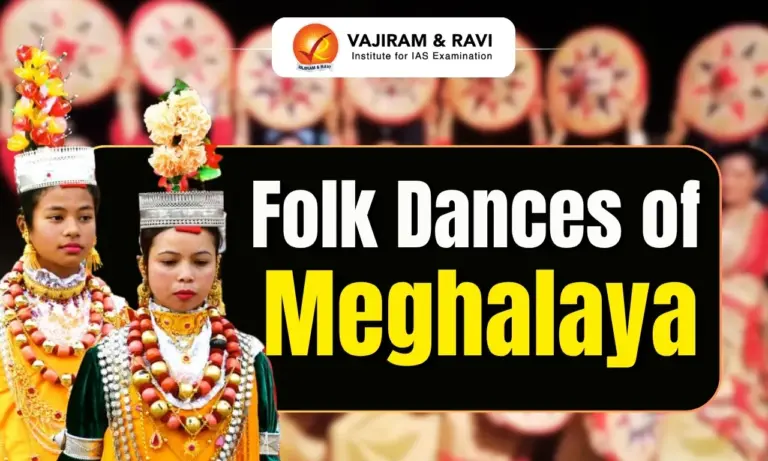
Meghalaya is known for its rich tribal culture, traditions, biodiversity and natural beauty. The Khasi, Garo and Jaintia communities have distinct dance traditions. Folk Dances of Meghalaya are closely linked with festivals, agriculture, religion, community life and important social occasions. These dances express joy, thanksgiving, devotion, sorrow and respect for nature. They remain an important part of the cultural heritage of the state.
Folk Dances of Meghalaya
Folk Dances of Meghalaya represent the cultural traditions of the Khasi, Garo and Jaintia communities. Their performances are connected with harvests, religious ceremonies, festivals, entertainment and social customs. The dances also show the importance of agriculture, community participation and traditional beliefs in Meghalaya. Different forms use drums, flutes, pipes, swords, spears, traditional costumes and rhythmic movements to express distinct cultural meanings.
Folk Dances of Meghalaya Features
The key highlighting features of the major Folk Dances of Meghalaya has been listed below:
- Cultural Significance of Folk Dances: Folk Dances of Meghalaya connect festivals and community life with agriculture, religious belief, thanksgiving, entertainment and remembrance. They show how Khasi, Garo and Jaintia traditions preserve cultural identity through collective participation.
- Traditional Instruments and Movements: Drums, flutes, Tangmuri, pipes, bamboo poles and other traditional elements support several performances. Circular formations, rhythmic steps, protective movements and coordinated group performances give each dance its distinct cultural character.
- Role in Festivals and Social Life: Dance accompanies important occasions ranging from birth and marriage to festivals, harvest activities and death ceremonies. This wide cultural role makes Folk Dances of Meghalaya an important expression of community traditions and beliefs.


List of Folk Dances of Meghalaya
The major Folk Dances of Meghalaya include Behdienkhlam, Nongkrem, Shad Suk Mynsiem, Wangala, Doregata, Laho and Ka Shad Shyngwiang-Thangiap.
Behdienkhlam
- Behdienkhlam is a major tribal dance festival of the Jaintia or Pnar community.
- It is held annually in July after sowing and seeks divine blessings for a healthy harvest while protecting against diseases and infections.
Nongkrem Dance
- Ka Pom-Blang Nongkrem, commonly called Nongkrem Dance, is a major Khasi religious dance festival.
- It is held at Smit during autumn, generally around October-November, for harvest, prosperity and thanksgiving to Goddess Ka Blei Synshar.
- The Syiem of Khyrim and the high priest conduct the Pomblang ceremony.
- Offerings include goats and a cock, followed by ceremonial dances in which unmarried women perform gracefully while men move energetically with swords and white yak-hair whisks.
Shad Suk Mynsiem
- Shad Suk Mynsiem, also called Shad Weiking, is a three day annual Khasi thanksgiving dance held in April.
- It marks joy, gratitude, harvest and planting through coordinated performances by unmarried men and women.
- Women wear colourful silk garments and jewellery, while men wear silk dhotis, coats and plumed turbans.
- Men carry swords or spears and plumes, while drums, flutes and the Tangmuri provide musical accompaniment.
Wangala Dance
- Wangala is a major harvest dance festival of the Garo community.
- It is celebrated in autumn after harvesting and includes ceremonies dedicated to the deity Patigipa Rarongipa before the community performs the Wangala dance.
- The final stage of the Wangala celebration features the famous “Dance of a Hundred Drums”.
- It is presented as a powerful warrior dance and forms the major attraction of the festival, with rhythmic group dancing and drumming.
Doregata Dance
- Doregata is a lively dance associated mainly with the Khasi community.
- It combines entertainment with a playful competition between men and women, where women attempt to remove the turban of their male partners using only their heads.
- Doregata also commemorates the war in Meghalaya and the sacrifices of many Khasis.
- The playful contest ends with the surrender of the men, creating a joyful atmosphere among participants and spectators.
Laho Dance
- Laho Dance, also known as Chipiah Dance, is popular among the Pnar community.
- It forms part of the Behdienkhlam festival and is performed mainly for enjoyment, social interaction and celebration without conventional musical instruments.
- A female dancer performs between two young men while linking arms with them.
- The dancers sway together, wearing colourful traditional clothing, while a male “cheerleader” maintains the performance through spontaneous humorous and ribald couplets.
Ka Shad Shyngwiang-Thangiap
- Ka Shad Shyngwiang-Thangiap is a ceremonial dance of the Khasi community associated with death.
- Instead of prolonged mourning after death, the dance begins on the day of death and continues until the deceased person’s last rites are completed.
- Men provide musical accompaniment using flutes, drums and bamboo poles.
- The dance expresses sorrow and forms part of the community’s traditional way of commemorating a deceased person.

 Last updated on Oct, 2026
→ UPSC 2027 Notification will be released on 13 January 2027 at upsconline.nic.in.
→ Check Nobel Prize 2026 Winners List here.
→ Download PIB PRiSM Monthly Magazine 2026 here.
→ Check UPSC Monthly Current Affairs Magazine The Recitals here.
→ Check out the latest UPSC Syllabus here.
→ Download UPSC Model Answers for Mains 2026
→ UPSC Mains Question Paper 2026 is out now for Essay & GS Paper 1, 2, 3 & 4.
→ UPSC Calendar 2027 has been released.
→ Enroll in Vajiram & Ravi’s UPSC Mains Test Series 2027 for structured answer writing practice, expert evaluation, and exam-oriented feedback.
→ Join Vajiram & Ravi’s UPSC Mentorship Program 2027 for personalized guidance, strategy planning, and one-to-one support from experienced mentors.
→ Go through the UPSC Mains Previous Year Papers to enhance your preparation.
→ UPSC has released UPSC Toppers List 2025 with the Civil Services final result on its official website.
→ Also check Best UPSC Coaching in India
Folk Dances of Meghalaya FAQs
Q1. What are the famous Folk Dances of Meghalaya?+
Q2. Which is the famous dance of the Khasi tribe?+
Q3. Which dance is associated with the Garo tribe of Meghalaya?+
Q4. Which folk dance of Meghalaya is associated with the Pnar tribe?+
Q5. What is the significance of Folk Dances of Meghalaya?+
Tags: folk dances folk dances of meghalaya