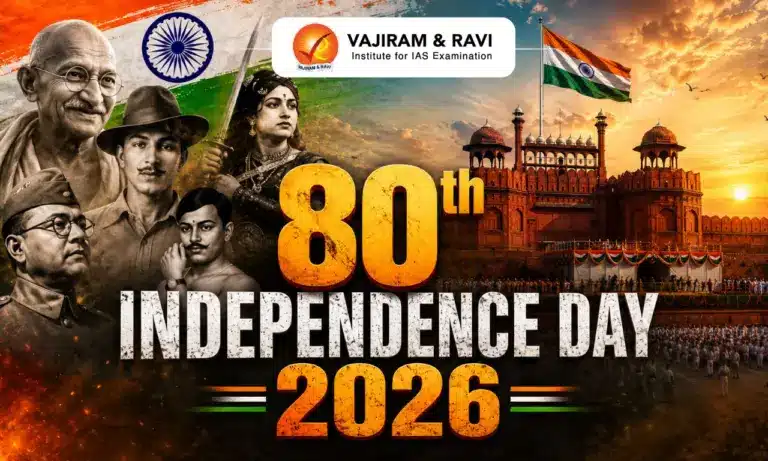
Independence Day 2026 will be observed on 15 August 2026 as India’s 80th Independence Day. The occasion marks 79 years of India’s independence from British rule since 15 August 1947. The 2026 celebrations will combine historical remembrance with the vision of Viksit Bharat 2047. Major focus areas include indigenous technology, green transition, Atmanirbhar Defence, youth participation and the 150 year commemoration of Vande Mataram.
15 August Independence Day 2026
India will celebrate 80th Independence Day 2026 on Saturday, 15 August. The national ceremony will be led by Prime Minister Narendra Modi at the Red Fort in New Delhi. The day will remember the freedom struggle and India’s democratic journey. It will also highlight youth, innovation, self reliance and sustainable development. The 80th Independence Day coincides with Navroz, the Parsi New Year, bringing additional cultural significance to the occasion.
Independence Day Theme 2026
The theme of Independence Day 2026 focuses on “150 Years of Vande Mataram” and “Yuva Shakti for Viksit Bharat@2047”. The themes connect India’s freedom movement with its future development goals. Vande Mataram represents the spirit of the national movement. Yuva Shakti highlights the role of young Indians in science, innovation, entrepreneurship and nation building. The celebrations also emphasise indigenous technologies, green transition and Atmanirbhar Defence.


Indian Independence Day 1947
India became independent on 15 August 1947 after a prolonged freedom struggle against British colonial rule. The transfer of power followed the Indian Independence Act 1947 and the Mountbatten Plan.
- British political control expanded across India, beginning a long period of colonial rule that lasted nearly 200 years.
- The Revolt of 1857 became an early major armed challenge to British authority and an important milestone in India’s freedom struggle.
- The Indian National Congress was founded in 1885 and became a major platform for self government and independence.
- Leaders such as Bal Gangadhar Tilak, Mahatma Gandhi, Sarojini Naidu, Subhas Chandra Bose, Bhagat Singh, Jawaharlal Nehru and Sardar Vallabhbhai Patel strengthened the national movement.
- Mahatma Gandhi led major mass movements, including Non Cooperation, Civil Disobedience and Satyagraha, expanding public participation.
- In 1942, the Quit India Movement demanded an immediate end to British rule, with Gandhi giving the famous “Do or Die” call.
- On 20 February 1947, British Prime Minister Clement Attlee announced that power would be transferred to Indian hands by June 1948.
- Lord Mountbatten then proposed the 1947 Partition Plan, accepted by the Congress and Muslim League amid growing communal tensions.
- The Indian Independence Act 1947 was passed on 5 July and received Royal Assent on 18 July 1947.
- The Act created India and Pakistan as two independent dominions and ended British sovereignty.
- At midnight between 14 and 15 August 1947, power was transferred, making India independent on 15 August 1947.
- British paramountcy over princely states ended, while Constituent Assemblies received power to frame new constitutions.
- India’s First Independence Day 1947 was celebrated on 15 August 1947, marking the beginning of independent India.
Also Read:- 150 Years of Vande Mataram
Har Ghar Tiranga 2026
As part of the wider Independence Day observance, the Har Ghar Tiranga Campaign 2026 continues to encourage citizens to hoist the national flag at their homes, offices and public buildings, reinforcing personal participation in the 80th Independence Day celebrations beyond the official Red Fort ceremony.
Independence Day Celebrations 2026
The National 15 August Independence Day 2026 Celebrations will centre on the Red Fort and will combine ceremonial traditions with cultural, technological and youth focused programmes across India.
- Red Fort Ceremony: Prime Minister Narendra Modi will lead the national ceremony at the Red Fort. The programme will include flag hoisting and the Prime Minister’s address.
- National Flag: The National Flag will be hoisted at the Red Fort before the nation. The ceremony will follow established national traditions.
- National Anthem: The National Anthem will form an important part of the ceremony following the flag hoisting proceedings.
- Vande Mataram: Vande Mataram will be sung from the Red Fort ramparts for the first time during the Independence Day ceremony in 2026.
- Vande Mataram Time: During the 2026 Red Fort ceremony, Vande Mataram Lyrics will be presented when Prime Minister Narendra Modi arrives, before the National Flag is hoisted and the national address begins.
- Guard of Honour: The Prime Minister will receive a ceremonial Guard of Honour from personnel representing the armed forces.
- 21 Gun Salute: The traditional 21 gun salute (21 topo ki salami) will accompany the national ceremony and mark the formal celebration of independence.
- Prime Minister’s Address: The Prime Minister will discuss India’s achievements, development priorities, national unity and the future vision associated with Viksit Bharat 2047.
- 150 Years of Vande Mataram: The 2026 celebrations coincide with the 150 year commemoration of Vande Mataram. Its composition is traced to 1875, with the commemoration running from 7 November 2025 to 7 November 2026.
- NCC and My Bharat: Around 2,500 NCC cadets and My Bharat volunteers will form ‘वंदे मातरम्’ on Gyanpath opposite the Red Fort ramparts.
- Mi-17 Tribute: An Indian Air Force Mi-17 helicopter will carry a banner commemorating 150 years of Vande Mataram and shower flower petals over the gathering.
- National Bands: Military and security force bands will conduct Vande Mataram themed programmes at 343 prominent locations between 8 and 15 August 2026.
- MyGov Independence Day Activities: MyGov will support public participation through activities such as essay writing, quizzes, photography and other Independence Day engagement campaigns.
- My Bharat Independence Day Activities: My Bharat will involve young citizens and volunteers in national celebration activities, strengthening youth participation in public and community initiatives.
What is Special about Independence Day 2026?
Independence Day 2026 carries both historical and contemporary importance by remembering the freedom struggle while highlighting India’s development priorities for the coming decades.
- Digital India Bhashini: Digital India Bhashini will provide real time translation of the Prime Minister’s speech into more than 22 Indian languages, supporting wider access to the national vision.
- Young Leaders Dialogue: The Young Leaders Dialogue during Independence Week 2026 will bring Gen Z and young entrepreneurs before national leaders to present solutions related to agriculture, fitness and startups.
- Youth Focus: Youth participation will remain central to the celebrations. Young Indians will be highlighted as contributors to innovation, entrepreneurship, technology and the Viksit Bharat 2047 vision.
- Indigenous Technology: The celebrations will highlight 6G trials, the Semiconductor Mission and artificial intelligence as important areas of India’s technological development and self reliance.
- Green Transition: Mission LiFE, solar powered villages and the Green Hydrogen Mission will represent the focus on cleaner energy, sustainability and environmentally responsible development.
- Atmanirbhar Defence: For the first time, all equipment used at the Red Fort ceremony will be indigenously built in India, highlighting domestic defence capability.
- Cultural Programmes: Students, artists and cultural groups will present patriotic songs and performances reflecting India’s cultural diversity and national heritage.
- Public Participation: MyGov, My Bharat, NCC volunteers, young leaders, students and local communities expand Independence Day beyond the central ceremony and encourage wider civic participation.
Independence Day 2026 How Many Years?
Is it 79 or 80 Independence Day in 2026? Independence Day 2026 is the 80th Independence Day of independence from British rule. The calculation begins with 15 August 1947 as the first year.
- 80th Independence Day 2026: India will observe its 80th Independence Day on 15 August 2026. This means the country has completed 79 years of independence.
- 79th Independence Day 2025: India celebrated its 79th Independence Day on 15 August 2025. It marked the completion of 78 years of independence.
Difference Between Independence Day & Republic Day
Independence Day marks India’s freedom from British rule, while Republic Day celebrates the adoption of the Constitution and India becoming a republic.
| Basis | Independence Day | Republic Day |
|---|---|---|
| Date | 15 August | 26 January |
| Significance | Marks India’s independence from British rule in 1947 | Marks the adoption of the Constitution of India in 1950 |
| Historical Event | India became independent on 15 August 1947 | Constitution came into effect on 26 January 1950 |
| Chief Guest | Usually no foreign chief guest is invited for the national ceremony | A foreign head of state or government is traditionally invited as chief guest |
| Main Ceremony | Flag hoisting and address by the Prime Minister at the Red Fort | Grand Republic Day Parade in New Delhi |
| Flag Ceremony | Prime Minister hoists the national flag at the Red Fort | President unfurls the national flag at Kartavya Path |
| Key Theme | Freedom and independence | Democracy, Constitution and republican values |
August 15 Declared as ‘India Independence Day’
The governors of New York and New Jersey declared August 15, 2026, as “India Independence Day” across their states ahead of India’s 80th Independence Day. The proclamations recognised the important contributions of Indian-American communities to culture, business, healthcare, education, technology, public service and community life.
The declarations highlighted India’s independence journey, democratic values and self-governance, while recognising the strong India-US Relations and the role of Indian Americans in strengthening community and cultural ties.
Independence Day 2025 Summary
India celebrated its 79th Independence Day on 15 August 2025, marking 78 years of independence from British rule. The main celebration was held at the Red Fort in New Delhi, where Prime Minister Narendra Modi hoisted the National Flag, received the Guard of Honour, and delivered his 12th consecutive Independence Day speech.
The theme of the celebration was “Naya Bharat”, reflecting India’s vision of becoming a Viksit Bharat (Developed India) by 2047. The celebrations included the National Anthem, a 21-gun salute, cultural programmes, participation of the armed forces and NCC, and a ceremonial flower shower by Indian Air Force helicopters.
Thousands of special guests, including grassroots workers, women, youth, and achievers, were invited to the Red Fort to recognise their contribution to nation-building. Across the country, schools, colleges, government offices, and communities celebrated the day through flag hoisting, patriotic events, and cultural programmes.

 Last updated on Oct, 2026
→ UPSC 2027 Notification will be released on 13 January 2027 at upsconline.nic.in.
→ Asian Games 2026 are being held in Aichi-Nagoya, Japan, from 19 September to 4 October.
→ Check Nobel Prize 2026 Winners List here.
→ Download PIB PRiSM Monthly Magazine 2026 here.
→ Check UPSC Monthly Current Affairs Magazine The Recitals here.
→ Check out the latest UPSC Syllabus here.
→ Download UPSC Model Answers for Mains 2026
→ UPSC Mains Question Paper 2026 is out now for Essay & GS Paper 1, 2, 3 & 4.
→ UPSC Calendar 2027 has been released.
→ Enroll in Vajiram & Ravi’s UPSC Mains Test Series 2027 for structured answer writing practice, expert evaluation, and exam-oriented feedback.
→ Join Vajiram & Ravi’s UPSC Mentorship Program 2027 for personalized guidance, strategy planning, and one-to-one support from experienced mentors.
→ Go through the UPSC Mains Previous Year Papers to enhance your preparation.
→ UPSC has released UPSC Toppers List 2025 with the Civil Services final result on its official website.
→ Also check Best UPSC Coaching in India
Independence Day 2026 FAQs
Q1. When is Independence Day 2026 celebrated in India?+
Q2. What is the theme of Independence Day 2026?+
Q3. Is 2026 the 80th Independence Day of India?+
Q4. Where will Independence Day 2026 celebrations be held?+
Q5. Who will hoist the National Flag on Independence Day 2026?+
Q6. What day is Independence Day observed in 2026?+
Q7. When is the 79th Independence Day?+
Q8. What is the Independence Day 2026 date?+
Q9. Who decided August 15 as Independence Day?+
Q10. Who declared independence day in India?+
Q11. Independence Day 2026 how many years will India complete?+
Q12. What is the difference between Independence Day and Republic Day?+
Tags: 15 august 15 august 2026 80th independence day 2026 independence day independence day 2026 independence day theme india independence day