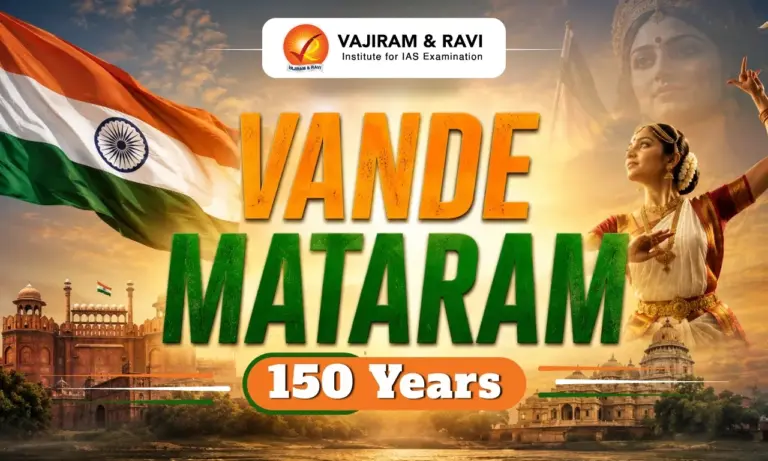
Why Vande Mataram in News?
For the first time, Vande Mataram will be sung from the Red Fort during India’s 80th Independence Day celebrations on August 15, 2026. The celebrations will also give greater representation to Gen Z and young achievers, highlighting the theme of Yuva Shakti.
150 Years of Vande Mataram
Parliament held a special discussion to mark 150 years of Vande Mataram, a song deeply woven into India’s freedom movement yet continuously debated for its religious imagery and political interpretations. Prime Minister Narendra Modi opened the Lok Sabha debate on this.
Once a patriotic hymn in Bankimchandra Chattopadhyay’s novel, Vande Mataram evolved into a rallying cry for nationalism, though concerns over its later stanzas led the Congress in 1937 to officially adopt only the first two.
In the Constituent Assembly, the song was ultimately accorded “equal honour and status” with the National Anthem.
Also Read: Independence Day 2026


Origins of Vande Mataram
- According to a historical account cited by the PIB, Bankimchandra Chattopadhyay composed Vande Mataram around 1875.
- The song gained prominence when his novel Anandamath was serialized in Bangadarshan magazine in 1881.
- Sri Aurobindo wrote in Bande Mataram (1907) that the hymn captured the spirit of patriotic devotion.
Literary Context: Anandamath
- Anandamath tells the story of the Santanas, ascetic warriors committed to liberating the motherland from oppression.
- Their loyalty is to Bharat Mata, represented as a personified motherland rather than a religious deity.
Symbolism of the Three Mothers
- In the Santanas’ temple, three forms of the Mother are depicted:
- The Mother That Was – powerful and magnificent
- The Mother That Is – weakened and suffering
- The Mother That Will Be – rejuvenated and triumphant
- These images symbolised India’s past glory, present subjugation, and envisioned future resurgence.
From song to slogan: Birth of a nationalist cry
- By the early 20th century, Vande Mataram transformed from a literary hymn into one of the most powerful rallying cries of India’s nationalist movement.
Central Role in the Swadeshi and Anti-Partition Movement
- After Lord Curzon’s 1905 partition of Bengal, the song became the emotional and political heartbeat of mass resistance.
- It energised:
- Boycott campaigns
- Protest marches
- Newspapers and political groups adopting its name
- A historic moment came in 1906 at Barisal, where over 10,000 Hindus and Muslims marched together shouting Vande Mataram, demonstrating its early inclusive appeal.
- Key leaders who popularised it included:
- Rabindranath Tagore
- Bipin Chandra Pal
- Sri Aurobindo, whose writings elevated the phrase into a spiritual and political call for self-rule.
Colonial Repression Against the Slogan
- Worried by its ability to mobilise masses, the British authorities attempted to suppress it by:
- Fining students
- Conducting police lathi-charges
- Banning public marches
- Threatening expulsion from schools and colleges
- Across Bengal and the Bombay Presidency, chanting Vande Mataram became an act of bold nationalist defiance.
Vande Mataram on the Global Stage
- In 1907, Madam Bhikaji Cama unfurled the first Indian tricolour at Stuttgart, with Vande Mataram written across it — marking its symbolic arrival on the international platform.
The song and the Indian National Congress
- The Indian National Congress not only appreciated Vande Mataram culturally but also adopted it formally in its national ceremonies.
1896: Tagore’s Iconic Rendition
- At the Calcutta Congress session, Rabindranath Tagore sang Vande Mataram, giving the song national prominence and embedding it in the Congress’s cultural identity.
1905: Formal Adoption During the Swadeshi Movement
- In Varanasi, the Congress formally adopted Vande Mataram for all-India events.
- This came at the height of the anti-partition protests, when the song had already become the anthem of political awakening throughout the country.
1937: Congress Working Committee Removes Later Stanzas
- By the 1930s, debates over the song’s Hindu goddess imagery became more pronounced.
- To maintain a broad, inclusive national movement, the Congress Working Committee (CWC) decided in 1937 to use only the first two stanzas, which were considered free of sectarian symbolism.
- Muslim leaders had objected to the later stanzas, arguing they evoked explicitly religious imagery inappropriate for a national movement meant to represent all communities.
Constituent Assembly’s Resolution: Equal Status for Vande Mataram (1950)
- In 1950, the Constituent Assembly faced no conflict between Jana Gana Mana and Vande Mataram when deciding national symbols.
- On January 24, 1950, Assembly President Dr. Rajendra Prasad formally declared:
- Jana Gana Mana would be the National Anthem.
- Vande Mataram, due to its historic significance in the freedom struggle, would receive equal honour and status.
- The announcement was met with applause and no objections from any member.
- This dual recognition balanced inclusivity with historical reverence, preserving national unity through the anthem while enshrining Vande Mataram as a pillar of India’s independence movement.

 Last updated on Oct, 2026
→ UPSC 2027 Notification will be released on 13 January 2027 at upsconline.nic.in.
→ Check Nobel Prize 2026 Winners List here.
→ Download PIB PRiSM Monthly Magazine 2026 here.
→ Check UPSC Monthly Current Affairs Magazine The Recitals here.
→ Check out the latest UPSC Syllabus here.
→ Download UPSC Model Answers for Mains 2026
→ UPSC Mains Question Paper 2026 is out now for Essay & GS Paper 1, 2, 3 & 4.
→ UPSC Calendar 2027 has been released.
→ Enroll in Vajiram & Ravi’s UPSC Mains Test Series 2027 for structured answer writing practice, expert evaluation, and exam-oriented feedback.
→ Join Vajiram & Ravi’s UPSC Mentorship Program 2027 for personalized guidance, strategy planning, and one-to-one support from experienced mentors.
→ Go through the UPSC Mains Previous Year Papers to enhance your preparation.
→ UPSC has released UPSC Toppers List 2025 with the Civil Services final result on its official website.
→ Also check Best UPSC Coaching in India
Vande Mataram FAQs
Q1. What is the historical origin of Vande Mataram? +
Q2. How did Vande Mataram become a nationalist slogan?+
Q3. Why did Congress adopt only the first two stanzas in 1937?+
Q4. What was the Constituent Assembly’s decision on Vande Mataram?+
Q5. Why does Vande Mataram remain debated today?+
Tags: upsc current affairs Vande Mataram