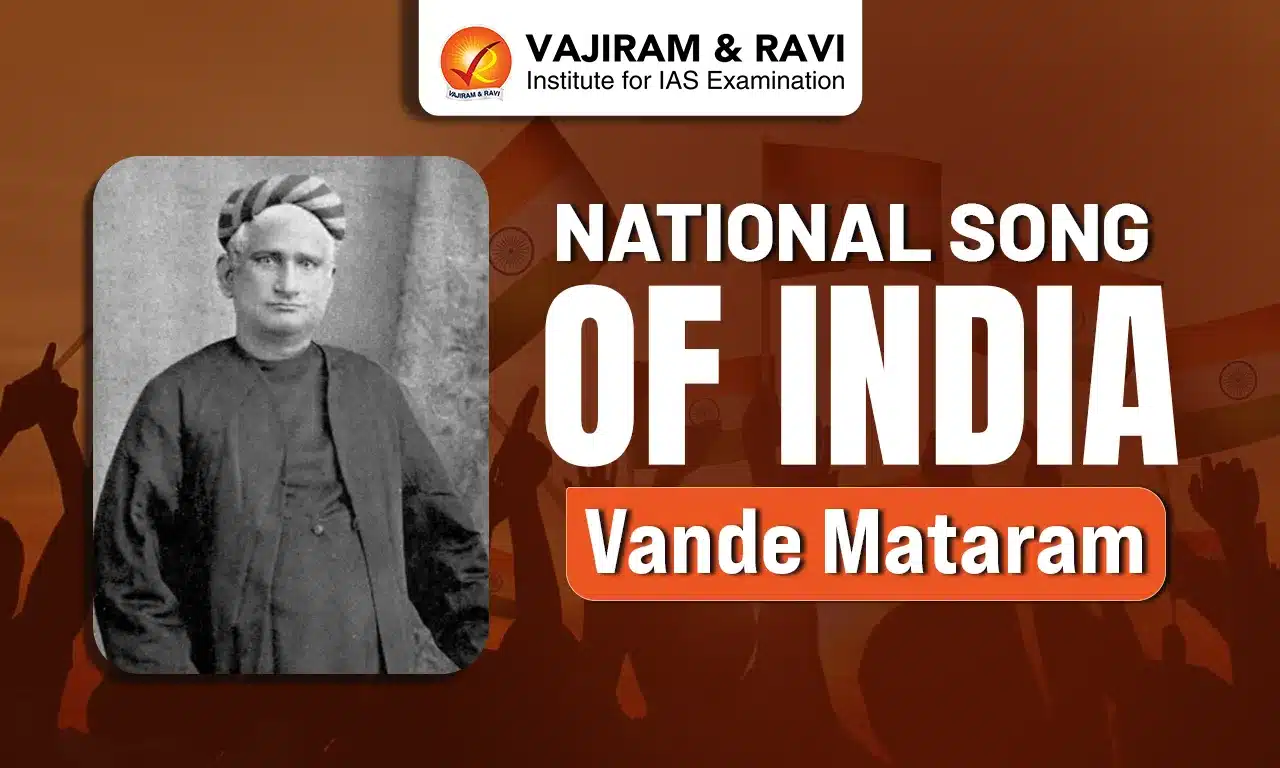
The National Song of India, Vande Mataram, holds a deeply rooted place in the country’s history and cultural heritage. Written by Bankim Chandra Chattopadhyay, it became a rallying cry in the freedom struggle. On 24 January 1950, the Constituent Assembly of India officially adopted it as the national song, giving it enduring significance.
National Song of India
A National Song serves as a symbol of national pride, unity and cultural identity. In India, Vande Mataram represents devotion to the mother-land and the spirit of selfless service. Composed in a mix of Sanskrit and Bengali, it reflects India’s plurality and storied past.
National Song of India Historical Background
The key milestones related to the historical background of the National Song of India has been listed below:
- Origin (1875): Bankim Chandra Chattopadhyay wrote the poem Vande Mataram on November 07, 1885.
- 1882: Publication of Anandamath including Vande Mataram
- First public rendition (1896): It was sung at the 1896 session of the Indian National Congress, evoking patriotic fervour.
- 1905: Surge of popularity during the Swadeshi Movement
- Adoption as National Song: On 24 January 1950, the Constituent Assembly declared Vande Mataram as the national song; President Rajendra Prasad emphasised its status equal to the national anthem.
- 2025: Celebration of 150 years of the song’s composition.


National Song of India Lyrics
The opening lines of the National Song of India is mentioned below:
“Vande Mataram!
Sujalam, suphalam, malayaja shitalam,
Shasyashyamalam, Mataram!
Vande Mataram!
Shubhrajyotsna pulakitayaminim,
Phullakusumita drumadala shobhinim,
Suhasinim sumadhura bhashinim,
Sukhadam varadam, Mataram!
Vande Mataram, Vande Mataram!”
The meaning of the refrain “Vande Mataram” is “I bow to thee, Mother.” It captures both reverence and devotion.
National Song of India during the Freedom Struggle
National Song of India- “Vande Mataram” became a beacon of resistance against colonial rule.
- It inspired freedom fighters to embrace national service despite repression.
- The British government at one point banned its public singing in Bengal, which only amplified its symbolic power.
- The song unified diverse communities under the shared aspiration of independence.
- Many of the freedom fighters sacrificed their life while chanting “Vande Mataram” including Shirish Kumar, Babu Genu, etc.
National Song of India Significance
Even today, National Song of India Vande Mataram is sung at national events, schools and flag hoist ceremonies. It stands as:
- A tribute to India’s cultural heritage and freedom legacy.
- A symbol of patriotism and collective identity.
- A reminder of service and sacrifice for the nation.
- Although the Constitution does not explicitly mention a “national song,” the Indian government’s official portal affirms its unique status.
- It highlights unity in diversity, written in a mixed language form and sung across communities.
- It embodies service to the nation and respect for freedom fighters’ sacrifice.
- It enriches India’s national identity, alongside other national symbols like the flag and anthem.
Also Read:- 150 Years of Vande Mataram
National Song of India Code of Conduct
While the National Anthem of India has formal guidelines and a legally mandated duration (52 seconds) under the Prevention of Insults to National Honour Act, 1971, the National Song of India- “Vande Mataram” does not carry mandatory legal etiquette or protocols. However, it is deeply respected and has been accorded equal honour by the President.
National Song of India Recent Develments
Prime Minister Narendra Modi will inaugurate the year-long commemoration of 150 years of the National Song “Vande Mataram” on 7th November 2025 at the Indira Gandhi Indoor Stadium, New Delhi. Written by Bankim Chandra Chatterjee on Akshaya Navami in 1875, Vande Mataram symbolizes India’s unity and patriotism. The event features mass singing of the full version nationwide at 9:50 AM and the release of a commemorative stamp and coin, marking the beginning of celebrations that will continue until 7th November 2026 across the country.

 Last updated on Oct, 2026
→ UPSC 2027 Notification will be released on 13 January 2027 at upsconline.nic.in.
→ Check Nobel Prize 2026 Winners List here.
→ Download PIB PRiSM Monthly Magazine 2026 here.
→ Check UPSC Monthly Current Affairs Magazine The Recitals here.
→ Check out the latest UPSC Syllabus here.
→ Download UPSC Model Answers for Mains 2026
→ UPSC Mains Question Paper 2026 is out now for Essay & GS Paper 1, 2, 3 & 4.
→ UPSC Calendar 2027 has been released.
→ Enroll in Vajiram & Ravi’s UPSC Mains Test Series 2027 for structured answer writing practice, expert evaluation, and exam-oriented feedback.
→ Join Vajiram & Ravi’s UPSC Mentorship Program 2027 for personalized guidance, strategy planning, and one-to-one support from experienced mentors.
→ Go through the UPSC Mains Previous Year Papers to enhance your preparation.
→ UPSC has released UPSC Toppers List 2025 with the Civil Services final result on its official website.
→ Also check Best UPSC Coaching in India
National Song of India FAQs
Q1. Who wrote the National Song of India?+
Q2. When is the 150th anniversary of Vande Mataram being celebrated?+
Q3. What special events are planned for the commemoration of National Song of India?+
Q4. What does the National Song of India- Vande Mataram symbolize?+
Q5. When was the National Song of India Vande Mataram first published?+
Tags: national song of india