Namdapha Tiger Reserve, Location, Features, Flora, Fauna

Namdapha Tiger Reserve

Namdapha Tiger Reserve, also known as Namdapha National Park, is one of India's most important wildlife conservation areas, located in the Changlang district of Arunachal Pradesh, near the India-Myanmar border. Established as a National Park and Tiger Reserve in 1983, it is known for its rich biodiversity, dense tropical rainforests and rare wildlife. The reserve is particularly famous for being home to four big cat species - tiger, leopard, snow leopard and clouded leopard. It plays a vital role in protecting the unique ecosystems of the Eastern Himalayas. 

Namdapha Tiger Reserve Geographical Features

Namdapha Tiger Reserve is situated in the Eastern Himalayan region of Arunachal Pradesh, close to the international border with Myanmar. It is known for its rugged mountains, dense forests, river valleys and diverse climatic conditions.

  • Location: Situated near Miao in Changlang district, Arunachal Pradesh, along the India-Myanmar border.
  • Area: Namdapha National Park covers approximately 1,985.23 sq. km, making it one of India's largest national parks.
  • Mountain Ranges: Located between the Daphabum Range of the Mishmi Hills and the Patkai Hills.
  • Highest Peak: Daphabum Peak, one of the highest points in the region.
  • Major Rivers: The Noa-Dihing River, a tributary of the Brahmaputra, flows through the reserve along with the Namdapha and Deban rivers.
  • Altitude: Extends from low-altitude tropical forests to alpine regions above 4,500 metres.
  • Vegetation: Includes tropical evergreen forests, subtropical forests, temperate forests and alpine vegetation.
  • Landscape: Features steep mountains, deep valleys, thick bamboo forests and largely undisturbed wilderness.

Namdapha Tiger Reserve History

Namdapha Tiger Reserve has a significant place in India's wildlife conservation history. Its protected status was established to conserve the region's exceptional biodiversity, particularly Bengal tigers and other endangered species.

  • Wildlife Sanctuary: Initially declared a Wildlife Sanctuary in 1972 to protect its natural forests and wildlife.
  • National Park Status: Upgraded to a National Park in 1983 because of its ecological importance.
  • Project Tiger: Included under Project Tiger in 1983, becoming India's 15th tiger reserve.
  • Conservation Importance: Established to protect rare species, including tigers, clouded leopards, snow leopards and hoolock gibbons.
  • International Recognition: Included in India's UNESCO World Heritage Tentative List for its outstanding natural biodiversity.
  • Protected Landscape: Its remote location has helped preserve large areas of natural forests with limited human disturbance.

Also Read : Namdapha National Park

Namdapha Tiger Reserve Flora and Fauna

Namdapha Tiger Reserve is one of India's richest biodiversity regions, supporting a wide variety of plants, mammals, birds, reptiles, amphibians and insects. Its different elevations and forest types provide suitable habitats for several rare and endangered species.

Floral Diversity

  • Forest Types: Includes tropical rainforests, evergreen forests, subtropical forests, temperate forests and alpine vegetation.
  • Plant Diversity: Contains more than 150 timber species, along with numerous medicinal plants, orchids, bamboo and cane species.
  • Rare Trees: Species such as Pinus merkusii and Abies delavayi are particularly important botanical features.
  • Rare Orchids: The endangered Blue Vanda orchid is among the reserve's notable plant species.
  • Medicinal Plants: Mishmi Teeta (Coptis teeta) is a valuable medicinal plant traditionally used by local tribal communities.
  • Other Vegetation: Dense bamboo, wild bananas, climbers, shrubs and grasses contribute to the reserve's rich plant diversity.

Faunal Diversity

Namdapha is especially famous for its four big cat species, along with several rare mammals, birds and reptiles.

  • Four Big Cats: Bengal tiger, leopard, snow leopard and clouded leopard occur in different habitats within the reserve.
  • Rare Mammals: Includes the Namdapha flying squirrel, a critically endangered species associated with the region.
  • Primates: Home to the hoolock gibbon, India's only native ape, along with Assamese, pig-tailed and stump-tailed macaques.
  • Other Mammals: Asian elephant, Asiatic black bear, gaur, red panda, Mishmi takin and various deer species.
  • Rare Birds: Includes the white-winged wood duck, great hornbill, junglefowl and pheasants.
  • Aquatic Wildlife: Rivers and streams support a variety of fish, amphibians and reptiles.

Namdapha Tiger Reserve Conservation Efforts

Namdapha Tiger Reserve plays an important role in protecting the Eastern Himalayan biodiversity hotspot, particularly its rare big cats, endangered wildlife and tropical forests. Conservation efforts focus on habitat protection, wildlife monitoring and reducing human-related threats.

  • Project Tiger Conservation: Protection under Project Tiger supports tiger habitat management, wildlife monitoring and conservation activities.
  • Habitat Protection: Efforts focus on preserving tropical rainforests, mountain forests and alpine ecosystems that support rare wildlife.
  • Wildlife Protection: Conservation measures aim to protect endangered species such as the Bengal tiger, clouded leopard, Namdapha flying squirrel and white-winged wood duck.
  • Anti-Poaching Measures: Forest protection and monitoring are important for controlling illegal hunting, wildlife trafficking and forest exploitation.
  • Wildlife Corridor Protection: Maintaining forest connectivity helps protect elephant movement routes and other wildlife habitats.
  • Community Participation: Involving local communities in conservation and responsible eco-tourism can reduce pressure on forest resources.
  • Eco-Sensitive Zone Protection: Environmental safeguards help limit harmful activities around the protected landscape.

Namdapha Tiger Reserve FAQs

Q1: Where is Namdapha Tiger Reserve located?

Ans: Namdapha Tiger Reserve is located in the Changlang district of Arunachal Pradesh, near the India-Myanmar border in northeastern India.

Q2: When was Namdapha Tiger Reserve established?

Ans: Namdapha Tiger Reserve was declared a Wildlife Sanctuary in 1972 and became a National Park and Tiger Reserve in 1983 under Project Tiger.

Q3: Why is Namdapha Tiger Reserve famous?

Ans: Namdapha is famous for being home to four big cat species - Bengal tiger, leopard, snow leopard and clouded leopard, along with its rich biodiversity.

Q4: Which river flows through Namdapha Tiger Reserve?

Ans: The Noa-Dihing River, a tributary of the Brahmaputra, flows through Namdapha Tiger Reserve, along with the Namdapha and Deban rivers.

Q5: What animals are found in Namdapha Tiger Reserve?

Ans: The reserve is home to tigers, leopards, hoolock gibbons, red pandas, Asian elephants, Namdapha flying squirrels and white-winged wood ducks.


UPSC Daily Quiz 23 November 2026

UPSC Daily Quiz

[WpProQuiz 303]

UPSC Daily Quiz FAQs

Q1: What is the Daily UPSC Quiz?

Ans: The Daily UPSC Quiz is a set of practice questions based on current affairs, static subjects, and PYQs that help aspirants enhance retention and test conceptual clarity regularly.

Q2: How is the Daily Quiz useful for UPSC preparation?

Ans: Daily quizzes support learning, help in revision, improve time management, and boost accuracy for both UPSC Prelims and Mains through consistent practice.

Q3: Are the quiz questions based on the UPSC syllabus?

Ans: Yes, all questions are aligned with the UPSC Syllabus 2025, covering key areas like Polity, Economy, Environment, History, Geography, and Current Affairs.

Q4: Are solutions and explanations provided with the quiz?

Ans: Yes, each quiz includes detailed explanations and source references to enhance conceptual understanding and enable self-assessment.

Q5: Is the Daily UPSC Quiz suitable for both Prelims and Mains?

Ans: Primarily focused on Prelims (MCQ format), but it also indirectly helps in Mains by strengthening subject knowledge and factual clarity.

International Day for the Elimination of Violence Against Women 2026

International Day for the Elimination of Violence Against Women

The International Day for the Elimination of Violence Against Women is observed annually on 25 November to raise awareness about gender-based violence and strengthen global efforts to protect women's rights. Established by the United Nations General Assembly in 1999 through Resolution 54/134, the observance commemorates the Mirabal sisters, who were assassinated in 1960 for opposing dictatorship in the Dominican Republic. It also marks the beginning of the 16 Days of Activism Against Gender-Based Violence (25 November-10 December), concluding on International Human Rights Day.

International Day for the Elimination of Violence Against Women 2026

The International Day for the Elimination of Violence Against Women 2026 highlights the continuing prevalence of gender-based violence and the need to strengthen justice systems and survivor protection. According to global estimates, violence affects approximately one in three women and girls, or 840 million people, during their lifetime. Despite progress in legislation and policies, many survivors continue to face barriers in reporting abuse, accessing essential services, and obtaining justice. The 2026 observance therefore emphasises accountability, effective law enforcement, accessible support systems, and protection against violence in homes, workplaces, public spaces, and online environments.

International Day for the Elimination of Violence Against Women Theme

The theme of the International Day for the Elimination of Violence Against Women 2026 is "UNiTE to End Violence Against Women and Girls: Ensure Justice, Protect Survivors, End Impunity." The campaign focuses on removing barriers that prevent survivors from accessing justice and support. It calls for safe reporting mechanisms, effective enforcement of laws, survivor-centred services, and accountability for perpetrators as well as institutions. It also highlights the importance of adequate funding for women's rights organisations and essential support services.

The 2026 UNiTE campaign promotes the public call to action "Speak Out. Believe Survivors. Demand Justice." It encourages individuals, communities, and governments to challenge social stigma, support survivors, and strengthen accountability.

  • Speak Out: Challenge victim-blaming attitudes and reject social practices that normalise violence against women and girls.
  • Believe Survivors: Listen without discrimination, respect survivors' decisions, and support their access to safety and justice.
  • Demand Justice: Advocate stronger laws, adequate funding for support services, and accountability for perpetrators and institutions.

International Day for the Elimination of Violence Against Women History

The International Day for the Elimination of Violence Against Women was officially designated by the United Nations General Assembly in 2000 to raise global awareness about gender-based violence. The date, 25 November, commemorates the assassination of the Mirabal sisters in 1960, who were activists opposing dictatorship in the Dominican Republic.

  • Declared by the UN General Assembly in 2000 through Resolution 54/134.
  • 25 November chosen to honour the Mirabal sisters, symbols of resistance against oppression.
  • Marks the start of the 16 Days of Activism (Nov 25-Dec 10).
  • Aims to mobilise governments, organisations, and citizens to end gender-based violence globally.

India’s Multi-Layered Approach to Ending Violence Against Women

India adopts a multi-layered approach that combines strong legal protections, institutional mechanisms, technology-driven systems, and comprehensive support services for women. This integrated framework focuses on prevention, timely response, survivor support, and long-term empowerment.

  • Robust legal reforms including Bharatiya Nyaya Sanhita 2023, PWDVA 2005, and POSH Act 2013.
  • Institutional mechanisms like NCW, State Commissions for Women, Fast Track Special Courts, and Women Help Desks.
  • Supportive schemes under Mission Shakti, including One Stop Centres, Swadhar Greh, and Women Helpline (181).
  • Technology-driven tools such as SHe-Box, ITSSO, Cri-MAC, NDSO, and Digital Shakti Campaign for safer digital environments.
  • Integrated emergency systems like ERSS (112) and specialised training programs like Stree Manoraksha for psychosocial support.

Legal Framework to Protect Women in India

India has strengthened its legal architecture with comprehensive laws addressing domestic violence, sexual harassment, cyber harms, and crimes against women and children. These reforms ensure speedy justice, survivor-friendly procedures, and stricter punishments. The introduction of the Bharatiya Nyaya Sanhita (BNS), 2023 marks a major shift in criminal law, with enhanced penalties and technology-enabled processes.

National Commission for Women (NCW)

The National Commission for Women, established on 31 January 1992, is the apex statutory body mandated to protect women’s constitutional and legal rights. It monitors safeguards, suggests law reforms, and addresses complaints online and offline. State Commissions for Women perform parallel roles at the local level. NCW also operates helpline 7827170170 providing 24×7 online support through IVR-based systems for psychological counselling, legal support, and emergency assistance.

Bharatiya Nyaya Sanhita, 2023

Effective from 1 July 2024, BNS replaces the Indian Penal Code (IPC) and introduces stronger provisions for crimes against women. It expands definitions of sexual offences, mandates audio-video recording of victim statements, and ensures that cases involving women and children receive priority in trial proceedings.

  • Life imprisonment for rape of minors under 18.
  • Time-bound trials and improved evidence collection.
  • Wider definitions of sexual assault and exploitation.
  • Survivor-friendly procedures including digital recording.

Protection of Women from Domestic Violence Act, 2005 (PWDVA)

PWDVA legally recognises domestic violence in all forms: physical, sexual, emotional, and economic. It defines an aggrieved person as any woman in a domestic relationship and ensures protection orders, residence rights, and compensation. This Act enables women to seek relief even through Protection Officers and service providers, ensuring a comprehensive support ecosystem.

Sexual Harassment of Women at Workplace Act, 2013 (POSH Act)

The POSH Act provides a robust legal framework to protect women across all workplaces: public, private, organised, and unorganised. It mandates the establishment of Internal Committees (ICs) in workplaces with more than 10 employees and Local Committees (LCs) for smaller establishments. The Ministry of Women and Child Development oversees implementation.

  • Mandatory ICs and LCs for grievance redressal
  • Completion of inquiries within 90 days
  • Accountability mechanisms for employers
  • Access to SHe-Box portal for online complaints

Digital Shakti Campaign

The NCW’s Digital Shakti Campaign aims to make women digitally skilled, aware, and empowered to combat online crimes. It trains women across India in identifying and responding to cyber threats, enhancing their ability to report and safeguard themselves online.

  • Cyber safety training
  • Awareness on digital rights
  • Reporting mechanisms for cybercrimes
  • Data privacy and protection awareness

Institutional Mechanisms for Fast and Survivor-Friendly Justice

India has invested in specialised institutions to speed up justice delivery and improve survivor experience.

  • Fast Track Special Courts (FTSCs): As of August 2025, 773 FTSCs, including 400 e-POCSO courts, are functional. These courts have disposed over 3.34 lakh cases relating to rape and POCSO.
  • Women Help Desks (WHDs): As of February 2025, 14,658 WHDs operate in police stations, facilitating easier reporting and improving sensitivity in investigations.
  • SHe-Box Portal: A unified digital platform that routes workplace harassment complaints to relevant Internal/Local Committees. It offers real-time tracking, data monitoring, and improved accountability.

Technology-Driven Reforms for Women’s Safety

The Government has introduced several digital tools to track offenders, strengthen policing, and enhance coordination between states.

  • Investigation Tracking System for Sexual Offences (ITSSO): Monitors progress of investigations to ensure timely completion.
  • National Database on Sexual Offenders (NDSO): Tracks convicted offenders and helps police identify repeat offenders.
  • Crime Multi-Agency Centre (Cri-MAC): Facilitates real-time sharing of information on heinous crimes across states.

International Day for the Elimination of Violence Against Women FAQs

Q1: When is the International Day for the Elimination of Violence Against Women observed?

Ans: It is observed every year on 25 November to raise global awareness about gender-based violence and mobilise action to end it.

Q2: Why is 25 November chosen for the observance?

Ans: The date marks the assassination of the Mirabal sisters in 1960, who became symbols of resistance against violence and dictatorship in the Dominican Republic.

Q3: What is the theme for International Day for the Elimination of Violence Against Women 2026 ?

Ans: The 2026 theme is 'UNiTE to End Violence Against Women and Girls: Ensure Justice, Protect Survivors, End Impunity."

Q4: Who established this international day?

Ans: The United Nations General Assembly (UNGA) officially designated the day in 2000 through Resolution 54/134.

Q5: What global campaign begins on this day?

Ans: The observance marks the start of the 16 Days of Activism Against Gender-Based Violence, ending on 10 December (Human Rights Day).

Mukundra Hills Tiger Reserve, Location, Area, Flora, Fauna

Mukundra Hills Tiger Reserve

Mukundra Hills Tiger Reserve is located in Rajasthan and forms part of the Vindhyan Range. Established in 2013, it comprises important protected areas and forest habitats, serving as a potential habitat for tigers and supporting wildlife conservation in the region.

Mukundra Hills Tiger Reserve

Mukundra Hills Tiger Reserve, also spelled as Mukundara Hills Tiger Reserve, Mukandara Hills Tiger Reserve or Mukandra Hills Tiger Reserve, extends across Rajasthan and covers the following geographical and administrative features:

  • Location: Situated in Rajasthan, the reserve extends between the Chambal and Kalisindh rivers, forming part of the Vindhyan hill system.
  • Geographical Features: It comprises two nearly parallel, flat topped hills with narrow central ridges, extending approximately 80 km in length and 2-5 km in width.
  • Establishment: The reserve was established in 2013 by combining Mukundra National Park, Dara Sanctuary, Jawahar Sagar Sanctuary and part of Chambal Sanctuary.
  • Core Area: The core or critical tiger habitat covers approximately 417.17 sq. km, including the protected areas forming the reserve's central habitat.
  • Buffer Area: The buffer covers approximately 342.82 sq. km and includes forest areas of Kota, Chittorgarh and Jhalawar districts.
  • Total Area: The reserve covers approximately 759.99 sq. km, comprising both core and buffer areas.
  • Tiger Conservation: The habitat has shown signs of revival following the cessation of mining activities, with tiger movement reported from Ranthambhore Tiger Reserve.
  • Wildlife Corridors: It is connected with Ranthambhore, Ramgarh Vishdhari and Bhainsrorgarh in Rajasthan, as well as Gandhi Sagar Sanctuary in Madhya Pradesh. These corridors require restoration.

Mukundra Hills Tiger Reserve Biodiversity (Flora and Fauna)

Mukundra Hills Tiger Reserve supports dry deciduous forests and diverse wildlife, making it an important habitat for biodiversity conservation in Rajasthan.

Flora of Mukundra Hills Tiger Reserve

The Mukundra Hills Tiger Reserve primarily consists of dry deciduous forests, classified under Category II in the Champion and Seth classification (1968).

  • Dominant Vegetation: Anogeissus pendula, locally known as Kala Dhok or Kaladhi, is the predominant tree species across the reserve's forest landscape.
  • Other Tree Species: Important vegetation includes Khair, Ber, Kakan, Raunj, Tendu, Gurjan, Karaya, Jhinjha, Kalam and Gutha Bor.
  • Higher Slope Vegetation: Anogeissus latifolia is found on higher slopes, along with Bel, Salar, Uum and Shisham.
  • Associated Vegetation: Small forest patches also contain Anogeissus pendula alongside Chhola and Ber, contributing to the reserve's dry deciduous vegetation.

Fauna of Mukundra Hills Tiger Reserve

The Mukundra Hills Tiger Reserve supports several mammals, birds, reptiles and aquatic species, contributing to its importance among the Tiger Reserves in India.

  • Major Mammals: Important species include Leopard, Sloth Bear, Nilgai, Chinkara, Spotted Deer, Jackal, Hyena, Jungle Cat and Indian Pangolin.
  • Other Mammals: Small Indian Civet, Toddy Cat, Common Langur, Common Mongoose, Ruddy Mongoose, Porcupine and Five striped Palm Squirrel are also found.
  • Birds: Notable bird species include Painted Partridge, Grey Hornbill, Alexandrine Parakeet, Spotted Dove, Peafowl, Little Egret, Cattle Egret and Little Cormorant.
  • Reptiles and Aquatic Fauna: Important species include Python, Rat Snake, Russell's Sandboa, Crocodile, Gharial, Otter and Turtles.
  • Tiger Habitat: The reserve has potential to support tiger populations through movement from Ranthambhore, making habitat restoration and protection important conservation priorities.

Mukundra Hills Tiger Reserve FAQs

Q1: Where is Mukundra Hills Tiger Reserve located?

Ans: Mukundra Hills Tiger Reserve is located in Rajasthan, between the Chambal and Kalisindh rivers.

Q2: When was Mukundra Hills Tiger Reserve established?

Ans: Mukundra Hills Tiger Reserve was established in 2013.

Q3: What is the total area of Mukundra Hills Tiger Reserve?

Ans: The reserve covers approximately 759.99 sq. km, including 417.17 sq. km of core area and 342.82 sq. km of buffer area.

Q4: Which rivers surround Mukundra Hills Tiger Reserve?

Ans: The reserve extends between the Chambal and Kalisindh rivers as part of the Vindhyan Range.

Q5: Which tiger reserves and wildlife sanctuaries are connected to Mukundra Hills Tiger Reserve?

Ans: It has linkages with Ranthambhore, Ramgarh Vishdhari and Bhainsrorgarh in Rajasthan and Gandhi Sagar Sanctuary in Madhya Pradesh.

Pali Inscriptions, History, Key Features, Major Inscriptions

Pali Inscriptions

Pali Inscriptions are ancient written records that provide valuable information about Buddhism, Indian history, language and cultural traditions. Pali is an ancient Middle Indo-Aryan language closely associated with the teachings of Gautama Buddha and the sacred texts of Theravada Buddhism. These inscriptions, along with Buddhist manuscripts, help historians understand the spread of Buddhism from India to Sri Lanka and Southeast Asia. The Government of India recognised Pali as a Classical Language in October 2024, highlighting its historical and literary importance. 

Pali Language Classical Status Recognition

The Government of India granted Classical Language status to Pali on October 4, 2024, following Union Cabinet approval on October 3, 2024. This decision recognised Pali's contribution to ancient Indian literature, Buddhist philosophy and cultural heritage.

  • Classical Language Status: Pali was recognised as a Classical Language along with Marathi, Prakrit, Assamese and Bengali.
  • Government Recognition: The decision increased the total number of Classical Languages in India to 11.
  • Historical Importance: Pali preserves important Buddhist teachings, ancient literature and historical records.
  • Language Preservation: Recognition can encourage the preservation of ancient Pali manuscripts, inscriptions and literary works.
  • Research and Education: The status supports greater academic research, language studies and the promotion of Pali in educational institutions.
  • Cultural Significance: It highlights India's commitment to protecting its linguistic diversity and Buddhist heritage.

Pali Inscriptions History in Ancient India

Pali Inscriptions are closely connected with the development of the Pali language and early Buddhist traditions. Pali emerged from the Middle Indo-Aryan linguistic tradition and became an important language for preserving Buddhist teachings and literature.

  • Language Origin: Pali belongs to the Middle Indo-Aryan language family and developed from ancient Prakrit linguistic traditions.
  • Historical Period: Its literary tradition is associated with early Buddhism, while the surviving inscriptional evidence largely dates to later centuries.
  • Connection with Magadha: Pali was traditionally linked to Magadhi, the language associated with the ancient Magadha region.
  • Language of Buddhism: Pali became the principal language of the Theravada Buddhist Canon, preserving teachings attributed to Gautama Buddha.
  • Origin of the Name: The term Pali originally referred to a line of canonical text and later became the name of the language itself.
  • Scholarly Views: Scholars such as Max Walleser, R.C. Childers and James Alwis proposed different theories about Pali's geographical and linguistic origins.
  • Early Writing System: Pali was recorded in scripts derived from ancient Brahmi, with different regional scripts used over time.

Major Pali Inscriptions and Their Historical Significance

The earliest surviving Pali inscriptions and manuscripts provide evidence of the development and spread of Buddhist literature. Important discoveries have been made in Thailand, Myanmar and Nepal, showing Pali's influence beyond the Indian subcontinent.

  • Early Pali Inscriptions: Some of the oldest surviving inscriptions date from approximately the 5th to 8th centuries CE, particularly in mainland Southeast Asia.
  • Central Thailand: Inscriptions from ancient Siam contain passages from the Pali Canon and Buddhist religious teachings.
  • Lower Myanmar: Pali inscriptions discovered in the region of ancient Sri Ksetra provide evidence of early Buddhist traditions.
  • Ye Dhamma Hetu Inscriptions: These contain a Buddhist verse explaining the relationship between causes and the ending of suffering.
  • Nepal Manuscript: One of the oldest surviving Pali manuscripts, dated to around the 9th century CE, consists of four palm-leaf folios containing part of the Cullavagga.
  • Sri Lanka and Southeast Asia: Surviving manuscripts from approximately the 13th to 15th centuries help trace the preservation of Buddhist literature.
  • Historical Significance: These records reveal the spread of Buddhist teachings, religious practices and cultural connections between India and Southeast Asia.

Key Features and Language of Pali Inscriptions

Pali Inscriptions reflect the religious, linguistic and literary traditions of early Buddhist communities. Their language and content provide important information about Buddhist philosophy, monastic life and ancient cultural practices.

  • Language Family: Pali is a Middle Indo-Aryan language, closely related to Sanskrit and other Prakrit languages.
  • Writing Scripts: Pali inscriptions were written using different regional scripts, many of which developed from Brahmi.
  • Religious Content: Inscriptions often contain Buddhist verses, doctrinal teachings and passages from sacred texts.
  • Simple Expression: Pali literary traditions helped communicate Buddhist ideas in forms more accessible than highly specialised Sanskrit literature.
  • Theravada Tradition: Pali became the main sacred language of Theravada Buddhism, particularly in Sri Lanka and Southeast Asia.
  • Historical Records: Pali inscriptions and manuscripts help researchers understand ancient religion, society, literature and linguistic development.

Major Pali Literary Works

Pali literature is broadly divided into canonical and non-canonical texts.

Literary Work Key Features

Vinaya Pitaka

Rules and discipline for Buddhist monks and nuns

Sutta Pitaka

Discourses and teachings attributed to Gautama Buddha

Abhidhamma Pitaka

Detailed analysis of Buddhist philosophy, psychology and ethics

Jataka Tales

Stories describing the previous lives of the Buddha

Milinda Panha

Philosophical dialogue between King Milinda and the monk Nagasena

The Tipitaka (Three Baskets) comprises the Vinaya Pitaka, Sutta Pitaka and Abhidhamma Pitaka and forms the foundation of Theravada Buddhist literature.

Role of Pali Inscriptions in the Spread of Buddhism

Pali Inscriptions played an important role in preserving Buddhist teachings and documenting the expansion of Buddhism across India, Sri Lanka and Southeast Asia. Together with manuscripts and religious literature, they provide evidence of Buddhism's historical influence.

  • Preservation of Teachings: Pali inscriptions helped preserve Buddhist verses, religious principles and teachings for future generations.
  • Spread of Theravada Buddhism: Pali became an important religious language in Sri Lanka, Myanmar, Thailand, Laos and Cambodia.
  • Religious Communication: The use of Pali helped Buddhist communities communicate and transmit teachings across different regions.
  • Buddhist Literature: Pali preserved important works such as the Tipitaka, Jataka Tales and Buddhist historical chronicles.
  • Cultural Exchange: Inscriptions reflect religious and cultural connections between the Indian subcontinent and Southeast Asian societies.
  • Historical Research: They provide valuable evidence about ancient Buddhist institutions, monastic traditions and religious practices.
  • Modern Preservation: Classical Language recognition and academic initiatives can support the study, documentation and conservation of Pali inscriptions and manuscripts.

Significance of Pali Language in Ancient India

The Pali language holds great historical, religious and cultural importance in India. It played a major role in preserving Buddhist teachings, ancient literature and philosophical traditions, helping spread Buddhism across Asia.

  • Preservation of Buddhist Teachings: Pali is the primary language of the Tipitaka (Pali Canon), which contains important teachings of Gautama Buddha.
  • Spread of Buddhism: Helped spread Theravada Buddhism across Sri Lanka, Myanmar, Thailand, Laos and Cambodia.
  • Historical Importance: Pali manuscripts, inscriptions and chronicles provide valuable information about ancient Indian society, religion and culture.
  • Literary Heritage: Preserves important Buddhist works, including the Jataka Tales, Milinda Panha and Buddhist historical chronicles.
  • Linguistic Significance: As a Middle Indo-Aryan language, Pali helps scholars understand the development of ancient Indian languages and Prakrit traditions.
  • Cultural Connections: Strengthened religious and cultural exchanges between India and Southeast Asian countries.
  • Classical Language Recognition: The Classical Language status granted in October 2024 supports the preservation, research and promotion of Pali literature and heritage.

Pali Inscriptions FAQs

Q1: What are Pali inscriptions?

Ans: Pali inscriptions are ancient written records containing Buddhist teachings, religious verses and historical information about Buddhism and Indian culture.

Q2: When did Pali receive Classical Language status in India?

Ans: The Government of India granted Classical Language status to Pali in October 2024, recognising its historical, literary and cultural importance.

Q3: What is the historical origin of the Pali language?

Ans: Pali is an ancient Middle Indo-Aryan language associated with Prakrit traditions, the Magadha region and early Buddhist literature.

Q4: Where were the earliest Pali inscriptions discovered?

Ans: Some of the earliest surviving Pali inscriptions, dating from the 5th to 8th centuries CE, were discovered in Thailand and Myanmar.

Q5: What are the major literary works written in Pali?

Ans: Major Pali literary works include the Tipitaka (Vinaya, Sutta and Abhidhamma Pitakas), Jataka Tales and Milinda Panha.

Dampa Tiger Reserve, Location, Area, Flora and Fauna, Map

Dampa Tiger Reserve

Dampa Tiger Reserve is located in western Mizoram, along the international border with Bangladesh. It is an important Tiger Reserve in Mizoram, known for its tropical forests, rich wildlife diversity and ecological connectivity with neighbouring forest areas. It forms part of the Tiger Reserves in India and has distinct core and buffer zones.

Dampa Tiger Reserve

Dampa Tiger Reserve (also called Dampha Tiger Reserve, DTR) is characterised by hilly terrain, forested slopes, river systems and an extensive protected area.

  • Location: Situated in western Mizoram, the reserve shares its western boundary with the Chittagong Hill Tracts (Sazek Hill Range) of Bangladesh.
  • Total Area: The reserve covers 988 sq. km, comprising a core area of 500 sq. km and a buffer area of 488 sq. km.
  • Elevation: Its terrain ranges from approximately 49 metres to 1,095 metres above mean sea level, with Chhawrpialtlang as its highest peak.
  • River Systems: The Khawthlangtuipui River flows through its western side, while the Teirei River and its tributaries drain the eastern part.
  • Tiger Population: Dampa has a relatively low tiger density, making wildlife protection and continuous monitoring important management priorities.
  • Core and Buffer Zones: The core area is maintained free from biotic disturbance, while the buffer includes 17 villages where shifting cultivation and plantation activities are practised.
  • Ecological Connectivity: The reserve is connected to Thorang Wildlife Sanctuary in the southeast and the Sazek Hill Range and Kahsalong forests of Bangladesh.
  • Conservation Measures: Major initiatives include community participation in protection, voluntary village relocation and wildlife monitoring to strengthen habitat conservation.

Dampa Tiger Reserve Biodiversity (Flora and Fauna)

Dampa Tiger Reserve supports diverse tropical forest ecosystems and wildlife, making it an important biodiversity conservation area in Mizoram.

Flora

  • Tropical Evergreen Forests: These forests mainly occur in moist valleys and form an important part of the reserve's natural vegetation.
  • Semi Evergreen Forests: These forests occur across the landscape, particularly on slopes and contribute to the reserve's diverse forest cover.
  • Bamboo Forests: Extensive bamboo vegetation is present, with Melocanna baccifera being a major dominant species.

Fauna

  • Primates: Important species include hoolock gibbon, capped langur, Phayre's leaf monkey, slow loris, rhesus macaque and stump tailed macaque.
  • Wild Cats: The reserve provides habitat for tiger, leopard, clouded leopard, golden cat, leopard cat and marbled cat.
  • Other Carnivores: Major species include wild dog (dhole), Himalayan black bear, Malayan sun bear, otters, civets and yellow throated marten.
  • Herbivores: Important mammals include Indian elephant, gaur, sambar, barking deer, serow and wild pig.
  • Other Mammals: Chinese pangolin, Himalayan crestless porcupine, brush tailed porcupine and Malayan giant squirrel are also found here.
  • Important Birds: Notable birds include Great Indian hornbill, wreathed hornbill, pied hornbill, imperial pheasant, Bhutan peacock pheasant and red headed trogon.

Dampa Tiger Reserve Map

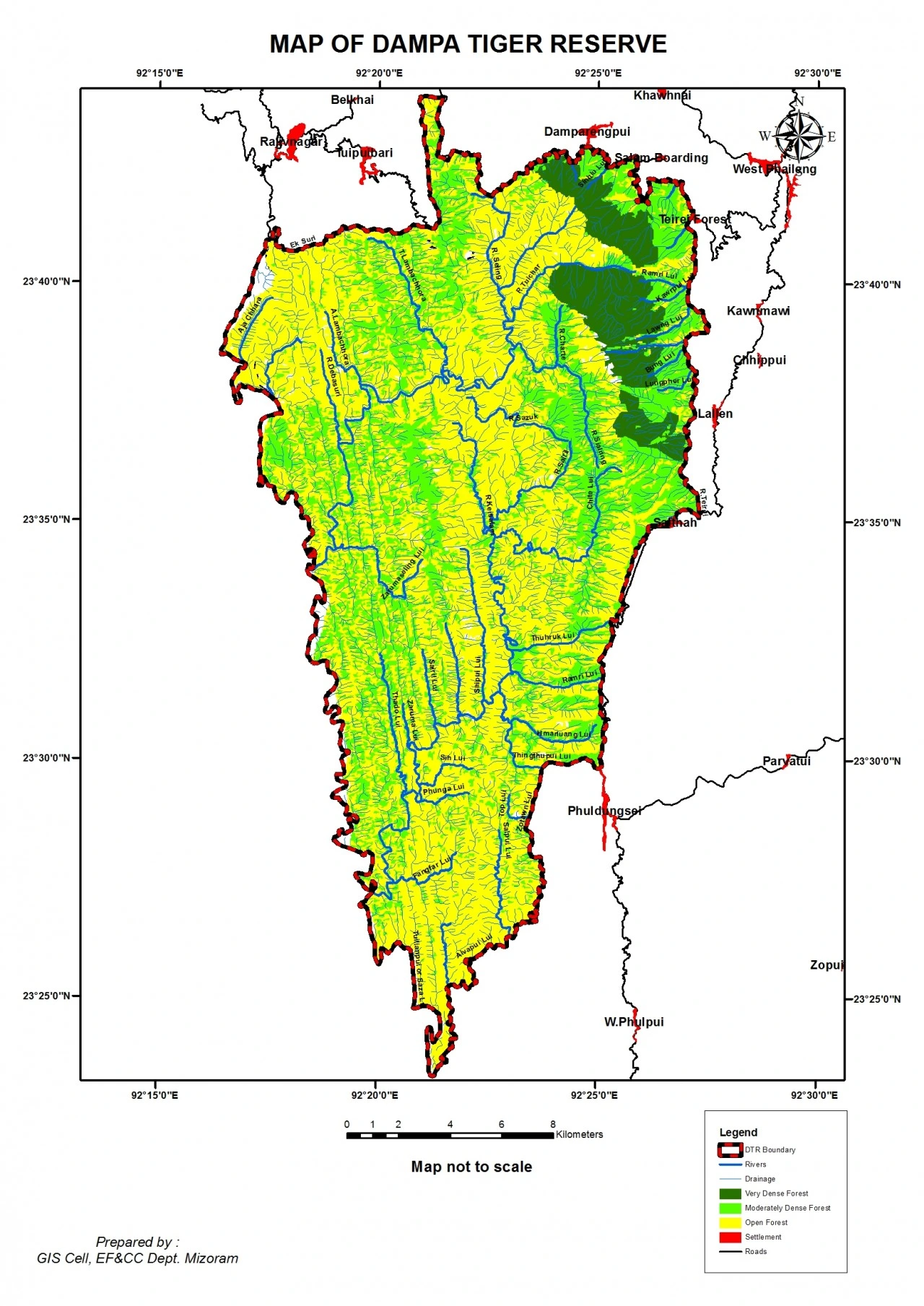
Dampa Tiger Reserve lies in western Mizoram, near the Bangladesh border. Its geographical coordinates are approximately 23°20′55″-23°47′50″ N latitude and 92°16′08″-92°31′39″ E longitude. The map for Dampa Tiger Reserve has been attached below as per the Environment, Forests & Climate Change Department under the Government of Mizoram:

Dampa Tiger Reserve Map

Dampa Tiger Reserve FAQs

Q1: Where is Dampa Tiger Reserve located?

Ans: Dampa Tiger Reserve is located in western Mizoram, along the international border with Bangladesh.

Q2: What is the total area of Dampa Tiger Reserve?

Ans: Dampa Tiger Reserve covers a total area of 988 sq. km, including 500 sq. km of core area and 488 sq. km of buffer area.

Q3: Which river flows through Dampa Tiger Reserve?

Ans: The Khawthlangtuipui River flows through the western part, while the Teirei River drains its eastern region.

Q4: Which animals are found in Dampa Tiger Reserve?

Ans: Major animals include tiger, leopard, clouded leopard, hoolock gibbon, Indian elephant, gaur, serow and Malayan sun bear.

Q5: Which state is home to Dampa Tiger Reserve?

Ans: Dampa Tiger Reserve is situated in Mizoram and is an important protected area among the Tiger Reserves in India.

Durgabai Deshmukh, Biography, Role, Contributions, Legacy

Durgabai Deshmukh

Durgabai Deshmukh (1909-1981) was a prominent Indian freedom fighter, social reformer, lawyer and politician, widely known as the "Iron Lady of Andhra." She played an important role in India's independence movement, Constitution-making, women's empowerment and social welfare reforms. Inspired by Mahatma Gandhi, she dedicated her life to promoting women's education, gender equality, social justice and national development. 

Durgabai Deshmukh Biography

Durgabai Deshmukh was born on July 15, 1909, in Rajahmundry, Andhra Pradesh. From childhood, she showed strong leadership qualities and actively supported women's education and India's freedom struggle.

  • Birth and Background: Durgabai Deshmukh was born on July 15, 1909, in Rajahmundry, Andhra Pradesh, then part of the Madras Presidency.
  • Early Activism: At the age of 12, she left school to protest against English as the medium of education.
  • Political Participation: At 14, she volunteered at an Indian National Congress conference in Kakinada, marking her early involvement in public service.
  • Gandhian Influence: Inspired by Mahatma Gandhi, she supported the Non-Cooperation Movement, khadi promotion and anti-liquor campaigns.
  • Higher and Legal Education: Completed her postgraduate studies at Andhra University and earned a law degree from Madras University in 1942, later practising at the Madras High Court.
  • Social Awareness: Her experiences with child marriage, educational inequality and restrictions on women's rights shaped her lifelong commitment to social reform.
  • Death: Passed away on May 9, 1981, leaving behind a lasting legacy in women's empowerment, education and social reform.

Durgabai Deshmukh's Role in India's Freedom Struggle

Durgabai Deshmukh actively participated in India's independence movement and became a strong supporter of Gandhian principles, women's participation and civil rights. She also contributed to shaping independent India's Constitution.

  • Civil Disobedience Movement: Participated in the Salt Satyagraha in Madras in May 1930, challenging British colonial laws.
  • Imprisonment: Arrested and imprisoned in 1930 and 1932 for participating in anti-British activities.
  • Women's Mobilisation: Encouraged women to join nationalist protests, peaceful demonstrations and social reform movements.
  • Promotion of Education: Founded and edited the Telugu journal Andhra Mahila, spreading awareness about women's education and social issues.
  • Constituent Assembly Membership: Elected to the Constituent Assembly from Madras Province in 1946, contributing to the framing of India's Constitution.
  • Constitutional Contributions: Participated in discussions on national language, judicial independence, human trafficking, women's rights and social justice.
  • Women in Constitution-Making: Served as the only woman on the panel of chairpersons of the Constituent Assembly, highlighting her leadership in national politics.

Major Contributions and Legacy of Durgabai Deshmukh

Durgabai Deshmukh made significant contributions to women's empowerment, education, legal reforms and social welfare after India's independence. She established important institutions and supported policies aimed at building an inclusive society.

Major Contributions

  • Andhra Mahila Sabha (1937): Established an organisation in Madras (now Chennai) to promote women's education, healthcare, vocational training and social welfare.
  • Central Social Welfare Board (1953): Became its first chairperson, supporting voluntary organisations working for women, children and disadvantaged communities.
  • Planning Commission: Served as a member of India's Planning Commission, promoting social welfare and women's development in national planning.
  • Women's Education: Chaired the National Committee on Women's Education in 1958, advocating free education, improved educational facilities and equal opportunities for girls.
  • Family Courts: Supported the introduction of Family Courts in India, inspired by her observations during a visit to China in 1953, to improve access to justice in family disputes.
  • Social Development: Contributed to the establishment of the Council for Social Development, promoting research on poverty, education and social justice.

Awards and Recognition

  • Nehru Literacy Award (1971): Recognised her contribution to literacy and educational development.
  • Paul G. Hoffman Award: Honoured her outstanding work in social welfare and community development.
  • Padma Vibhushan (1975): Received India's second-highest civilian award for her contributions to social work and national development.
  • Institutional Legacy: Institutions such as Durgabai Deshmukh Hospital and Research Centre continue to reflect her commitment to public welfare.

Durgabai Deshmukh FAQs

Q1: Who was Durgabai Deshmukh?

Ans: Durgabai Deshmukh (1909-1981) was an Indian freedom fighter, social reformer, lawyer and politician, popularly known as the "Iron Lady of Andhra."

Q2: When and where was Durgabai Deshmukh born?

Ans: Durgabai Deshmukh was born on July 15, 1909, in Rajahmundry, Andhra Pradesh, then part of the Madras Presidency.

Q3: What was Durgabai Deshmukh's role in India's freedom struggle?

Ans: She participated in the Salt Satyagraha of 1930, supported the Civil Disobedience Movement and was imprisoned for her anti-British activities.

Q4: What was Durgabai Deshmukh's contribution to the Constituent Assembly?

Ans: As a Constituent Assembly member, she contributed to discussions on women's rights, judicial independence, national language and social justice.

Q5: Which organisation was founded by Durgabai Deshmukh?

Ans: Durgabai Deshmukh founded Andhra Mahila Sabha in 1937 to promote women's education, healthcare, vocational training and social welfare.

Explosion Hits Russian Ship at Libya’s Benghazi Port, Drone Attack Suspected

Benghazi Port

Benghazi Port Latest News

An explosion and fire were recently reported aboard a Russian ship docked at Libya's Benghazi port, with the eastern-based Libyan government suspecting a drone attack.

About Benghazi Port

  • It is one of the largest commercial ports in eastern Libya, serving the eastern and southern regions. 
  • It is situated on the coast of the Gulf of Sidra, an arm of the Mediterranean Sea in the region of Cyrenaica. 
  • Spanning more than 450,000 sq m, Benghazi port deals with conventional cargo, bulk, and containers. 
  • Major exports include oil, wool, livestock, rugs, while major imports include food, textiles, chemicals, and pottery.  
  • Apart from commercial maritime traffic, Benghazi port also handles humanitarian cargoes such as medicines, etc, destined for other war-torn African nations like Darfur and Chad.  
  • It also houses one of the world’s biggest water desalination plants, which provides fresh water to most of Libya’s cities. 
  • The port is well connected to major cities by roadways. 
  • Benghazi port suffered due to political reasons and was blocked after 2013, resuming port operations in 2018. 

News: MC

Benghazi Port FAQ's

Q1: Where is Benghazi Port located?

Ans: It is located in eastern Libya, on the coast of the Gulf of Sidra.

Q2: What is the significance of Benghazi Port?

Ans: It is one of the largest commercial ports in eastern Libya, serving the eastern and southern regions of the country.

Q3: What are the major exports handled by Benghazi Port?

Ans: Oil, wool, livestock and rugs.

Q4: What are the major imports handled by Benghazi Port?

Ans: Food, textiles, chemicals and pottery.

Madras High Court Allows Bangladesh’s GI Challenge Over Tangail Saree

Tangail Saree

Tangail Saree Latest News

The Madras High Court recently held that Bangladesh's petition challenging India's Geographical Indication (GI) registration of the 'Tangail Saree of Bengal' is maintainable.

About Tangail Saree

  • It is a traditional handwoven cotton saree from Bengal.
  • It began in the Tangail district in present-day Bangladesh, and after Partition, many of its weavers settled in Phulia and nearby villages of West Bengal, so today it is woven on both sides of the border. 
  • Features:
    • Tangail sarees are characterized by their fine texture, detailed designs and local patterns, making each piece a work of art that reflects local social and cultural practices. 
    • It has a fine body scattered with small woven motifs called buti and a decorated border and pallu. 
    • A typical Tangail feels light, smooth, and slightly crisp, because the yarn is fine and the cloth is starched during weaving. 
    • The body is often a soft or pale colour, the buti are spaced across it, and the border and pallu carry most of the colour and pattern. 
    • Silk, tussar, and blended versions exist too, but cotton is what most people mean by a Tangail. 
  • The sarees hold strong cultural value and are often worn during major festivals, weddings, and celebrations. 
  • Men generally lead the main weaving process, including designing, dyeing the yarn, and crafting the fabric using the traditional handloom. 
  • The Tangail Saree of Bengal was officially granted a Geographical Indication (GI) tag on January 2, 2024, by the Indian GI Registry in Chennai, registered in favor of the West Bengal State Handloom Weavers Co-Operative Society Limited.
  • However, the registration triggered opposition in Bangladesh, which subsequently secured a separate GI registration for 'Tangail Sari' under its domestic law in 2024. 
  • In December 2025, UNESCO also inscribed Bangladesh's traditional saree weaving art of Tangail on its Representative List of the Intangible Cultural Heritage of Humanity.

News: BAR

Tangail Saree FAQs

Q1: What is the Tangail Saree?

Ans: The Tangail Saree is a traditional handwoven cotton saree originating from the Bengal region.

Q2: Where did the Tangail Saree originate?

Ans: It originated in the Tangail district of present-day Bangladesh.

Q3: Where is the Tangail Saree traditionally woven today?

Ans: It is woven on both sides of the India-Bangladesh border, particularly in West Bengal and Bangladesh.

Q4: What are the distinctive features of Tangail sarees?

Ans: They are known for their fine texture, intricate designs, local patterns and decorated borders and pallus.

Q5: Why do Tangail sarees have a light, smooth and slightly crisp texture?

Ans: Because they are made using fine yarn and the fabric is starched during weaving.

Nayi Chetna 5.0 to Launch on November 25, Focus on Women’s Economic Empowerment

Nayi Chetna 5.0

Nayi Chetna 5.0 Latest News

The Ministry of Rural Development will launch the fifth edition of its national gender campaign, Nayi Chetna 5.0 under the Deendayal Antyodaya Yojana–National Rural Livelihoods Mission (DAY-NRLM).

About Nayi Chetna 5.0

  • It is an initiative of the Ministry of Rural Development.
  • It is implemented under the Deendayal Antyodaya Yojana–National Rural Livelihoods Mission (DAY-NRLM).
  • It will place women’s economic empowerment at the centre of its approach.
  • It focuses on four interconnected areas: recognising women as economic contributors, strengthening women’s access to and control over assets, promoting safe mobility, and redistributing unpaid care work.
  • It particularly emphasises on addressing barriers that restrict women’s access to livelihood opportunities, markets, financial services, public spaces and essential services, and their ability to move freely, safely and independently.
  • The campaign aims to move beyond awareness generation towards coordinated action and measurable improvements in women’s economic participation, agency and decision-making.
  • The theme of Nayi Chetna 5.0: From Access to Agency: Empowering Women through Livelihoods and Equal Opportunities for a Viksit Bharat,” 

Source: PIB

Nayi Chetna 5.0 FAQs

Q1: Nayi Chetna 5.0 is an initiative of which ministry?

Ans: It is an initiative of the Ministry of Rural Development.

Q2: Under which mission Nayi Chetna 5.0 is being implemented?

Ans: It is implemented under the Deendayal Antyodaya Yojana–National Rural Livelihoods Mission (DAY-NRLM).

SCO Adopts 12-Point Indraprastha Communique at First Civilisational Dialogue Forum

Indraprastha Communique

Indraprastha Communique Latest News

The first SCO Civilisational Dialogue Forum, held in New Delhi, concluded recently with a 12-point outcome document, the ‘Indraprastha Communique’.

About Indraprastha Communique

  • It is a 12-point outcome document adopted at the First Shanghai Cooperation Organisation (SCO) Civilisational Dialogue Forum, held at Purana Qila, New Delhi, from 20–22 November 2026. 
  • It recognises culture as a "vital bridge for friendship, good neighbourliness" among nations.
  • The Communiqué affirmed respecting every civilisation as an equal voice, and acknowledging its identity and contribution to humanity. 
  • It recognised that cultural heritage encompasses monuments, manuscripts, literature, works of art, living traditions, cuisine, performing arts, creative endeavours and knowledge systems passed on through generations. 
  • The document also highlighted the role of technology, including Artificial Intelligence, in making our cultural heritage easier to understand, access and appreciate. 
    • It stressed that these technologies must be used responsibly while respecting the accuracy and cultural importance of our heritage. 
    • The interests of the communities and institutions that preserve it must also be kept in mind.
  • The Communiqué also called for greater efforts to protect cultural heritage from threats such as illegal trafficking, environmental damage and natural disasters. 
  • It underlined the importance of sharing experiences and working together to preserve our rich heritage for future generations.
  • The communique also proposed exploring joint nominations for UNESCO heritage inscription. 
  • The communiqué further records India’s proposal to hold the SCO Civilisational Dialogue every two years, at a venue to be decided by member states at the respective SCO summits.

News: NIE

Indraprastha Communique FAQs

Q1: What is the Indraprastha Communiqué?

Ans: It is a 12-point outcome document adopted at the First Shanghai Cooperation Organisation (SCO) Civilisational Dialogue Forum.

Q2: What is the key theme of the Indraprastha Communiqué?

Ans: Recognising culture as a vital bridge for friendship and good neighbourliness among nations.

Q3: What role does the Indraprastha Communiqué recognise for Artificial Intelligence in cultural heritage preservation?

Ans: It highlights the role of AI and other technologies in making cultural heritage easier to understand, access and appreciate.

Q4: What are the major threats to cultural heritage identified in the Indraprastha Communiqué?

Ans: Illegal trafficking, environmental damage and natural disasters.

Rare Short-Eared Owl Sighting Reported at Karnataka’s Sasihithlu Beach

Short-Eared Owl

Short-Eared Owl Latest News

A short-eared owl was recently spotted at Sasihithlu beach and estuary in Dakshina Kannada, Karnataka, adding to recent unusual bird sightings along the coast.

About Short-Eared Owl

  • It is a medium-sized owl belonging to the family Strigidae. 
  • It is named after its very small ear tufts, which are usually difficult to see.  
  • Scientific Name: Asio flammeus 

Short-Eared Owl Habitat and Distribution

  • It is one of the most widespread owls in the world; can be found on every continent except Australia and Antarctica.
  • Northern populations migrate south for the winter. 
  • Although the species winters in suitable grassland habitat across the Indian Subcontinent, it is most abundant in the western and northwestern parts of the region.  
  • It utilizes a wide variety of habitats that are typically open and have low vegetation with an abundance of small mammals. 

Short-Eared Owl Features

  • It is 13-17 inches (33-43.2 cm) in length and has a wingspan of  33-40 inches (84-102 cm). 
  • It is mottled yellowy-brown above, paler underneath and has dark circles around its yellow eyes. 
  • The upper tail has four or five prominent bars on a sandy background. 
  • Males and females look alike. 
  • They are distinctive in flight, with the wings ‘pushed forward’ on deep, wing beats in a way that is often described as rowing in slow-motion.  
  • It uses its strong beak and talons to snatch up prey while it is in flight. 

Short-Eared Owl Conservations Status

It is classified as 'Least Concern' under the IUCN Red List.

News: TOI

Short-Eared Owl FAQs

Q1: What is the Short-Eared Owl?

Ans: The Short-Eared Owl is a medium-sized owl belonging to the family Strigidae.

Q2: Why is the Short-Eared Owl called so?

Ans: It is named after its very small ear tufts, which are usually difficult to see.

Q3: Which continents are home to the Short-Eared Owl?

Ans: It is found on every continent except Australia and Antarctica.

Q4: What is the typical body coloration of the Short-Eared Owl?

Ans: It is mottled yellowish-brown above and paler underneath.

Q5: What is the conservation status of the Short-Eared Owl according to the IUCN Red List?

Ans: Least Concern (LC).

Genome Language Models: Scientists Use AI to Predict Genetic Changes and Design DNA

Genome Language Model

Genome Language Model Latest News

Scientists are currently using genome language models to help predict the consequences of genetic changes and to generate entirely new sequences. 

About Genome Language Model

  • A genome language model is an AI trained to recognise patterns in Deoxyribonucleic acid (DNA).
  • These are large language models trained on DNA, RNA, and related biological sequences to learn regulatory syntax, gene function, and long-range interactions across genomes.
    • DNA contains four chemical building blocks called adenine, thymine, guanine, and cytosine.
    • Their sequence carries the genetic instructions organisms use to build and maintain themselves.
    • The complete set of instructions is called the genome.
  • Working of Models
    • To train a genome language model, researchers feed an artificial neural network large quantities of DNA sequence data collected from various organisms.
    • The model learns by predicting the next DNA letter in a sequence or filling in missing letters.
    • Once after training, the model will be able to identify patterns of genes and the relationships between them without also learning about all the underlying biological rules.
  • Potential Applications
    • Genome Language Models are helping scientists study and design simple biological systems — together with lab experiments.
    • It could also help scientists to better understand genetic processes and potentially design new treatments.
    • It helps scientists to predict the consequences of genetic changes and to generate entirely new sequences.

Source: TH

Genome Language Model FAQs

Q1: What is Genome Language Model?

Ans: A genome language model is an AI trained to recognise patterns in Deoxyribonucleic acid (DNA).

Q2: What is the application of Genome Language Model?

Ans: It could also help scientists to better understand genetic processes and potentially design new treatments.

Kerala’s First Tribal Panchayat Faces Closure Amid Financial Crisis, Affecting Muthuvan Community

Muthuvan Tribe

Muthuvan Tribe Latest News

Keralam’s first tribal panchayat, Edamalakkudy, established exclusively for the Muthuvan community in Idukki, has shut down due to an acute financial crisis recently.

About Muthuvan Tribe

  • The Muthuvans, or Mudugars, live in the Western Ghats mountains in the Indian states of Kerala and Tamil Nadu.
  • The Muthuvan language belongs to the Dravidian language family.
  • There are two different groups among the Muthuvan, and they speak slightly different dialects. Hence, they call each other Malayalam Muthuvan and Pandi Muthuvan.
  • They are known for coexisting with the wildlife with their traditional knowledge and understanding of hills.
  • They have expertise in traditional medicines, which are very effective, and these medicines and the medicine men are confidentially preserved and passed on to the generations.

Muthuvan Tribe Social Organization

  • The community is subdivided into six matrilineal clans, called kootams. Each koottam is again divided into sub-clans. 
  • The functions of these divisions are mainly for marriage alliances, to keep up the social status, and to indicate descent and ancestry. 
  • The Muthuvan adhere to community endogamy and clan exogamy. 
  • They follow a unique system of governance called the ‘Kani System’.
  • The law and order in the community is handled by a council of elders under the leadership of the Kani, the headman.
  • The elders select the kani. They have various penal codes for breaking their traditions and moral standards.
  • The houses are lined up in parallel rows facing each other to form the kudi or settlement. 

Muthuvan Tribe Religion and Beliefs

  • They are animists and spirit worshippers and also worship the forest gods.
  • They believe that the spirits of their ancestors are to be the first migrants to the hill forests.
  • Nowadays, the Hindu gods and goddesses of the plains are also being worshipped, one of the effects of cultural infiltration.

Muthuvan Tribe Occupation

  • Virippukrishi (a form of shifting cultivation) is their traditional means of livelihood.
  • Traditionally the community is a millet cultivator. Nowadays Muthuvan also cultivates cash crops such as cardamom, pepper, arecanut, lemon grass, etc. 

News: TH

Muthuvan Tribe FAQs

Q1: Who are the Muthuvans?

Ans: The Muthuvans, also known as Mudugars, are an indigenous tribal community living in the Western Ghats of Kerala and Tamil Nadu.

Q2: In which Indian states do the Muthuvans primarily live?

Ans: Kerala and Tamil Nadu.

Q3: What are the two major groups among the Muthuvan community?

Ans: Malayalam Muthuvan and Pandi Muthuvan.

Q4: What religious beliefs are traditionally followed by the Muthuvans?

Ans: They are animists and spirit worshippers who also worship forest gods.

India and Bulgaria Discuss Stronger Bilateral Ties During Foreign Minister’s Visit

Bulgaria

Bulgaria Latest News

Recently, the Bulgarian Foreign Minister called on the President of India with discussions focusing on expanding cooperation between India and Bulgaria across a range of sectors.

About Bulgaria

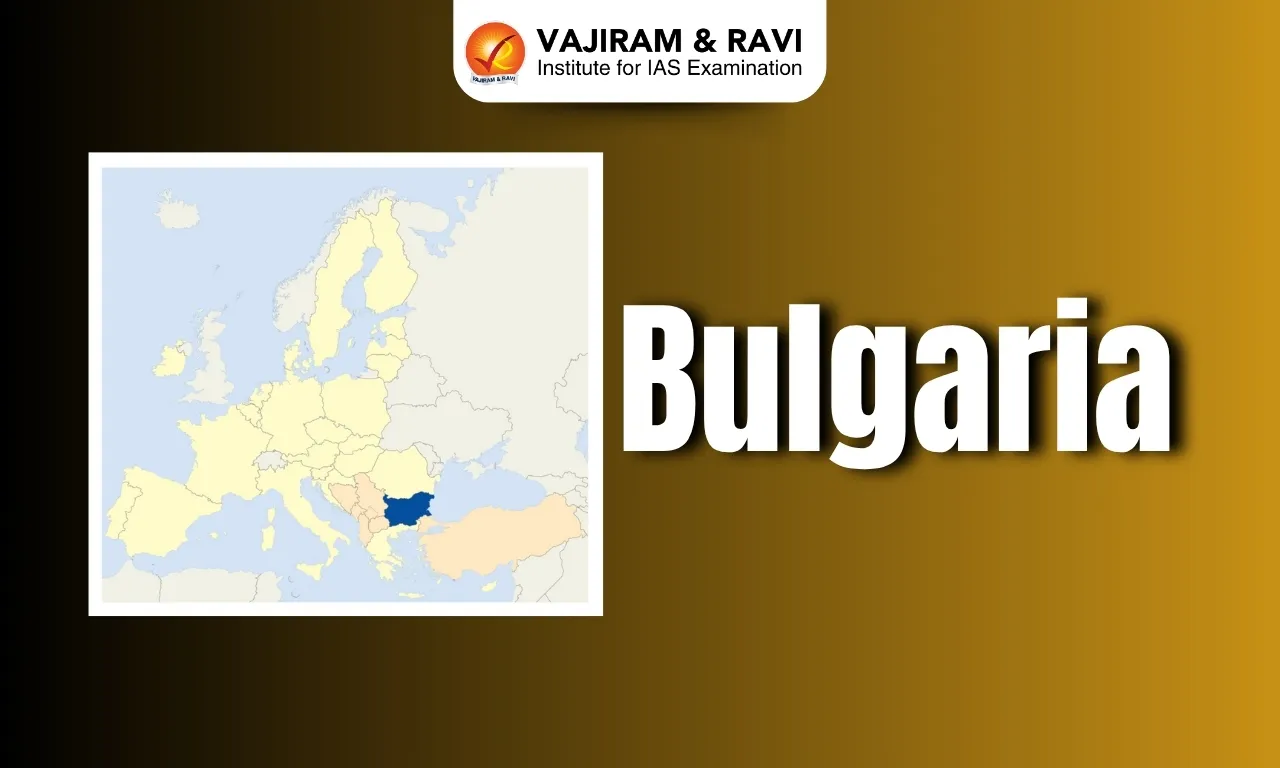
  • Location: It is located in the south eastern region of the European continent, occupying the eastern part of the Balkan Peninsula.
  • Bordering Countries: It shares its land border with Romania in the north; by Turkey and Greece in the south; by North Macedonia in the southwest and by Serbia in the west.
  • Maritime Border: It is bounded by the Black Sea in the east.
  • Capital City: Sofia

Geographical Features of Bulgaria

  • Climate: It has a moderate continental climate, which is tempered by Mediterranean influences in the south. 
  • Mountain Ranges: The Balkan Mountains cut across the central part of the country, while the Rhodope Mountains run through southern Bulgaria, along its border with Greece.
  • Highest Point: Musala Mt (at 9,594 ft.) which is located in the Rila Mountains.
  • Major Rivers: Major rivers include the Danube River, Iskur, Maritsa, Struma, Tundzha and Yantra rivers.
  • Natural Resources: It consists of Bauxite, Copper, lead, zinc, coal etc.

Source: DD News

Bulgaria FAQs

Q1: Which sea borders Bulgaria?

Ans: It is bounded by the Black Sea in the east.

Q2: Which type of climate is found in Bulgaria?

Ans: Moderate continental climate

BepiColombo Mission Begins Orbiting Mercury After Eight-Year Journey Through Space

BepiColombo Mission

BepiColombo Mission Latest News

Recently, after an eight-year journey, the European-Japanese spacecraft BepiColombo has begun orbiting the solar system's smallest ​and innermost planet Mercury.

About BepiColombo Mission

  • It was launched on October 20, 2018.
  • It is a joint European Space Agency (ESA) and Japan Aerospace Exploration Agency (JAXA) mission to Mercury.
  • The mission was named after Giuseppe “Bepi” Colombo, an Italian mathematician and engineer who made significant contributions to the understanding of Mercury’s orbit.
  • It is an ambitious and complex mission designed to study Mercury’s surface, composition, magnetic field, and its interaction with the solar environment.
  • Components of BepiColombo
    • Mercury Planetary Orbiter (MPO): It is developed by ESA, carries 11 instruments, including spectrometers and HIS cameras, and will study the interior and surface of the planet Mercury as well as its exosphere.
    • Mercury Magnetospheric Orbiter (MMO): It is developed by the Japanese space agency JAXA, includes 5 scientific instruments, and aims to study the magnetic field, the exosphere as well as waves and particles located in the immediate environment of the planet.
  • Objectives
    • Investigating Mercury’s surface and composition to better understand its geological history and formation processes.
    • Studying Mercury’s magnetic field and magnetosphere to gain insights into its internal structure and how it interacts with the solar wind.
    • Measuring Mercury’s exosphere (a thin atmosphere) and understanding its composition and dynamics.
    • Conducting experiments to test certain principles of general relativity and improve our understanding of gravity.

Source: TH

BepiColombo Mission FAQs

Q1: Which organisations developed the BepiColombo Mission?

Ans: It is a joint European Space Agency (ESA) and Japan Aerospace Exploration Agency (JAXA) mission to Mercury.

Q2: What is the main objective of BepiColombo Mission?

Ans: It is designed to study Mercury’s surface, composition, magnetic field, and its interaction with the solar environment.

Tiger Reserves in Mizoram, Location, Area, Flora and Fauna

Tiger Reserves in Mizoram

Tiger Reserves in Mizoram are important for wildlife conservation and biodiversity protection in Northeast India. Mizoram has one notified Tiger Reserve, Dampa Tiger Reserve, which forms part of the Tiger Reserves in India network. Located along the Bangladesh border, it provides important habitat for tigers and other wildlife.

Tiger Reserves in Mizoram 2026

As of 2026, Mizoram has one Tiger Reserve, namely Dampa Tiger Reserve, notified in 2007. It is located in western Mizoram and covers 988 sq. km, including its core and buffer areas, making it important for regional wildlife conservation.

Also Read:- Folk Dances of Mizoram

Dampa Tiger Reserve in Mizoram

Dampa Tiger Reserve (also designated as Dampa Wildlife Sanctuary) is the largest wildlife sanctuary in Mizoram and is situated along its western boundary, adjoining Bangladesh.

  • Establishment and Notification: The reserve was established as a protected area in 1994-95 and received Tiger Reserve notification in 2007. It is recognised as the 23rd Tiger Reserve in India.
  • Total Area: Dampa covers 988 sq. km, comprising a core area of 500 sq. km and a buffer area of 488 sq. km. The core is maintained free from human disturbance.
  • Geographical Location: Located in western Mizoram, the reserve shares its western boundary with the Chittagong Hill Tracts of Bangladesh. Its landscape is predominantly hilly, with elevations ranging from 49 to 1,095 metres.
  • Forest and Vegetation: The reserve mainly comprises tropical evergreen and semi evergreen forests. Bamboo forests are also prominent, while forest composition varies between moist valleys and steeper slopes.
  • Major Wildlife: Important animals found here include tiger, leopard, clouded leopard, elephant, gaur, sambar, hoolock gibbon, capped langur and Himalayan black bear.
  • Tiger Population: Dampa has a relatively low tiger density. Strengthening wildlife monitoring, habitat protection and conservation measures remains important for maintaining its tiger population.
  • Buffer Zone and Human Activities: The buffer area includes 17 villages with a population of about 24,578 (as reported by NTCA). Shifting cultivation and the cultivation of palm and rubber are among the major livelihood activities.
  • Wildlife Connectivity and Conservation: Dampa is connected to Thorang Wildlife Sanctuary in the southeast and forest areas of Bangladesh in the southwest. Community participation, wildlife monitoring and voluntary village relocation support its conservation efforts.

Tiger Reserves in Mizoram FAQs

Q1: How many Tiger Reserves are there in Mizoram?

Ans: Mizoram has one notified Tiger Reserve, known as Dampa Tiger Reserve.

Q2: Which is the 23rd Tiger Reserve in India?

Ans: Dampa Tiger Reserve in Mizoram is the 23rd Tiger Reserve in India. It was officially notified as a tiger reserve in 2007.

Q3: When was Dampa Tiger Reserve established?

Ans: Dampa was established as a protected area in 1994-95 and notified as a Tiger Reserve in 2007.

Q4: What is the total area of Dampa Tiger Reserve?

Ans: Dampa Tiger Reserve covers 988 sq. km, consisting of 500 sq. km of core area and 488 sq. km of buffer area.

Q5: Which country shares a boundary with Dampa Tiger Reserve?

Ans: Dampa Tiger Reserve shares its western boundary with Bangladesh, adjoining the Chittagong Hill Tracts.

Migratory Birds from Siberia and Central Asia Arrive at Telangana’s Kawal Tiger Reserve

Kawal Tiger Reserve

Kawal Tiger Reserve Latest News

The arrival of migratory birds from Siberia, Central Asia and other northern regions has brought renewed attention to the ecological significance of Kawal Tiger Reserve (KTR).

About Kawal Tiger Reserve

  • Location: It is located in the state of Telangana.
  • The reserve is nestled in the Sahyadri Mountain Ranges.
  • Geographically, the reserve is situated at the southernmost tip of the Central Indian Tiger landscape, having linkages with the Tadoba-Andhari (Maharashtra) and Indravati (Chhattisgarh) tiger reserves.
  • Rivers: It is a major catchment of the river Godavari and local rivulets like Peddavagu and Kadam.
  • Terrain: It has diverse habitats comprising dense forests, grasslands, rivers, streams, and water bodies.
  • Vegetation: It mainly consists of Southern Tropical Dry Deciduous Forest.
  • Flora: It consists of teak along with bamboo and other species like Anogeissus latifolia, Mitragyna parviflora, Terminalia crenulata, Terminalia arjuna, Boswellia serrata, etc.
  • Fauna:  The major wild animals include: tiger, nilgai, chousinga, chinkara, black buck, sambar, spotted deer, wild dog, wolf, jackal, fox, leopard,  and the jungle cat.

Source: TH

Kawal Tiger Reserve FAQs

Q1: Where is Kawal Tiger Reserve located?

Ans: Telangana

Q2: What type of vegetation is found in Kawal Tiger Reserve?

Ans: It mainly consists of Southern Tropical Dry Deciduous Forest.

Parliamentary Prorogation: Understanding Adjournment and Prorogation

Parliamentary Prorogation

Parliamentary Prorogation Latest News

  • Parliament's Monsoon Session was adjourned sine die on August 13, but has still not been prorogued by the President — making it 100 days without prorogation, the longest unprorogued period in Indian parliamentary history. 
  • This has triggered renewed debate on constitutional provisions governing summoning and prorogation of Parliament.

Key Constitutional Provisions

  • Article 85 of the Constitution governs the summoning and prorogation of Parliament's Houses.
    • The President, acting on the advice of the Council of Ministers, must summon each House from time to time.
    • The gap between two sessions cannot exceed six months.
    • This means at least two sessions of Parliament must be held each year — though by convention, three sessions (Budget, Monsoon, Winter) are typically held.

Understanding the Terminology: Adjournment vs. Prorogation

  • Adjournment: Done periodically during a session by the Speaker (Lok Sabha) or Chairman (Rajya Sabha), suspending proceedings temporarily.
  • Adjournment sine die: Occurs typically on the last scheduled day of a session — the House is adjourned indefinitely, with no fixed date for the next sitting.
  • Prorogation: The President, on the Council of Ministers' advice, formally terminates a session. This usually happens within a few days of adjournment sine die — but is not constitutionally mandatory to happen immediately.

The Current Context: Why the Delay Matters

  • The Monsoon Session ran from July 20 to August 13. Despite adjournment sine die on August 13, the Houses remain unprorogued even today — a gap of 100 days.
  • Article 85 sets no minimum notice period for summoning a new session; however: 
    • By convention, at least 14 days' notice is given before summoning a new session.
    • Rule 15 of the Lok Sabha Rules allows the Speaker to call a sitting at any time after adjournment sine die — provided the House has not yet been prorogued.
    • Rajya Sabha rules similarly allow the Chairman to direct sittings with no specified notice period, though convention permits reconvening at short notice of even two days.
  • This flexibility is the crux of the issue: an unprorogued House can be recalled quickly, without the formal process (and notice period) required to summon an entirely new session.

Speculation and Its Resolution

  • There was speculation that the government deliberately kept the Monsoon Session "live" (unprorogued) to convene it at short notice and push through a contentious constitutional amendment bill on delimitation.
  • This theory has weakened with the Winter Session's regular schedule approaching, rendering the need for a surprise short-notice sitting less plausible.

Historical Precedents

  • Extended unprorogued periods are not unprecedented:
    • 2008: Houses remained unprorogued for 87 days.
    • 1963–1987: Several instances of unprorogued periods ranging from 41 to 76 days.
  • NCT of Delhi's 7th Legislative Assembly (2020–25): Sessions were held annually in multiple parts, often adjourned without prorogation for extended periods.
  • Important note: MPs and State legislators continue to enjoy their parliamentary privileges even during unprorogued periods — prorogation status does not affect this protection.

The Bigger Concern: Declining Sitting Days

  • Beyond the prorogation debate lies a more structural concern:
    • Average annual sitting days of Parliament have fallen sharply — from 135 days in the First Lok Sabha to just 55 days today.
    • This decline raises questions about the effective functioning of India's legislative institutions, regardless of procedural technicalities around prorogation.

Conclusion

  • The prorogation debate is less about a constitutional crisis and more a reminder of procedural flexibility built into parliamentary convention — one that allows swift reconvening without formal summoning. 
  • Yet the deeper takeaway is structural: with sitting days nearly a third of what they were seven decades ago, strengthening Parliament's substantive functioning matters far more than the technicalities of when a session is formally closed.

Source: TH

Parliamentary Prorogation FAQs

Q1: What is parliamentary prorogation?

Ans: Parliamentary prorogation is the formal termination of a session by the President, acting on the advice of the Council of Ministers.

Q2: How does adjournment differ from parliamentary prorogation?

Ans: Adjournment temporarily suspends proceedings, whereas parliamentary prorogation formally terminates a session, ending its proceedings until another session is summoned.

Q3: Which constitutional provision governs parliamentary prorogation?

Ans: Article 85 of the Constitution governs parliamentary prorogation and summoning, requiring that the gap between two sessions not exceed six months.

Q4: Why can an unprorogued Parliament be reconvened quickly?

Ans: An unprorogued Parliament can be recalled under procedural rules without summoning an entirely new session, allowing sittings at relatively short notice.

Q5: What is the larger concern beyond parliamentary prorogation?

Ans: The larger concern is declining parliamentary productivity, as annual sitting days have fallen from 135 during the First Lok Sabha to approximately 55 today.

COP31 Ends Without Consensus as Fossil Fuel Phase-Out Divides Nations

COP31

COP31 Latest News

  • The UN climate summit at Antalya, Turkey, ended on Sunday (22 November 2026) without a consensus on its main political agreement, after running a record 48 hours into overtime. 

About COP

  • The COP is the annual meeting of parties to the UNFCCC (1992), the Kyoto Protocol (1997) and the Paris Agreement (2015). 
  • Decisions are taken only by consensus, so objection from even one country can block an agreement.
  • The host country proposes a “cover text” or political agreement meant to accelerate climate action. Turkey had proposed to call it the Antalya Pact.

Key Takeaways from the COP31

  • Reasons for Failure of Talks
    • The EU, backed by 130+ countries, went for broke: either a deal with a phase-out provision or no deal. It had taken a similar position at COP30 in Brazil but stepped back then.
    • Ireland’s Climate Minister Darragh O’Brien, speaking for the EU, said the bloc would not accept “a COP that greenwashes fossil fuels”. He said the draft ignored the science and the implementation gap, and risked deepening the chasm between commitments and action needed to bring 1.5°C within reach.
    • Panama formally objected. It called the text “a setback, a rollback”, citing its repeat of old commitments, heavy reliance on carbon capture and storage, and weakened language from earlier decisions.
    • This was the first COP since the UN confirmed that global temperatures are set to overshoot the 1.5°C limit.
  • The other side of the divide
    • Saudi Arabia, China and India, all part of the Like Minded Developing Countries (LMDC) group, favoured the way the cover text was framed. They oppose explicit language on fossil fuels and want to keep using them for the foreseeable future, although they have also deployed renewable energy at scale.
    • They also voiced misgivings about the lack of clarity on adaptation finance.
    • LMDC said the principles of equity and common but differentiated responsibilities were inadequately reflected, and that the principle of developed countries’ historical responsibility was diluted. 
    • India asked whose past and continuing emissions had exhausted the global carbon budget.
  • Other contentious issues
    • Electrification target: Turkey proposed a voluntary 35% electrification rate by 2035, up from about 23% of final energy consumption today. Many countries wanted it limited to clean sources.
    • Adaptation finance: The first draft proposed tripling adaptation finance to US$120 billion by 2035. Later drafts dropped the number, as developed countries refused to earmark a sum within their US$300 billion climate finance obligation from 2035.
    • Carbon capture and storage: Its emphasis as a mitigation strategy drew objections.
  • Background
    • Fossil fuels account for nearly three-quarters of annual global greenhouse gas emissions and over 80% of world energy needs.
    • The term “fossil fuels” appeared in a main COP agreement only at COP28 (Dubai, 2023), which referred to transitioning away from them in a “just, orderly and equitable manner”. Later attempts to build on this have been blocked.
    • With the US, under President Donald Trump, out of the Paris Agreement and the UNFCCC, the balance of power has shifted somewhat towards China and other large developing countries.
    • The last comparable failure was COP15 in Copenhagen (2009). COPs also neared collapse in Glasgow (2021) and Baku (2024) but ended in compromise.

Significance for India

  • India sided with the LMDC bloc against an explicit phase-out, framing climate ambition as dependent on finance, technology and capacity-building. 
  • Union Environment Minister Bhupender Yadav said energy transitions must be “nationally determined, just and equitable”.
  • He said India engaged “constructively and tirelessly” with the presidencies (Turkey and Australia), had reservations on some elements, and remains committed to building consensus. He added that the absence of a cover decision “does not pause climate action”.
  • He said India’s voice shaped the draft on food security, livelihoods and cultural practices recognised in action on methane.
  • India now faces pressure to define its position more clearly at COP32 in Addis Ababa, Ethiopia, where the contested issues will return.

Source: TH | IE

COP31 FAQs

Q1: What happened at COP31?

Ans: The summit in Antalya ended without consensus on its main political agreement. The EU and over 130 countries rejected a cover text that did not mention a fossil fuel phase-out.

Q2: Why did the EU reject the text?

Ans: It argued the text did not respond to the science, ignored the implementation gap and risked “greenwashing” fossil fuels while the world overshoots 1.5°C.

Q3: What was India’s position?

Ans: India supported the framing of the text, opposed explicit fossil fuel language, and stressed that ambition must be matched by finance and technology. It also said it had reservations on some elements and would keep seeking consensus.

Q4: Does the failure mean COP31 achieved nothing?

Ans: No. Decisions on other agenda items stand. Only the cover text, proposed as the Antalya Pact, was dropped.

Q5: What happens next?

Ans: The unresolved issues, including the fossil fuel phase-out, electrification target and adaptation finance, are expected to return at COP32 in Addis Ababa, Ethiopia, next year.

EPFO 3.0: Expanding Social Security Coverage to Gig Workers

EPFO 3.0

EPFO 3.0 Latest News

  • The Employees' Provident Fund Organisation (EPFO) is planning to launch EPFO 3.0 in February 2026, marking its next-generation technological and structural overhaul. 
  • The reform aims to extend universal social security coverage to all formal and informal sector workers, including gig and platform workers, for the first time.

Core Objective: Technology Overhaul

  • EPFO 3.0 will involve a complete overhaul of EPFO's technological infrastructure.
  • The new platform is being built to handle data for 200 crore workers over the next 50 years.
  • The reform will push EPFO towards becoming a fully paperless system.
  • Enables direct UAN (Universal Account Number)-linked PF contributions for all categories of workers, not just those in formal employment.

UPI Facility: Near Launch

  • EPFO is in the final stages of launching a UPI facility, expected by end of December 2026.
  • Once live, members will be able to: 
    • Withdraw PF funds directly using the BHIM app.
    • View their available balance, withdrawal-eligible balance, and minimum balance separately.
  • This builds on EPFO's recent WhatsApp service (launched earlier this month), which already allows subscribers to check PF balance, latest transactions, and passbook details.

Extending Coverage to Gig and Unorganised Workers

  • EPFO 3.0 is designed to operationalise the Code on Social Security, which for the first time brings gig and platform workers into India's formal social security net.
    • Aggregator contribution structure under the Code: 
    • Aggregators must contribute 1-2% of annual turnover towards social security.
    • Total contribution is capped at 5% of the amount payable by the aggregator.
  • Current EPFO numbers: 
    • Nearly 8 crore active members; over 34 crore total members.
    • Retirement corpus of nearly Rs 32 lakh crore.
  • With full rollout, EPFO must prepare for a workforce exceeding 60 crore.
  • EPFO expects to cover around 2.5 crore gig workers and Building and Other Construction Workers (BOCW) over the next five years.

One-to-Many Mapping and Flexible Contributions

  • A key structural innovation is "one-to-many mapping": a single UAN can be linked to multiple employers and aggregators simultaneously. 
  • Workers can view total PF and pension contributions across all sources, while still retaining an employer-wise breakdown.
  • The system will also permit third-party contributions from: 
    • NGOs
    • Individuals
    • Donor organisations
    • Corporate Social Responsibility (CSR) funds
  • These contributions will be tracked under each UAN with a configurable upper limit, supporting flexible co-contribution models for delivery partners, drivers, and other platform workers.

Centralised Banking-Style System

  • EPFO will integrate a Core Banking Solution (CBS), moving its operations closer to how banks function.
  • This will allow members to access accounts and resolve issues at any regional office across the country.
  • The shift particularly benefits workers who relocate between cities for employment, removing the current dependence on a fixed regional office.

Systematic Withdrawal Plan (SWP): A Parallel Reform

  • Ahead of EPFO 3.0, the EPFO has already approved a Systematic Withdrawal Plan (SWP), approved at a meeting held recently.
  • Current rule: Members can withdraw 100% of accumulated EPF balance at retirement (age 58) and claim monthly EPS pension after at least ten years of service.
  • Under SWP: Members can retain savings within the EPF ecosystem, continue earning EPF interest, and receive periodic post-retirement income instead of withdrawing the entire corpus as a lump sum.
  • Withdrawal options proposed: 
    • Full systematic withdrawal
    • Partial lump-sum withdrawal with SWP for the remaining balance
    • Interest-only withdrawal
  • Under SWP, members can choose the frequency of payouts — monthly, quarterly, or half-yearly — based on preference.

Conclusion

  • EPFO 3.0 represents a structural shift from a formal-sector-only retirement fund body to a universal social security platform covering gig workers, unorganised labour, and mobile workforces alike. 
  • By combining technological modernisation (UAN-linked contributions, UPI integration, centralised banking) with financial flexibility (SWP, one-to-many mapping), the reform seeks to future-proof India's social security architecture for a rapidly diversifying and mobile workforce — directly advancing the goals of the Code on Social Security, 2020.

Source: IE

EPFO 3.0 FAQs

Q1: What is EPFO 3.0?

Ans: EPFO 3.0 is a technological and structural overhaul aimed at modernising provident fund services and expanding social security coverage across India's workforce.

Q2: How will EPFO 3.0 benefit gig and platform workers?

Ans: EPFO 3.0 seeks to extend social security coverage to gig and platform workers through aggregator contributions and flexible contribution mechanisms.

Q3: What is the proposed UPI facility under EPFO 3.0?

Ans: EPFO 3.0 will enable members to withdraw provident fund money through BHIM, check balances and view withdrawal eligibility digitally.

Q4: What is one-to-many mapping under EPFO 3.0?

Ans: EPFO 3.0 will allow a single UAN to connect multiple employers and aggregators, consolidating contributions while retaining employer-wise records.

Q5: How will EPFO 3.0 improve post-retirement financial flexibility?

Ans: EPFO 3.0 complements systematic withdrawals, allowing retirees to retain savings, earn EPF interest and receive periodic payouts instead of lump-sum withdrawals.

SCO Civilisational Dialogue Forum (CDF) Adopts ‘Indraprastha Communique’

Indraprastha Communique

Indraprastha Communique Latest News

  • The first SCO CDF Forum (concluded in New Delhi recently) adopted the 12-point 'Indraprastha Communique', outlining areas of consensus on cultural cooperation, heritage conservation and people-to-people engagement.
  • The name reflects the venue's historical association with the ancient city of Indraprastha, mentioned in the Mahabharata.
  • The initiative seeks to complement the SCO's traditional security-oriented agenda with a stronger focus on civilisational ties and cultural diplomacy.

Indraprastha Communique - Key Proposals

  • Culture as a bridge of mutual trust: The Communique moves cultural cooperation beyond symbolic exchanges towards institutional partnerships.
  • Civilisational equality: Respect every civilisation as an equal voice, recognising its distinct identity and contribution to humanity.
  • Heritage protection: Combat illicit trafficking of cultural property and protect heritage from environmental pressures and natural disasters.
  • UNESCO cooperation: Explore joint nominations by SCO countries for UNESCO World Heritage inscription.
  • Cultural exchanges: Organise joint exhibitions, cultural festivals, film and performing arts programmes.
  • Institutional partnerships: Strengthen collaboration among museums, libraries, archives, universities and research institutions.
  • Spiritual traditions: Preserve religious and philosophical traditions, pilgrimage sites, monastic trails and historical centres of learning.
  • Technology and AI: Use AI to improve heritage documentation, accessibility and understanding.
  • Climate resilience: Explore collaborative mechanisms to protect cultural assets against climate-related disasters.

Four Dimensions of Civilisational Cooperation

  • Manuscripts and linguistic heritage: Preserving languages, scripts, manuscripts and literary traditions and transmitting knowledge across generations.
  • Archaeology: Understanding shared historical connections through archaeological evidence and heritage sites.
  • Cultural expressions: Promoting mutual appreciation through art, festivals, films and performing arts.
  • Monastic trails: Exploring historical linkages among religious institutions, philosophical traditions and centres of learning.

India-Pakistan Engagement

  • A diplomatic opening:
    • The participation of Pakistan's Climate Change Minister attracted considerable attention, marking the first visit by a Pakistani minister to India since Operation Sindoor (in May 2025).
    • He emphasised prioritising the welfare of poor and vulnerable populations and resolving regional challenges through dialogue.
  • Diplomatic significance:
    • Former Indian diplomats described the visit as an opportunity for limited engagement amid strained bilateral relations.
    • They viewed the interaction as an episode of 'common civility' that could create possibilities for future engagement, highlighting the role of multilateral platforms in enabling coexistence without direct bilateral engagement.
  • Not a thaw: 
    • India clarified that the invitation was extended under the SCO framework and that no formal bilateral meetings took place.
    • India maintained its position on outstanding issues, including cross-border terrorism following the Pahalgam attack and the suspension of the Indus Waters Treaty.

Why Does the SCO Forum Matter for India?

  • Strengthening cultural soft power: Showcases India's civilisational heritage, pluralism and traditions of peaceful coexistence. Reinforces India's image as a promoter of dialogue and cultural understanding.
  • Reorienting the SCO's agenda:
    • Broadens the organisation's traditional focus on regional security towards cultural, educational and people-to-people cooperation.
    • Provides India an opportunity to strengthen its engagement with Central Asia and other SCO members.
  • Strategic diplomatic space:
    • Keeps multilateral communication channels open despite the absence of normal India-Pakistan bilateral dialogue.
    • Offers opportunities for interaction on regional concerns without compromising India's stated diplomatic positions.
  • Reviving regional cooperation: Could create conditions for broader regional engagement, including a possible revival of the dormant SAARC process, although this remains uncertain.

Challenges and the Way Forward

  • Geopolitical rivalries and historical tensions: Insulate cultural cooperation from bilateral political disputes.
  • Illicit trafficking and deterioration of heritage: Strengthen legal cooperation, documentation and conservation capabilities.
  • Unequal recognition of civilisational narratives: Ensure inclusivity and equal representation of diverse traditions.
  • Climate change and natural disasters: Develop joint heritage-risk assessment and disaster-resilience mechanisms.
  • Digital distortion and misuse of AI: Ensure authentic documentation, community participation and ethical AI applications.
  • Limited institutional follow-up: Establish regular exchanges, collaborative research and measurable implementation mechanisms.

Other Suggestions

  • Institutionalise the biennial forum, as proposed by India, with a clear implementation roadmap.
  • Translate the Communique into joint heritage projects, academic exchanges and cultural collaborations.
  • Leverage India's civilisational philosophy of 'Vasudhaiva Kutumbakam' (The World Is One Family) to promote mutual respect.
  • Use cultural diplomacy as a complementary instrument of regional engagement, without treating it as a substitute for resolving political and security disputes.

Conclusion 

  • The SCO Civilisational Dialogue demonstrates that shared cultural heritage can provide common ground even when political relations remain strained. 
  • For India, its success will depend on converting civilisational goodwill into sustained institutional cooperation and regional trust.

Source: IE | IE | TH

Indraprastha Communique FAQs

Q1: How does the SCO Civilisational Dialogue strengthen India's cultural diplomacy?

Ans: It promotes India's civilisational heritage, soft power, pluralism and people-to-people ties.

Q2: What are the key outcomes of the Indraprastha Communique?

Ans: It emphasises heritage protection, joint UNESCO nominations, cultural exchanges, institutional partnerships, etc.

Q3: What is the diplomatic significance of Pakistan's participation in the SCO Civilisational Dialogue?

Ans: It provides a limited multilateral channel for regional engagement and 'common civility'.

Q4: How can cultural diplomacy complement the SCO's traditional security-oriented agenda?

Ans: By expanding cooperation into education, heritage conservation, research and people-to-people exchanges.

Q5: What challenges must be addressed to translate SCO civilisational cooperation into tangible outcomes?

Ans: Geopolitical rivalries, illicit heritage trafficking, climate threats and weak institutional follow-up require sustained dialogue.

Daily Editorial Analysis 23 November 2026

Daily-Editorial-Analysis

Thumba to Kourou, Over 60 Years of Space Partnership

Context

  • India and France share one of the world's oldest and most trusted space partnerships, spanning more than six decades.
  • Established in 1964, their cooperation has evolved into a comprehensive relationship covering space exploration, defence, industrial development and emerging technologies.
  • In an increasingly uncertain international environment, this partnership has acquired greater strategic significance.

Historical Foundations of India-France Cooperation

  • Evolution of a Long-standing Strategic Partnership

    • India and France established their strategic partnership in 1998, building upon decades of defence and technological cooperation.
    • Defence remains a major pillar, encompassing Alouette III/Chetak helicopters, Rafale aircraft and Scorpène submarines manufactured in India.
    • Their collaboration has expanded into artificial intelligence, the blue economy and advanced technologies.
    • Both countries believe that strategic autonomy requires developing domestic capabilities without isolating themselves from international partners.
  • Legacy of Space Cooperation

    • India-France space cooperation began in 1964, when French assistance enabled India to manufacture Centaure sounding rockets and acquire solid-propulsion technology, contributing to the development of Rohini rockets.
    • The partnership subsequently became reciprocal.
    • Europe's Ariane launch vehicle placed more than 20 Indian communication satellites into orbit, while India's Polar Satellite Launch Vehicle (PSLV) launched French Earth-observation satellites, including the SPOT series.
  • Important Joint Missions

    • Megha-Tropiques (2011): Studies tropical weather systems and climate patterns.
    • SARAL-AltiKa (2013): Supports oceanographic research and ocean-surface measurements.
    • TRISHNA: A joint mission for thermal infrared observation of the Earth's surface.
    • The TRISHNA mission represents advanced technological collaboration between the Indian Space Research Organisation (ISRO) and France's Centre National d'Études Spatiales (CNES).
    • France is developing the thermal infrared instrument, while India is providing the satellite platform and an optical sensor.

From Strategic Partnership to Industrial Production

  • Promoting Make in India Through French Collaboration

    • The partnership is increasingly moving from scientific cooperation towards joint manufacturing, industrial production and commercial innovation.
    • The principle of Make in India, together with France reflects their ambition to combine French technological expertise with India's expanding industrial capabilities.
    • India's space-sector reforms since 2020 have encouraged private investment and entrepreneurship.
    • The establishment of more than 400 space start-ups and the successful orbital launch of India's first privately developed launch vehicle in July 2026 demonstrate the sector's growing potential.
    • India's expanding space economy offers opportunities in satellite manufacturing, launch services, research and space-based applications.
  • Complementary Strengths and Industrial Opportunities

    • France brings several advantages to this partnership:
      • Strategic trust: Decades of cooperation have established a reliable relationship based on mutual confidence.
      • Institutional expertise: Regular exchanges between ISRO and CNES scientists and engineers strengthen research capabilities.
      • Technological excellence: France possesses advanced capabilities in satellite manufacturing, launch systems and space engineering.
      • Innovation ecosystem: French scientific institutions and entrepreneurial networks complement India's expanding start-up sector.
    • Joint ventures, technology transfers, research partnerships and domestic manufacturing can strengthen India's technological self-reliance while providing French companies access to India's growing space market.
    • Such collaboration can generate employment, encourage innovation and integrate Indian enterprises into global space supply chains.

Ensuring a Safer and Sustainable Space Environment

  • Growing Challenges in Outer Space

  • Increasing satellite launches, private-sector participation and geopolitical competition have made outer space increasingly crowded.
  • A major concern is space debris proliferation. Defunct satellites, collision fragments and discarded rocket components threaten operational spacecraft.
  • Further collisions could generate additional debris, creating long-term risks for space missions.
  • Modern societies increasingly depend on satellites for communication, navigation, weather forecasting, agriculture, disaster management and financial transactions.
  • Protecting space-based critical infrastructure is therefore essential for economic stability and national security.
  • Strengthening International Space Governance

    • India and France recognise that sustainable space exploration requires international cooperation and responsible behaviour.
    • Their partnership can address several priorities:
      • Space sustainability: Developing mechanisms to monitor and reduce orbital debris.
      • Space safety: Improving coordination and information-sharing to prevent collisions.
      • International space law: Promoting compliance with existing legal frameworks.
      • Transparency: Encouraging responsible conduct and confidence-building among space-faring nations.
      • Infrastructure protection: Safeguarding satellites against cyberattacks, interference and other threats.

Conclusion

  • India-France space cooperation has evolved from technological assistance into a comprehensive partnership encompassing scientific research, advanced manufacturing, commercial innovation and international space governance.
  • Its future potential lies in combining India's technological capabilities and entrepreneurial ecosystem with France's scientific excellence and industrial expertise.
  • Joint production and technology development can strengthen India's self-reliance while creating opportunities for both countries.
  • At the same time, addressing space debris, security threats and regulatory challenges requires collective international action.

Thumba to Kourou, Over 60 Years of Space Partnership FAQs

Q1. When did India-France space cooperation begin?

Ans. India-France space cooperation began in 1964 with technological assistance in rocket development.

Q2. What is the significance of the TRISHNA mission?

Ans. The TRISHNA mission will improve water resource management, agricultural monitoring and climate-change assessment.

Q3. What does the principle of Make in India, together with France, aim to achieve?

Ans. It aims to promote joint manufacturing, technology transfer and indigenous space-sector capabilities.

Q4. What are the major challenges to space sustainability?

Ans. Space debris, satellite collisions, security threats and inadequate international coordination are major challenges.

Q5. How does India-France cooperation promote strategic autonomy?

Ans. It strengthens domestic technological capabilities while enabling both countries to benefit from international cooperation.

Source: The Hindu


A Louder Gavel to Bridge India’s Justice Deficit

Context

  • On October 9, 2026, Judge Navanethem "Navi" Pillay was named the 2026 Nobel Peace Prize laureate at Nuremberg's Courtroom 600 — the birthplace of international criminal justice. Dedicating the award to "survivors of international crimes," she called for ending impunity worldwide.
  • This moment invites introspection closer to home: how well has India domesticated international criminal law (ICL) to hold perpetrators of mass atrocities accountable?

Why International Criminal Justice Matters Domestically

  • The word "international" in ICL refers to the gravity of crimes, not their geography — these laws exist to serve domestic justice too.
  • India already accepts this principle in practice:
    • Ratified the 1948 Genocide Convention and 1949 Geneva Conventions, both applicable to purely domestic situations.
    • Voted for UN Security Council resolutions treating internal crises (Somalia 1992, Libya 2011, Côte d'Ivoire 2011) as threats to international peace.
  • This makes the "internal affairs" defence invalid — India cannot claim mass atrocities are purely domestic matters while simultaneously endorsing this logic internationally.
  • The claim that ICL is an "Anglospherical" or neo-colonial imposition is called a regrettable excuse — refusing to criminalise atrocities domestically protects only perpetrators.
    • Anglosphere—the group of English-speaking nations that share historical, cultural, and legal roots with the United Kingdom.

What the Ordinary Citizen Actually Cares About

  • Debates over ICL's colonial origins or "victor's justice" legacy are abstractions that matter little to ordinary citizens. What they do care about:
    • That genocide is named and punished as genocide.
    • That "crimes against humanity" as a label reflects the true scale of their suffering.
    • That India's armed forces are never credibly accused of war crimes — because of rigorous IHL (International Humanitarian Law) training and discipline, not because India avoids the vocabulary altogether.
  • As Judge Dire Tladi put it, "the Court is only a court" — opposing institutions like the ICC must not deprive citizens of the broader rule of international criminal law itself.

India's Legal Vocabulary Gap

  • Justice S. Muralidhar observed that neither "genocide" nor "crimes against humanity" exists in India's domestic criminal law. ('Crimes against humanity' was invoked only once, for the 1984 anti-Sikh violence, in State vs Sajjan Kumar (2018).)
  • Genocide would instead be prosecuted under the 2023 Bharatiya Nyaya Sanhita (BNS) via ordinary charges like 'murder' or 'grievous hurt' combined with 'promoting enmity' — none of which capture genocide's unique gravity.
  • This breaches the principle of fair labelling: moral distinctions between crimes must be reflected in how they are named and punished.

The War Crimes Framework: Narrow and Toothless

  • Of 24 IHL conventions India has ratified, only three have implementing legislation — necessary to make them domestically binding with criminal consequences.
  • The 1960 Geneva Conventions Act (GCA):
    • Criminalises only "grave breaches" occurring in international armed conflicts, leaving other customary war crimes uncriminalised.
    • Bars any prosecution not initiated by the central government, leaving citizens no legal recourse ( Monteiro vs Goa, 1969).
    • Has produced zero prosecutions in 66 years, across seven international armed conflicts, despite credible reports of grave breaches.
  • Ordinary criminal charges are a poor substitute:
    • Carry lower sentences (5 years for 'wrongful confinement' versus 14 years under the GCA).
    • Only partially map onto actual grave breaches.
    • Completely fail to criminalise some acts, such as deporting protected persons from occupied territory.

Courts-Martial: An Inadequate Alternative

  • Courts-martial cannot try "war crimes" under the GCA — only narrower "civil offences" and "military offences" aimed at crimes against the military establishment, not civilians or enemy combatants.
  • Torture, for instance, would be misclassified merely as conduct "prejudicial to good order and military discipline."
  • Courts-martial can award lower punishments than ordinary criminal courts unless the offence carries death or life imprisonment (Sikkim vs Jasbir Singh, 2022).

The Deeper Gap: No Framework for Internal Conflicts

  • The sharpest gap is that no "war crimes" regime exists at all for non-international armed conflicts — arguably India's most frequent real-world scenario.
  • India often insists it faces only "internal disturbances," not armed conflicts. But whether an armed conflict exists is an objective legal test — based on intensity, duration, and organisation of the parties — not a judgment on the legitimacy of the cause.
  • Case in point — CPI (Maoist) conflict: Evidence suggests this conflict crossed the threshold for an armed conflict, given the organisation of both the Maoists and Salwa Judum (a civilian vigilante group recruited and trained by Chhattisgarh to fight alongside state and central forces).
    • In Nandini Sundar vs Chhattisgarh (2011), the Supreme Court sharply condemned the State government but never invoked IHL or used the term "war crimes."
    • While Maoists were prosecuted, no member of Salwa Judum or the security forces has ever been tried for widely reported war crimes.

The Case for a Principled Approach

  • India's approach to accountability "must not be riddled with double standards."
  • Sovereign interests and the difficulty of maintaining state integrity must be acknowledged — but admitting fault enhances, rather than diminishes, a nation's standing.
  • To genuinely be a "Vishwaguru" (world leader/teacher), India needs both an adequate legal framework and a credible, public record of accountability for mass atrocities — not just economic, political and military stature.

Conclusion

  • Justice delayed by vocabulary is justice denied. India's silence on 'genocide' and 'war crimes' protects perpetrators, not sovereignty.
  • A nation aspiring to global leadership must match moral courage with legal clarity — for the gavel's strike must ring louder than victims' unheard cries.

A Louder Gavel to Bridge India’s Justice Deficit FAQs

Q1. Why is international criminal law relevant to India's domestic justice system?

Ans. International criminal law addresses grave crimes regardless of geography, requiring countries to ensure accountability for atrocities committed within their own borders.

Q2. What is India's legal vocabulary gap concerning mass atrocities?

Ans. Indian criminal law lacks specific offences of genocide and crimes against humanity, often prosecuting such acts under ordinary criminal provisions.

Q3. What are the limitations of India's Geneva Conventions Act, 1960?

Ans. It covers only grave breaches in international armed conflicts, restricts prosecution initiation to the Centre and has recorded no prosecutions.

Q4. Why are courts-martial inadequate for prosecuting war crimes?

Ans. Courts-martial primarily address military offences and disciplinary violations, lacking jurisdiction and appropriate sentencing powers for several war crimes.

Q5. Why does India need a framework for non-international armed conflicts?

Ans. Such a framework would enable accountability for war crimes during internal conflicts, where existing laws inadequately address violations committed by state and non-state actors.

Source: TH

Daily Editorial Analysis 2026 FAQs

Q1: What is editorial analysis?

Ans: Editorial analysis is the critical examination and interpretation of newspaper editorials to extract key insights, arguments, and perspectives relevant to UPSC preparation.

Q2: What is an editorial analyst?

Ans: An editorial analyst is someone who studies and breaks down editorials to highlight their relevance, structure, and usefulness for competitive exams like the UPSC.

Q3: What is an editorial for UPSC?

Ans: For UPSC, an editorial refers to opinion-based articles in reputed newspapers that provide analysis on current affairs, governance, policy, and socio-economic issues.

Q4: What are the sources of UPSC Editorial Analysis?

Ans: Key sources include editorials from The Hindu and Indian Express.

Q5: Can Editorial Analysis help in Mains Answer Writing?

Ans: Yes, editorial analysis enhances content quality, analytical depth, and structure in Mains answer writing.

Tiger Reserves in Jharkhand, Palamau Tiger Reserve, Location, Area & Wildlife

Tiger Reserves in Jharkhand

Tiger Reserves in Jharkhand are important for conserving the state's wildlife and forest ecosystems. Jharkhand has one Tiger Reserve established under Project Tiger in 1973-74. It is located on the Chotanagpur Plateau and plays an important role in tiger conservation, biodiversity protection and maintaining ecological connectivity with other tiger habitats in Central India.

Tiger Reserves in Jharkhand 2026

As of 2026, Jharkhand has only one notified Tiger Reserve, i.e., Palamau Tiger Reserve. It is located across Latehar and Garhwa districts. It was among the first nine reserves established under Project Tiger and is an important part of the Tiger Reserves in India network.

Palamau Tiger Reserve

Palamau Tiger Reserve (Palamu Tiger Reserve) was established in 1973-74 under Project Tiger and formally notified as a Tiger Reserve in 2012. Its key geographical and conservation details are:

  • Location: Situated in the western part of the Chotanagpur Plateau, the reserve extends across Latehar and Garhwa districts of Jharkhand.
  • Total Area: The reserve covers 1,129.93 sq. km., comprising 414.08 sq. km. of core area and 715.85 sq. km. of buffer area.
  • Historical Significance: It was among the first nine Tiger Reserves established in India under Project Tiger. It also has the distinction of conducting a tiger census through pugmark counting in 1932.
  • National Park: Betla National Park, covering 226.32 sq. km., forms part of the Palamau Tiger Reserve.
  • Rivers: The North Koel, Auranga and Burha rivers flow through the reserve, making it an important watershed region.
  • Vegetation: The reserve is primarily characterised by tropical dry deciduous Sal forests, mixed deciduous forests and bamboo vegetation.
  • Wildlife Conservation: Apart from tigers, the reserve provides habitat to important wildlife, including elephants, leopards, gaurs, sloth bears and wild dogs.
  • Conservation Challenges: Major challenges include forest fires, illegal grazing, dependence of local communities on forest resources, shortage of frontline staff and security related disturbances.
  • Tiger Corridors: The reserve has ecological connectivity with Bandhavgarh, Sanjay-Dubri, Achanakmar and Kanha Tiger Reserve, forming part of the Central Indian Tiger Landscape.
  • Conservation Measures: Fire prevention, water harvesting, habitat improvement, anti poaching measures and community participation are important initiatives for protecting the reserve.

Tiger Reserves in Jharkhand FAQs

Q1: How many Tiger Reserves are there in Jharkhand?

Ans: Jharkhand has one Tiger Reserve, known as Palamau Tiger Reserve.

Q2: Which is the only Tiger Reserve in Jharkhand?

Ans: Palamau Tiger Reserve is the only Tiger Reserve in Jharkhand.

Q3: When was Palamau Tiger Reserve established?

Ans: Palamau Tiger Reserve was established in 1973-74 under Project Tiger and notified as a Tiger Reserve in 2012.

Q4: What is the total area of Palamau Tiger Reserve?

Ans: Palamau Tiger Reserve covers a total area of 1,129.93 sq. km., including 414.08 sq. km. of core area and 715.85 sq. km. of buffer area.

Q5: Which National Park is part of Palamau Tiger Reserve?

Ans: Betla National Park, covering 226.32 sq. km., forms part of Palamau Tiger Reserve.

Nepal PM India Visit 2026, India-Nepal Relations, Significance

Nepal PM India Visit 2026

The Nepal PM India Visit on 22-23 November 2026 marks an important step in strengthening India-Nepal Relations. The visit reflects the close historical, cultural and strategic ties between the neighbouring countries. It also provides an opportunity to review bilateral cooperation in trade, energy, connectivity, development partnership and regional issues.

Nepal PM India Visit 2026

Nepal's Prime Minister Balendra Shah will undertake a two day State visit to India from 22-23 November 2026, at the invitation of Prime Minister Narendra Modi. This is his first India visit since assuming office in March 2026. He will meet President Droupadi Murmu, while bilateral talks with Prime Minister Modi are scheduled for 23 November.

India-Nepal Relations 2026

India and Nepal share a unique partnership based on geographical proximity, historical ties, cultural connections and mutual economic interests.

  • Treaty of Peace and Friendship 1950: Signed on 31 July 1950, the treaty provides the foundation for India-Nepal Bilateral Relations and recognises the sovereignty, territorial integrity and independence of both countries.
  • High Level Diplomatic Engagement: Over the past twelve years, the countries have witnessed 17 exchanges at the Head of State or Head of Government level, reflecting sustained political engagement.
  • Institutional Cooperation: More than 40 bilateral mechanisms address areas such as border management, security, trade, energy, railways and water resources. The Joint Commission provides an important platform for bilateral discussions.
  • Trade and Investment: India is Nepal's largest trading partner and a major source of foreign investment. Bilateral goods trade reached approximately US$9.38 billion in FY 2025-26, accounting for more than 60% of Nepal's external goods trade.
  • Development Partnership: Indian assistance supports projects in healthcare, education, infrastructure, agriculture and capacity building. The High Impact Community Development Programme has undertaken 598 projects worth approximately NPR 1,583 crore across Nepal.
  • Connectivity Cooperation: Major initiatives include the Jaynagar-Bijalpura and Jogbani-Nepal Customs Yard railway links, three operational Integrated Check Posts and the Motihari-Amlekhgunj petroleum pipeline.
  • Energy and Water Resources: Cooperation covers hydropower development, cross border electricity trade and transmission infrastructure. Nepal exported approximately 1,100 MW of electricity to India in the previous year and also supplied electricity to Bangladesh through the Indian grid.
  • Digital Cooperation: The India-Nepal UPI-NPI linkage, launched in June 2026, enables direct peer to peer cross border remittances, strengthening financial connectivity and facilitating digital payments between the countries.
  • Defence and Security: Cooperation includes military training, joint exercises such as Exercise Surya Kiran, intelligence sharing and coordination against cross border crimes. The Mutual Legal Assistance Agreement in Criminal Matters was signed in February 2026.
  • Cultural and Educational Relations: Shared religious traditions, festivals and cultural heritage strengthen people to people connections. India also provides approximately 1,500 scholarships annually to Nepali students and supports professional training through the ITEC programme.

Nepal PM India Visit Significance

The Nepal PM’s India Visit holds diplomatic, economic and strategic importance for strengthening India's neighbourhood engagement and advancing mutually beneficial cooperation with Nepal.

  • Strengthening Bilateral Relations: The visit provides an opportunity for both countries to review existing agreements, address bilateral concerns and establish priorities for deeper political and diplomatic cooperation.
  • Advancing Neighbourhood First Policy: Nepal's geographical and strategic importance makes it a key partner in India's Neighbourhood First policy. Regular leadership level engagement reinforces regional cooperation and mutual trust.
  • Enhancing Economic Cooperation: Discussions can support stronger trade, investment and development partnerships, particularly in infrastructure, energy, connectivity and emerging sectors such as technology and innovation.
  • Strengthening Regional Stability: Continued diplomatic engagement can facilitate cooperation on shared security concerns, border management, disaster response and regional and international issues of mutual interest.

Nepal PM India Visit FAQs

Q1: When is Nepal Prime Minister Balendra Shah visiting India in 2026?

Ans: Nepal Prime Minister Balendra Shah is scheduled to visit India from 22 to 23 November 2026 on a two day State visit.

Q2: Why is Nepal Prime Minister Balendra Shah's India visit significant?

Ans: It is his first visit to India since becoming Prime Minister in March 2026 and provides an opportunity to strengthen bilateral relations and cooperation.

Q3: Which treaty forms the foundation of India-Nepal Relations?

Ans: The Treaty of Peace and Friendship, signed on 31 July 1950, forms an important foundation of India-Nepal Relations.

Q4: What is the UPI-NPI linkage between India and Nepal?

Ans: The UPI-NPI linkage is a cross border digital remittance mechanism launched in June 2026, connecting India's Unified Payments Interface with Nepal's National Payments Interface for direct peer to peer money transfers.

Q5: What is the significance of the 1950 India-Nepal Treaty of Peace and Friendship?

Ans: The treaty establishes the framework for peace and friendship, mutual recognition of sovereignty and reciprocal privileges relating to residence, trade, movement and economic participation.

31st UN Climate Change Conference (COP31) 2026, Date, Venue

31st UN Climate Change Conference

31st UN Climate Change Conference (COP31) will be held in Antalya, Turkiye, from November 9 to November 20, 2026. The conference will focus on climate finance, clean energy transition, methane reduction, climate adaptation and the implementation of global climate commitments.

31st UN Climate Change Conference (COP31) 2026 Key Highlights

The key highlights related to the 31st UN Climate Change Conference (COP31) 2026 have been tabulated below.

31st UN Climate Change Conference

Particulars

Details

Conference

31st UN Climate Change Conference

Full Form

Conference of the Parties (COP)

Dates

November 9-20, 2026

Host Country

Turkiye

Venue

Antalya Expo Center, Antalya

COP31 President

Murat Kurum

President of Negotiations

Chris Bowen, Australia

World Leaders’ Summit

November 11-12, 2026

Pre-COP31

October 5-8, 2026, in Fiji and Tuvalu

What Is the 31st UN Climate Change Conference?

The 31st UN Climate Change Conference, also known as COP31, is an international climate summit organised under the United Nations Framework Convention on Climate Change (UNFCCC).

It brings together countries to discuss ways to reduce greenhouse gas emissions, address global warming and strengthen climate resilience. The conference also reviews progress under the Paris Agreement and encourages countries to implement their climate commitments.

Key Issues on the COP31 Agenda

  • Climate Finance: Mobilising funds to help developing countries reduce emissions and adapt to climate change.
  • Clean Energy Transition: Expanding solar and wind energy, improving energy efficiency and promoting electrification.
  • Transition Away from Fossil Fuels: Implementing commitments to reduce dependence on coal, oil and natural gas.
  • Methane Reduction: Controlling methane emissions from agriculture, fossil fuel production and waste management.
  • Climate Adaptation: Strengthening resilience against floods, droughts, heatwaves and sea-level rise.
  • Loss and Damage: Supporting countries facing severe and irreversible climate-related losses.
  • Zero-Waste Initiatives: Promoting recycling, waste reduction and circular economy practices.
  • Nationally Determined Contributions (NDCs): Strengthening national climate targets and their implementation.

COP31 Pre-COP Meeting: Fiji and Tuvalu

The Pre-COP31 meeting took place from October 5 to October 8, 2026, with preparatory events in Fiji and Tuvalu. The discussions highlighted the climate challenges faced by Pacific island nations.

Key concerns included sea-level rise, coastal erosion, climate finance, clean energy and ocean protection. These discussions helped highlight the priorities of vulnerable island nations ahead of the main conference.

India and COP31

India's participation in COP31 is important for balancing climate action, economic growth, energy security and sustainable development.

India's key priorities include:

  • Climate Finance: Ensuring adequate and accessible funding for developing countries.
  • Climate Justice: Recognising differences in historical emissions and national capacities.
  • Renewable Energy: Expanding clean energy and improving energy efficiency.
  • Climate Adaptation: Protecting agriculture, water resources and vulnerable communities.
  • Technology Transfer: Improving access to affordable climate-friendly technologies.

India supports the principle of Common but Differentiated Responsibilities and Respective Capabilities (CBDR-RC). It recognises that all countries must address climate change, but their responsibilities and capacities differ according to their historical emissions and development needs.

Major International Climate Agreements

Major international climate agreements provide a global framework for reducing greenhouse gas emissions, limiting global warming, supporting climate adaptation and promoting international cooperation to address climate change.

Major International Climate Agreements

Agreement

Key Objective

UNFCCC, 1992

Establishes a framework for international climate cooperation.

Kyoto Protocol, 1997

Established emission-reduction commitments for developed countries during its commitment periods.

Paris Agreement, 2015

Aims to limit global warming to well below 2°C and pursue efforts to limit it to 1.5°C.

Glasgow Climate Pact, 2021

Strengthened global climate action, adaptation and finance discussions.

UAE Consensus, COP28

Called for transitioning away from fossil fuels in energy systems.

COP29, 2024

Established a new collective climate finance goal for developing countries.

Major Challenges Before COP31

COP31 faces several challenges in achieving effective climate action, ensuring climate justice and implementing global climate commitments.

  • Climate Finance Gap: Developing countries need adequate funding for climate mitigation and adaptation.
  • Fossil Fuel Dependence: Many economies rely on coal, oil and natural gas for energy and industrial growth.
  • Implementation Gap: Climate pledges do not always translate into effective action.
  • Unequal Capacities: Developing countries face financial and technological constraints.
  • Climate Justice: Countries differ over historical responsibilities and the distribution of climate burdens.
  • Energy Security: Governments must balance emissions reduction with affordable and reliable energy supplies.

Way Forward

COP31 should focus on practical climate solutions, stronger international cooperation and equitable implementation of climate commitments.

  • Improve Climate Finance: Ensure predictable, accessible and adequate funding for developing countries.
  • Accelerate Clean Energy: Expand renewable energy, improve energy efficiency and strengthen electricity storage.
  • Strengthen Adaptation: Invest in climate-resilient agriculture, water conservation and disaster preparedness.
  • Reduce Methane Emissions: Improve emissions monitoring, industrial practices and waste management.
  • Promote a Just Transition: Support workers and communities affected by the shift towards cleaner energy.
  • Strengthen Accountability: Monitor national climate targets and improve the implementation of climate commitments.

Conclusion

The 31st UN Climate Change Conference (COP31) will provide an important platform for advancing global climate action. Its success will depend on effective climate finance, stronger national commitments and practical measures to reduce greenhouse gas emissions while protecting vulnerable communities.

31st UN Climate Change Conference FAQs

Q1: When and where will COP31 be held?

Ans: COP31 will be held from November 9 to November 20, 2026, at the Antalya Expo Center in Antalya, Türkiye.

Q2: Who will host COP31?

Ans: Türkiye will host COP31, with Murat Kurum as COP31 President and Chris Bowen leading the negotiations.

Q3: What are the main issues of COP31?

Ans: The major issues include climate finance, clean energy transition, methane reduction, climate adaptation, loss and damage, and the implementation of the Paris Agreement.

Q4: What is the role of India in COP31?

Ans: India's priorities include climate justice, renewable energy, affordable climate finance, technology transfer and climate adaptation.

Q5: What is the Paris Agreement?

Ans: The Paris Agreement is an international climate treaty adopted in 2015. It aims to limit global warming to well below 2°C above pre-industrial levels while pursuing efforts to limit the temperature rise to 1.5°C.

Enquire Now