Fiber Optic Drones

Fiber Optic Drones

Fiber Optic Drones Latest News

Recently, it was observed that Hezbollah is using Fiber Optic Drones against Israel. 

About Fiber Optic Drones

  • Fiber optic drones are specialized unmanned aerial vehicles (UAVs) that integrate fiber optic technology.

Working of Fiber Optic Drones

  • Fiber optic drones operate by using optical fiber cables instead of traditional wireless systems.
  • These are operated while connected to the ground through a fiber optic tether.
  • Unlike regular drones that rely on radio frequencies for communication and batteries for power, these drones receive both data connectivity and often electrical power through the tether.
  • Applications: Military and Drone Warfare, Telecommunications and Infrastructure Maintenance, Emergency and Disaster Response

Advantages of Fiber Optic Drones

  • Real-time Data: It operates at near-zero latency transmission, ideal for surveillance, targeting and network maintenance. 
  • Improved Coverage: These can be operated in GPS-denied, RF-jammed environments like electronic warfare zones. 
  • High Security: These drones carry optical fiber cables, ensuring the transmission of large data volumes with minimal signal interference.  
  • Reliable Transmission: These drones provide high-speed, reliable data transmission over vast distances.

Source: IE

Fiber Optic Drones FAQs

Q1: Why Fiber optic drones are especially useful in electronic warfare zones?

Ans: They bypass RF interference and cannot be jammed

Q2: What is the key feature that distinguishes fiber optic drones from regular drones?

Ans: Operation via fiber optic tether for data and often power

Padma Doree

Padma Doree

Padma Doree Latest News

Recently, the North Eastern Handicrafts and Handlooms Development Corporation (NEHHDC), formally unveiled Padma Doree. 

About Padma Doree

  • It is a unique cross-cultural textile initiative that brings together the Eri (Ahimsa) silk traditions of Northeast India with the rich Chanderi weaving heritage of Madhya Pradesh.
  • It aims to promote sustainable textiles, strengthen cross-regional craft collaboration, and create new livelihood opportunities for artisans while showcasing India’s rich textile heritage.
  • Launched by: It was launched by the Ministry of Development of North Eastern Region (MDoNER).
  • Executing Agency: It is executed by the North Eastern Handicrafts and Handlooms Development Corporation (NEHHDC).

Key Aspects of 'Padma Doree'

  • Convergence of Traditions: It is developed across two culturally significant regions of India, and represents a convergence of textile traditions and generational knowledge systems.
  • Environmental Integrity: Padma Doree is crafted using natural dyes, drawing from time-honoured dyeing practices that yield depth and environmental integrity.
  • Ethical Philosophy: In alignment with an ethical philosophy, Padma Doree adopts a non-violent silk approach, ensuring that silkworms are not harmed in its production.

Source: PIB

Padma Doree FAQs

Q1: What is 'Padma Doree' in the context of textiles?

Ans: A cross-cultural textile initiative

Q2: Padma Doree initiative is associated with which two regions?

Ans: North East India and Madhya Pradesh

Udayan Fort

Udayan Fort

Udayan Fort Latest News

The historic Udyan Fort in Kaushambi, dating back nearly 2,500 years to the era of the ancient Vatsa Mahajanapada, is set to undergo restoration following official approval, officials said recently.

About Udayan Fort

  • Udayan Fort, also known as Udayan Kila, is a historical site located in the Kaushambi district of Uttar Pradesh. 
  • It is located on the banks of the Yamuna River.
  • The fort is associated with King Udayana, the ruler of the Vatsa kingdomone of the 16 Mahajanapadas of ancient India. 
  • It served as the capital fort of the Vatsa kingdom during the 6th century BCE. 
    • King Udayana was known for his military strength, diplomatic skills, and cultural patronage. 
    • According to Buddhist and Jain texts, Udayana had connections with both Lord Buddha and Mahavira, who visited Kaushambi and contributed to its spiritual growth. 
    • The fort thus played a key role in shaping the early political and religious landscape of the region. 
  • Architectural Remains and Layout:
    • The layout of the fort suggests a well-planned administrative and residential zone, complete with defensive structures and public buildings. 
    • The defensive structures include thick brick walls, earth ramparts, and bastions rising up to 50 to 60 feet, along with evidence of protective moats or trenches. 
    • The site is characterized by extensive brickbats scattered across the ground, hinting at the density of buildings that once stood inside the fortress. 
    • Archaeologists have unearthed pottery, coins, and ancient tools from the area, providing evidence of a thriving settlement.

Source: HT

Udayan Fort FAQs

Q1: Where is Udayan Fort located?

Ans: Kaushambi district, Uttar Pradesh

Q2: On the banks of which river is Udayan Fort situated?

Ans: Yamuna River

Q3: Udayan Fort is associated with which ancient king?

Ans: King Udayana, the ruler of the Vatsa kingdom—one of the 16 Mahajanapadas of ancient India.

Q4: During which century did Udayan Fort serve as the capital of the Vatsa Kingdom?

Ans: 6th century BCE

Allele

Allele

Allele Latest News

A study from South Africa finds that while protective HLA-B alleles once aided survival and reduced HIV transmission before Antiretroviral therapy, widespread ART use has significantly slowed this natural selection-driven genetic shift.

About Allele

  • An allele is a variant form of a gene. 
  • Some genes have a variety of different forms, which are located at the same position, or genetic locus, on a chromosome. 
  • Humans are called diploid organisms because they have two alleles at each genetic locus, with one allele inherited from each parent. 
  • Each pair of alleles represents the genotype of a specific gene. 
  • Genotypes are described as homozygous if there are two identical alleles at a particular locus and as heterozygous if the two alleles differ. 
  • Alleles contribute to the organism's phenotype, which is the outward appearance of the organism. 
  • Some alleles are dominant or recessive. When an organism is heterozygous at a specific locus and carries one dominant and one recessive allele, the organism will express the dominant phenotype. 
  • This genetic diversity allows offspring to inherit traits from both parents while exhibiting unique characteristics. 
  • For example, in hair color, dark hair is typically dominant over light hair; a child may inherit light hair only if both parents pass on the recessive allele. 
  • All genetic traits are the result of the interactions of alleles. 
  • Mutation, crossing over, and environmental conditions selectively change the frequency of phenotypes (and thus their alleles) within a population.

Source: TH

Allele FAQs

Q1: What is an allele?

Ans: A variant form of a gene.

Q2: Why are humans called diploid organisms?

Ans: Humans are called diploid organisms because they have two alleles at each genetic locus, with one allele inherited from each parent.

Q3: What does a pair of alleles represent?

Ans: The genotype of a specific gene.

Q4: What is a heterozygous genotype?

Ans: When the two alleles at a locus are different.

Q5: How do alleles influence phenotype?

Ans: They determine the expression of traits.

Ichak

Ichak

Ichak Latest News

Around 15 km from Hazaribag town lies Ichak — once the flourishing capital of a powerful dynasty and now a fading symbol of Jharkhand’s rich cultural past.

About Ichak

  • Ichak is a small village about 15 kms NE of Hazaribagh town in Jharkhand.
  • Known as the “temple town” of Hazaribag district, Ichak is dotted with hundreds of ancient temples, ponds, and gardens, many of which today stand in a state of alarming neglect.
  • Ichak’s origins trace back over two centuries to the Ramgarh Raj under the Singh dynasty. 
  • The rulers had established Ichak as one of their prominent capitals before shifting to areas near the Padma River. 
  • During their reign, they built an extensive network of temples, akharas (traditional centres), ponds, and gardens.
    • At the heart of Ichak’s main market stands the imposing Singh Dwar, a massive domed gateway that once marked the entrance to the royal palace.
    • From Baba Banshidhar and Bhairavnath temples to Lakshmi Narayan (Bada Akhara) and Shri Ram Janaki (Chota Akhara), each structure carries historical, architectural, and cultural value.
    • Ichak is also home to the Budhiya Mata Temple, where devotees worship a formless deity — a rare and unique tradition for over 300 years.
    • Bhagwati Math Temple reflects architectural influences akin to the Mahabodhi Temple, showcasing the artistic excellence of the past.
  • The style of the temples reveals the Nagara and the Bengal styles of architecture. The mosque-type domes emphasize the Moghul influence on these temples. 
  • Historians and locals said that at one point, Ichak had nearly 174 temples. Today, only a fraction of them remain, and many of them have either lost their idols—allegedly stolen—or are on the verge of collapse.

Source: TOI

Ichak FAQs

Q1: Where is Ichak located

Ans: About 15 km northeast of Hazaribagh town in Jharkhand

Q2: What is Ichak popularly known as?

Ans: The “Temple Town” of Hazaribagh district

Q3: Ichak’s origins are linked to which ruling dynasty?

Ans: Singh dynasty of the Ramgarh Raj

Q4: Which architectural styles are seen in Ichak temples?

Ans: Nagara and Bengal styles.

Ecuador

Ecuador

Ecuador Latest News

India and Ecuador are looking at the possibility of firming up a preferential trade pact to boost economic ties.

About Ecuador

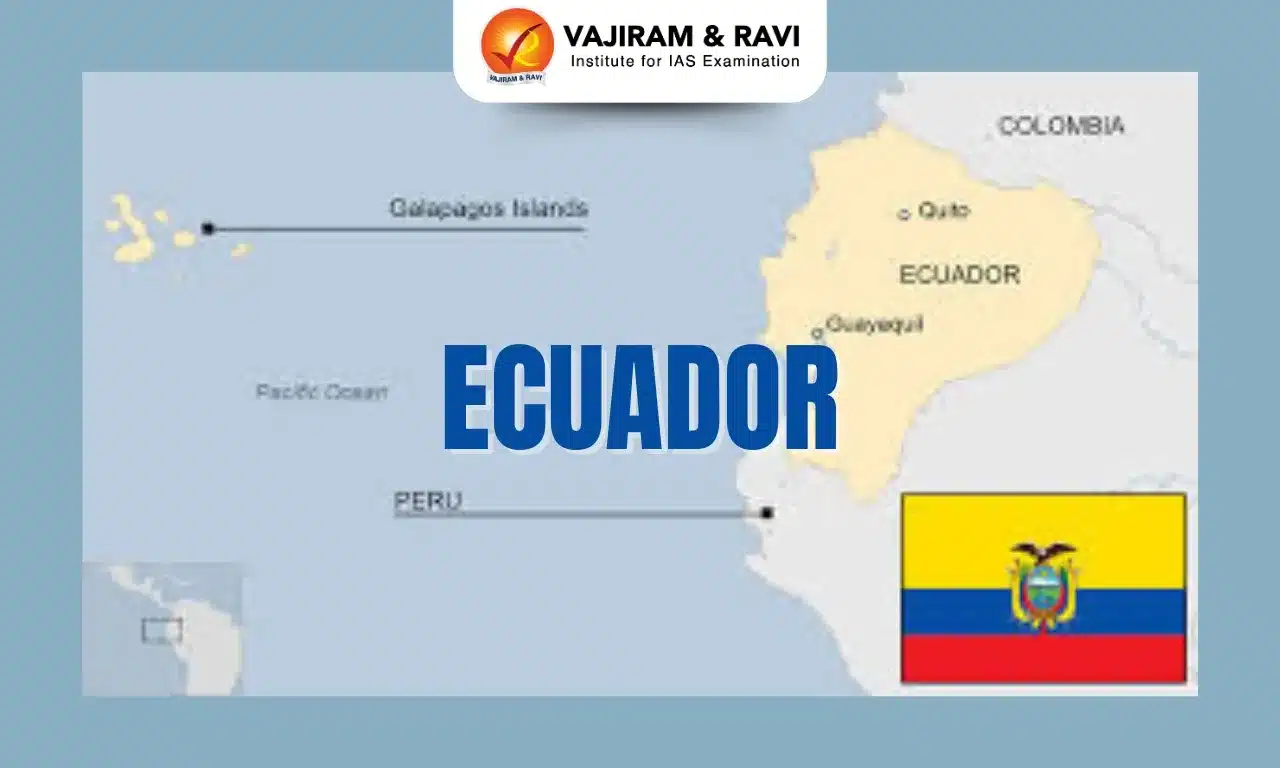
  • Location: It is a country located on the northwestern edge of South America.
  • Bordering countries: It is bordered by Colombia to the north, by Peru to the south and east.
  • Maritime boundaries: It shares borders with the Pacific Ocean to the west.
  • Capital City: Quito.

Geographical Features of Ecuador

  • It consists of 4 geographic regions namely
    • Coastal lowlands and mountain area; the Central Andes Mountains and its two major chains Cordillera Occidental in the West and the Cordillera Oriental in the east.
  • Climate: Tropical along coast, becoming cooler inland at higher elevations; tropical in Amazonian jungle lowlands.
  • Highest Point: The highest point in Ecuador is Mount Chimborazo, at 20,560ft (6,268m).
  • Volcano: Cotopaxi is one of the world’s highest active volcanoes located in the Andes Mountains.
  • Rivers:  Babahoyo, Chira, Coca, Curaray.
  • Natural resources: It mainly consists of Petroleum, fish, timber, hydropower

Source: ET

Ecuador FAQs

Q1: What is the capital of Ecuador?

Ans: Quito

Q2: Which famous archipelago, a UNESCO World Heritage Site, belongs to Ecuador?

Ans: Galapagos Islands

Atomic Energy Regulatory Board

Atomic Energy Regulatory Board

Atomic Energy Regulatory Board Latest News

Recently, the Atomic Energy Regulatory Board (AERB) has issued permission for "major equipment erection" at Kudankulam Nuclear Power Project (KKNPP) Units 5 and 6. 

About Atomic Energy Regulatory Board

  • It is India’s premier regulatory authority for nuclear and radiation safety.
  • Background: The AERB was constituted on November 15, 1983, by the President of India by exercising the powers conferred by the Atomic Energy Act, 1962 to carry out certain regulatory and safety functions under the Act.
  • Objective: To ensure the use of ionizing radiation and nuclear energy in India does not cause undue risk to the health of people and the environment.
  • Headquarters: Mumbai.
  • Composition
    • It comprises six members of which two are whole time members including the chairman. 
    • The other whole-time member is the executive director of the AERB Secretariat who is an ex-officio member of the Board. 
    • The other four members are eminent experts from various disciplines relevant to the mandate of the board.
    • The Board shall be responsible to the Atomic Energy Commission.

Functions of AERB

  • Develop safety policies in nuclear, radiation and industrial safety areas for facilities under its purview.
  • Develop Safety Codes, Guides and Standards for siting, design, construction, commissioning, operation and decommissioning of different types of nuclear and radiation facilities.
  • Grant consents for siting, construction, commissioning, operation and decommissioning, after an appropriate safety review and assessment, for establishment of nuclear and radiation facilities.
  • AERB license is a mandatory certification for entities involved in the use of ionizing radiation and nuclear energy in India. 
  • It shall have authority to administer the provisions of the Factories Act, 1948, the industrial safety for the units of Department of Atomic Energy (DAE).

Source: TH

Atomic Energy Regulatory Board FAQs

Q1: The Atomic Energy Regulatory Board was constituted under which Act?

Ans: Atomic Energy Act, 1962

Q2: What is Atomic Energy Regulatory Board?

Ans: The nuclear safety regulator of India under Department of Atomic Energy

SACHET Emergency Alert System: How SACHET Emergency Alert System is Transforming Disaster Communication in India

SACHET Emergency Alert System

SACHET Emergency Alert System Latest News

  • India has introduced the SACHET Cell Broadcast system, an indigenous emergency messaging service designed to deliver instant alerts to citizens during crises such as natural disasters, wars, or other emergencies. 
  • As part of testing, the government sent a nationwide notification with a siren sound, clarifying that no action was required as it was only a test message.
  • The initiative aims to strengthen India’s disaster response framework by ensuring timely alerts, thereby enhancing public safety and building a more resilient communication ecosystem.

SACHET: India’s Integrated Emergency Alert System

  • SACHET (meaning “alert”) is an Integrated Alert System designed to deliver disaster and emergency warnings directly to mobile users in geo-targeted areas via SMS.

Institutional Framework

  • Launched by the Department of Telecommunications (DoT)
  • Developed in collaboration with the National Disaster Management Authority (NDMA) 
  • Aims to strengthen real-time disaster communication across India

Purpose and Scope

  • Provides timely alerts during: 
  • Ensures rapid dissemination of critical information to citizens

How the System Works

  • Uses cellular network towers to broadcast alerts
  • Works as a one-way communication system
  • Does not require internet connectivity
  • Can deliver messages to billions of users within seconds (if connected to network)
  • Alerts can be nationwide or location-specific

Coverage and Reach

  • Operational across all 36 States and Union Territories
  • Has delivered over 134 billion SMS alerts
  • Supports communication in 19 Indian languages

Test Use in India

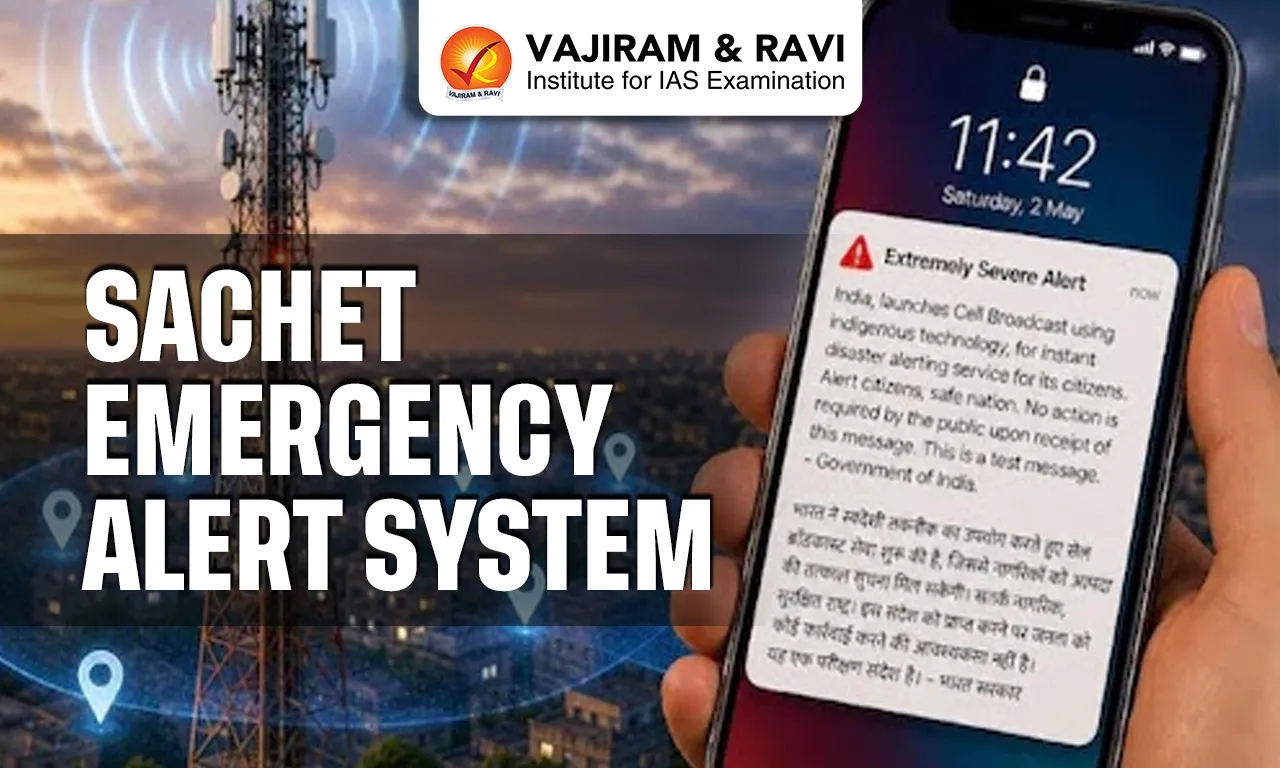
  • Around 11:40 AM on May 2, 2026, smartphones across India emitted a loud alert sound with vibrations and a pop-up message titled “extremely severe alert”, as part of a nationwide test of the cell broadcast system.
  • Similar systems are already used in countries like Japan for tsunami and disaster warnings.
  • India’s recent test marks one of the largest-scale implementations of this technology.

Significance

  • Enhances disaster preparedness and response 
  • Improves last-mile connectivity of emergency alerts
  • Builds a more resilient and responsive public communication system in India

Cell Broadcast Technology: A Powerful Tool for Emergency Alerts

  • Cell Broadcast is a communication method that enables authorities to send short messages simultaneously to multiple mobile phones within a specific geographic area.
  • It can target either a large population or a limited set of users in a hazard-affected zone, ensuring precise and efficient dissemination of alerts.
  • A major advantage of cell broadcast technology is its ability to bypass network congestion, allowing messages to be delivered instantly even during peak traffic conditions.
  • It does not rely on internet connectivity and can be customised based on user preferences such as language, making it highly effective for mass communication.

Origin and Global Adoption

  • Developed in the early 1990s by the European Telecommunications Standards Institute and first demonstrated in Paris in 1997, the technology has since been adopted globally.
  • Today, it is used by over 30 countries as a best practice for issuing timely warnings during natural disasters.

How Cell Broadcast Technology Works

  • Cell broadcast operates through the routine communication between mobile network towers and phones within their coverage area. 
  • These towers continuously transmit network-related information to connected devices, which usually remains invisible to users.
  • Authorities utilise this existing one-way communication system to send emergency alerts. 
  • Instead of relying on individual messaging, the system enables a single alert to be transmitted from a cell tower to all connected devices simultaneously.
  • By broadcasting one message to multiple users at once, cell broadcast ensures instant, wide-scale delivery without network congestion, making it highly effective for real-time alerts during disasters and emergencies.

Cell Broadcast vs SMS: Key Differences

  • So far, India relied on an SMS-based disaster alert system operational across all 36 States and Union Territories.
  • Now it has developed cell broadcast technology as a more advanced alert mechanism.
    • It is not clear when the full rollout of this technology will take place.
  • Cell Broadcast (CB) is a one-to-many system, allowing a single message to reach millions of devices simultaneously, whereas SMS operates on a one-to-one basis, sending messages individually to each recipient.
  • CB sends alerts through specific cell towers, targeting users within a geographic area. 
    • Unlike SMS, it does not require phone numbers, enabling precise, location-specific messaging without tracking individuals.
  • Cell Broadcast is more privacy-friendly, as it does not rely on user data. It can also reach visitors and foreign users in the area, often delivering messages in multiple languages.
  • CB alerts are highly conspicuous, featuring loud sounds and pop-ups, making them difficult to ignore. In contrast, SMS messages can be missed or overlooked more easily.

Source: IE | PIB | IE

SACHET Emergency Alert System FAQs

Q1: What is the SACHET emergency alert system?

Ans: The SACHET emergency alert system is India’s integrated disaster communication platform that delivers instant alerts via cell broadcast to warn citizens during natural disasters and emergencies.

Q2: How does the SACHET emergency alert system work?

Ans: The SACHET emergency alert system uses cell towers to broadcast alerts to all connected mobile devices simultaneously, ensuring instant delivery without relying on internet or SMS networks.

Q3: Why is the SACHET emergency alert system important?

Ans: The SACHET emergency alert system improves disaster preparedness by providing real-time alerts, reducing response time, and ensuring last-mile communication during emergencies across India.

Q4: How is the SACHET emergency alert system different from SMS alerts?

Ans: The SACHET emergency alert system uses one-to-many broadcasting, making alerts instant and unmissable, unlike SMS which can be delayed, missed, or dependent on network congestion.

Q5: What is the coverage of the SACHET emergency alert system in India?

Ans: The SACHET emergency alert system is operational across all states and UTs, supporting multiple languages and capable of reaching billions of users during emergencies.

100% FDI in Insurance Sector – A New Phase of Liberalisation

FDI in Insurance Sector

FDI in Insurance Sector Latest News

  • In a major reform push, the Government of India has allowed 100% Foreign Direct Investment (FDI) in the insurance sector under the automatic route.
  • This is notified through the Foreign Exchange Management (Non-debt Instruments) (2nd Amendment) Rules, 2026.
  • This follows the enactment of the Sabka Bima Sabki Raksha (Amendment of Insurance Laws) Act, 2025, signalling deeper financial sector liberalisation and efforts to enhance insurance penetration.

FDI in Insurance

  • Meaning:
    • FDI refers to investment made by a company or individual from one country into business interests located in another country. 
    • In the insurance industry, FDI typically involves foreign insurers investing in or owning stakes in Indian insurance companies.
    • FDI helps bring:
    • Capital for business expansion
    • Advanced technology platforms
    • Global management practices
    • Product innovation and risk management expertise
  • Regulatory oversight:
  • FDI limit increase:
    • Purpose: India has gradually increased foreign ownership limits for insurance companies, reflecting the government’s efforts to attract investment while maintaining regulatory stability.
    • Timeline:
      • Earlier 26% cap: When the Indian insurance sector was opened to private players in 2000, the foreign ownership limit was capped at 26% (a minority stake in joint ventures with Indian companies). 
      • Increase to 49%: In 2015, the government raised the FDI cap in insurance companies to 49% (management control remained with Indian partners) through amendments to insurance laws. 
      • Increase to 74% - liberalising the insurance sector: In 2021, the government further raised the foreign ownership limit to 74%. Under the new rules, foreign insurers could now hold majority stakes in the Indian companies.

Key Features of the Recent Reform

  • Full FDI liberalisation: FDI cap increased from 74% to 100% in insurance companies, and insurance intermediaries (brokers, TPAs, consultants, etc.). Investment will be permitted under the automatic route (no prior government approval required).
  • Special provision for LIC: Foreign investment capped at 20% in the Life Insurance Corporation of India (LIC), reflecting LIC’s strategic and sovereign importance.
  • Coverage of intermediaries: FDI liberalisation extended to insurance brokers and reinsurance brokers, Third Party Administrators (TPAs), corporate agents, surveyors and loss assessors, insurance repositories and managing general agents.

Regulatory Framework and Oversight

  • Role of IRDAI: All FDI investments are subject to verification and regulatory oversight by the Insurance Regulatory and Development Authority of India (IRDAI), ensuring financial stability and policyholder protection.
  • Governance safeguards: At least one key managerial person (Chairperson / Managing Director / CEO) must be a Resident Indian citizen.
  • Special conditions for intermediaries: If an intermediary is part of a non-insurance entity (e.g., bank) sectoral FDI caps of that sector apply, and non-insurance revenue must exceed 50% of total revenue.

Legislative Background

  • Sabka Bima Sabki Raksha (Amendment) Act, 2025: It amended three core laws - the Insurance Act, 1938; the LIC Act, 1956; and the IRDAI Act, 1999.
  • Objective: To enhance insurance coverage, attract global capital, and modernise regulation.

Significance of the Reform

  • Boost to insurance penetration: India’s insurance penetration remains low (~4% of GDP), and increased FDI can expand reach in rural and underserved areas, and promote financial inclusion.
  • Capital infusion and growth: Enables insurers to raise long-term capital, improve solvency margins, and invest in infrastructure and innovation.
  • Technology and expertise transfer: Entry of global players brings advanced underwriting practices, digital insurance models (InsurTech), and risk management capabilities.
  • Ease of Doing Business: Automatic route reduces regulatory delays. Aligns with broader economic liberalisation policies.

Challenges and Concerns

  • Domestic industry competition: Smaller Indian insurers may face pressure from large global firms.
  • Regulatory capacity: IRDAI must strengthen supervision mechanisms, and risk monitoring of foreign-dominated entities.
  • Policyholder protection: Ensuring that profit motives do not compromise claim settlement, and consumer rights.
  • Strategic concerns: Excessive foreign control in financial sectors may raise economic sovereignty issues, and data security concerns.

Way Forward

  • Strengthening regulatory oversight: Enhance IRDAI’s capacity for real-time monitoring, and risk-based supervision.
  • Promoting inclusive insurance: Incentivise insurers to expand in rural areas, and low-income segments.
  • Safeguards for domestic players: Through regulatory support and innovation incentives.
  • Consumer protection framework: Strengthen grievance redressal mechanisms. Improve transparency in policy terms.

Conclusion

  • The move to allow 100% FDI in the insurance sector marks a significant step in India’s financial sector reforms, aimed at boosting capital inflows, enhancing insurance penetration, and modernising the industry. 
  • However, its success will depend on robust regulation, balanced competition, and strong consumer safeguards, ensuring that liberalisation translates into inclusive and sustainable growth.

Source: BS

FDI in Insurance Sector FAQs

Q1: What is the significance of allowing 100% FDI in India’s insurance sector under the automatic route?

Ans: It enhances capital inflows, promotes insurance penetration, and brings global expertise into the sector.

Q2: Why has the government retained a lower FDI cap for LIC despite liberalising the insurance sector?

Ans: Due to LIC’s strategic importance and its role as a public sector financial stabiliser.

Q3: What is the role of IRDAI in the context of increased foreign investment in insurance?

Ans: IRDAI ensures regulatory oversight, financial stability, and protection of policyholders amid rising foreign participation.

Q4: What are the key challenges associated with 100% FDI in the insurance sector?

Ans: Increased competition for domestic firms, regulatory capacity constraints, and concerns over consumer protection.

Q5: How does the Sabka Bima Sabki Raksha Amendment Act, 2025 contribute to insurance sector reforms?

Ans: It modernises legal frameworks and enables full FDI liberalisation to improve insurance coverage and sectoral efficiency.

Enforcement Directorate Annual Report – Rs. 81,422 Crore in Attachments

Enforcement Directorate

Enforcement Directorate Latest News

  • The Enforcement Directorate’s latest annual report highlights its intensified action against financial crimes, attaching assets worth Rs. 81,422 crore, achieving a 94% conviction rate, and declaring 21 individuals as fugitive economic offenders.

Understanding Economic Offences in India

  • Economic offences refer to crimes that cause wrongful gain to one party and financial loss to another through deceit, fraud, or abuse of financial systems. 
  • These crimes often involve money laundering, tax evasion, corruption, cyber fraud, and violations of foreign exchange regulations. 
  • They threaten the stability of the financial system and undermine public trust in institutions.
  • The major legal frameworks addressing these offences include:
    • Prevention of Money Laundering Act (PMLA), 2002: The primary law enabling confiscation of proceeds of crime and prosecution of money laundering. It empowers the ED to trace illicit funds and attach assets derived from criminal activity.
    • Fugitive Economic Offenders Act (FEOA), 2018: Enacted to deter economic offenders who flee India to evade prosecution. It allows the ED to confiscate assets of offenders involving economic offences exceeding Rs. 100 crore.
    • Benami Transactions (Prohibition) Act, 1988: Prohibits property held in the name of another person to conceal ownership.
    • Foreign Exchange Management Act (FEMA), 1999: Regulates foreign exchange and cross-border financial transactions.
    • Companies Act, 2013 and SEBI Act, 1992: Provide provisions for corporate fraud and market-related offences.
  • The Enforcement Directorate, functioning under the Ministry of Finance, is the chief investigative agency enforcing PMLA and FEOA.  Its powers include:
    • Attachment of properties derived from crime. 
    • Arrest and prosecution of offenders. 
    • Coordination with international agencies for extradition.
  • It plays a crucial role in tracing illicit financial flows, recovering assets, and fostering economic integrity.

News Summary

  • The Enforcement Directorate’s annual report for the year ending March 2026 underscores significant progress in financial crime enforcement and asset recovery.
  • Massive Asset Attachments and Recoveries
    • According to the report, the ED attached assets worth Rs. 81,422 crore in the last financial year, marking one of its largest seizures to date. 
    • Out of these, assets worth Rs. 63,142 crore have already been returned to banks, investors, and homebuyers, a major step in restitution and recovering public funds lost to fraud.
  • High Conviction Rate but Slow Judicial Disposal
    • One of the most striking figures from the report is the 94% conviction rate in concluded cases, the highest ever achieved by the agency. 
    • This demonstrates improved investigative outcomes and robust prosecution under PMLA.
    • However, the report also reveals that over 2,400 cases remain pending in various courts, and only around 60 cases have reached final verdicts
    • This indicates that judicial delays remain a critical bottleneck in ensuring swift justice, despite the agency’s success in establishing guilt in most resolved cases.
  • Crackdown on Fugitive Economic Offenders
    • The agency’s report further highlights its growing emphasis on action against economic offenders who have fled abroad. 
    • Under the Fugitive Economic Offenders Act (FEOA), ED has initiated proceedings against 54 individuals, out of which 21 have been officially declared Fugitive Economic Offenders.
    • The confiscated assets in these cases total Rs. 2,178.34 crore.
  • Rise in Money Laundering and Digital Crime Cases
    • Between October 2025 and March 2026, the ED registered nearly 800 new money laundering cases under PMLA. 
    • These include cases related to digital arrest scams, intellectual property fraud, foreign interference, and offences against national interest.
    • Much of this activity was authorised by the newly formed risk assessment committee, which convened 91 meetings and approved 794 case registrations in just seven months. 
    • This marks a major procedural advance in identifying emerging threats in the digital economy and transnational financial crime patterns.
  • Institutional Strengthening and Technological Upgrades
    • The ED’s leadership has acknowledged that advanced data analytics, AI-assisted investigations, and inter-agency coordination have vastly improved efficiency. 
    • These capabilities enhance asset tracing, reduce delays, and improve confidence in India’s anti-money laundering efforts.

Source: TH | IE

Enforcement Directorate FAQs

Q1: What is the Prevention of Money Laundering Act (PMLA)?

Ans: PMLA, 2002, is India’s key law against money laundering, enabling attachment and confiscation of proceeds of crime.

Q2: How much property did the ED attach in FY 2025-26?

Ans: The ED attached assets worth Rs. 81,422 crore, of which Rs. 63,142 crore was restituted to victims and institutions.

Q3: What is the Fugitive Economic Offenders Act (FEOA)?

Ans: The 2018 FEOA allows confiscation of assets of offenders who flee India to avoid trial for cases involving Rs. 100 crore or more.

Q4: How many individuals have been declared fugitive economic offenders?

Ans: Twenty-one individuals, including Nirav Modi and Vijay Mallya, have been declared fugitives under the Act.

Q5: What continues to challenge ED’s operations?

Ans: Delays in judicial disposal of pending cases, despite strong conviction rates and improved investigations.

SVAMITVA Scheme

SVAMITVA Scheme

SVAMITVA Scheme Latest News

The rural property ownership scheme, SVAMITVA, is emerging as a potent tool for formalisation of residential land, improving the financial standing of gram panchayats, and making a positive impact on the rural economy, says a survey by IIM Ahmedabad.

About SVAMITVA Scheme

  • The Survey of Villages and Mapping with Improvised Technology in Village Areas (SVAMITVA) is a central sector scheme of the Ministry of Panchayati Raj.
  • It was launched nationwide on National Panchayati Raj Day, 24th April 2021, after successful completion of the pilot phase of the scheme ( 2020-2021) in 9 states. 
  • It aims to empower rural citizens with property cards, enabling access to credit, dispute resolution, and better planning.
  • It provides a ‘Record of Rights’ to village household owners with the issuance of legal ownership cards (property cards/title deeds) to the property owners by mapping land parcels using drone technology. 
  • The mapping shall be done across the country in a phased manner. It generates high-resolution and accurate maps to confer ownership property rights. 
  • The scheme seeks to achieve the following objectives:
    • To bring financial stability to the citizens in rural India by enabling them to use their property as a financial asset for taking loans and other financial benefits.
    • Creation of accurate land records for rural planning.
    • Determination of property tax, which would accrue to the Gram Panchayats (GPs) directly in States where it is devolved or else add to the State exchequer.
    • Creation of survey infrastructure and GIS maps that can be leveraged by any department for their use.
    • To support the preparation of a better-quality Gram Panchayat Development Plan (GPDP) by making use of GIS maps.
    • To reduce property-related disputes and legal cases.
  • Eligibility: The applicant should have a property in a rural inhabited (Abadi) area.
  • Exclusions: Agricultural lands are not covered under this scheme.
  • Implementing Agency: 
    • It is implemented by the Survey of India (SoI) with the National Informatics Centre Services Inc. (NICSI) as the technology partner. 
    • In the States, the Revenue Department/Land Records Department will be the Nodal Department and shall carry out the scheme with the support of the State Panchayati Raj Department.

Source: TI

SVAMITVA Scheme FAQs

Q1: What does SVAMITVA stand for?

Ans: Survey of Villages and Mapping with Improvised Technology in Village Areas

Q2: Which ministry implements the SVAMITVA Scheme?

Ans: Ministry of Panchayati Raj

Q3: What is the primary aim of the SVAMITVA Scheme?

Ans: To provide property rights to rural citizens through property cards.

Q4: Who is eligible under the SVAMITVA Scheme?

Ans: Residents owning property in rural inhabited (Abadi) areas.

Vantara Colombia Hippo Crisis: How Vantara Colombia Hippo Crisis Solution Could Reshape Wildlife Conservation

Vantara Colombia Hippo Crisis

Vantara Colombia Hippo Crisis Latest News

  • Vantara, a 3,500-acre wildlife rescue and rehabilitation centre in Jamnagar, Gujarat, owned by Anant Ambani (son of Reliance chairman), has offered to relocate and care for 80 hippos that were otherwise set to be euthanised.

Origin of Colombia’s Hippo Population

  • Colombia’s hippos trace back to four animals—three females and one male—imported in 1981 by Pablo Escobar for his private zoo at Hacienda Nápoles. 
  • After his death in 1993, the estate was abandoned, allowing the hippos to escape into the Magdalena River basin, where they reproduced rapidly, growing to an estimated population of around 170 today.

Why Colombia Decided to Cull Hippos

  • Colombia declared Hippopotamus amphibius an invasive species in 2022 after rapid population growth became a major ecological concern. 
  • Earlier efforts like sterilisation, launched in 2021, proved costly, labour-intensive, and largely ineffective, especially since dominant males mate with multiple females. 
  • Scientific research further highlighted the urgency, showing that the rising population and high management costs left only a limited window for control. 
  • Experts concluded that even with relocation efforts, some level of culling would be unavoidable.

Ecological Impact: Why Colombia’s Hippos Need Control

  • Peer-reviewed research highlights that Colombia’s hippos are significantly altering local ecosystems. 
  • A 2020 study found that hippo-inhabited lakes showed disrupted ecosystem metabolism, increased nutrient loading from waste, and a shift in aquatic life, with phytoplankton increasingly dominated by harmful cyanobacteria
  • These changes indicate serious ecological imbalance, underscoring the need for population control.

Challenges in Relocating Hippos

  • Moving hippos is extremely difficult due to biological, logistical, and financial constraints. 
  • Tranquilising them is risky because of their thick skin and proximity to water, where sedated animals can easily drown. 
  • Studies have shown high mortality during capture, often due to capture myopathy—a stress-induced condition. 
  • Additionally, their massive size (up to 3,000 kg) makes transport complex and costly, with expenses running into tens of thousands of dollars per animal.
  • Also, peer-reviewed consensus is that no single intervention — sterilisation, translocation, or culling — is sufficient on its own, and that the window for combined intervention is narrowing each year.

Can Vantara Accommodate 80 Hippos

  • Vantara’s Greens Zoological Rescue and Rehabilitation Centre, spread over about 650 acres, has sufficient space to house 80 hippos, as the minimum enclosure requirement would take only around 18 acres. 
  • However, practical challenges remain. 
    • Hippos live in social groups led by dominant males, so the animals would need to be divided into multiple separate enclosures rather than housed together. 
    • Additionally, Jamnagar’s hotter and drier climate would require continuous freshwater management to replicate their natural habitat, making long-term care more complex.

CITES and Concerns Over Wildlife Transfers to India

  • The Convention on International Trade in Endangered Species of Wild Fauna and Flora (CITES) reviewed India’s handling of wildlife imports after inspecting Vantara and found gaps in due diligence while issuing permits for endangered species. 
  • It initially recommended halting further import permits until procedures improved and animal origins were verified. 
  • However, this recommendation was later reversed after countries like the US, Japan, Brazil, and India argued that the move was premature.

Source: TH

Vantara Colombia Hippo Crisis FAQs

Q1: What is the Vantara Colombia hippo crisis issue?

Ans: The Vantara Colombia hippo crisis refers to the proposal to relocate Colombia’s invasive hippos to Vantara, a wildlife centre in India, to avoid culling.

Q2: Why is the Vantara Colombia hippo crisis significant?

Ans: The Vantara Colombia hippo crisis highlights global conservation challenges, balancing ecological damage caused by invasive species with ethical concerns over culling and relocation.

Q3: Can Vantara solve the Colombia hippo crisis?

Ans: The Vantara Colombia hippo crisis solution is feasible in terms of space, but challenges include climate differences, social grouping, and long-term ecological and logistical management.

Q4: What are the ecological concerns in the Vantara Colombia hippo crisis?

Ans: The Vantara Colombia hippo crisis involves ecosystem disruption, including nutrient imbalance and harmful algae growth, making population control essential for environmental stability.

Q5: What role does CITES play in the Vantara Colombia hippo crisis?

Ans: In the Vantara Colombia hippo crisis, CITES regulates wildlife transfers and raised concerns over India’s import procedures, though restrictions were later relaxed after international discussions.

Great Himalayan National Park (GHNP)

Great Himalayan National Park

Great Himalayan National Park Latest News

The Ministry of Environment recently declared a 326.69 sq.km. area around the Great Himalayan National Park in Himachal Pradesh as an eco-sensitive zone.

About Great Himalayan National Park 

  • It is a high altitude national park located in Kullu District of Himachal Pradesh.
  • It spreads across a total area of 1171 sq.km, encompassing elevations ranging from 1,500 to 6,000 meters. 
  • Nestled in the far Western Himalayas, the park comprises four valleys: the Tirthan Valley, the Sainj Valley, the Parvati Valley, and the Jiwa Nal Valley. 
  • It is surrounded by steep ridges and permanent snow on its northern, eastern, and southern edges. 
  • The GHNP is situated adjacent to Pin Valley National Park, Rupi-Bhaba Wildlife Sanctuary, and the Tirthan and Sainj Wildlife Sanctuaries.
  • Topography: The park is a stunning mix of lush coniferous forests, meadows, glaciers, and mountain peaks.
  • It was awarded UNESCO World Heritage Site status in 2014.
  • Flora:
    • Vegetation grows in well-defined altitude zones, beginning with rather open, subtropical forests at the lowest valley bottoms, gradually grading to mixed forests of horse chestnut, evergreen oak, spruce, and deodar, then to rusty-leaved kharsu oak, spruce, and fir in the upper temperate zone
    • Further up is a subalpine zone of birches, stunted firs, and rhododendron bushes, followed by the higher alpine areas where vegetation is reduced to grasses, herbs, and low shrubs, such as juniper. 
  • Fauna:
    • The park is home to 31 mammals, including the elusive snow leopard, the majestic Himalayan brown bear, and the vibrant blue sheep, or bharal. 
    • Other notable residents include the Himalayan tahr, musk deer, and serow
    • Birdlife in the park is equally diverse, with 209 species recorded, such as the endangered western tragopan and the impressive lammergeiers, alongside the Himalayan griffon vulture and golden eagle. 

Source: DEVD

Great Himalayan National Park FAQs

Q1: Where is the Great Himalayan National Park located?

Ans: Kullu district of Himachal Pradesh

Q2: n which mountain range is Great Himalayan National Park situated?

Ans: Western Himalayas

Q3: What are the the four valleys in Great Himalayan National Park?

Ans: Tirthan Valley, Sainj Valley, Parvati Valley, and Jiwa Nal Valley.

Spinal Muscular Atrophy

Spinal Muscular Atrophy

Spinal Muscular Atrophy Latest News

Recently, persons living with Spinal Muscular Atrophy (SMA), and parents have written to the Prime Minister of India seeking urgent intervention to ensure nationwide access to generic Risdiplam under the National Policy for Rare Diseases (NPRD). 

About Spinal Muscular Atrophy

  • It is a rare and progressive neuromuscular disorder that leads to muscle weakness and can cause life-threatening complications. 
  • It is a debilitating genetic condition which affects motor neurons that control movement, and leads to progressive muscle weakening.
  • Cause: Most forms of SMA are caused by mutations of the survival motor neuron 1 gene (SMN1) on the fifth chromosome, resulting in insufficient expression levels of the SMN protein.
  • Types of SMA: There are five subtypes of SMA- type 0, 1, 2, 3, 4. Healthcare providers classify them based on the age of onset, as well as the severity and life expectancy.

Symptoms of Spinal Muscular Atrophy

  • Its symptoms vary and may be mild or disabling, but involve a weakness of the muscles that control movement.
  • The weakness in SMA tends to be more severe in the muscles that are close to the center of your body than in the muscles farther away from your body’s center.
  • Treatment: Unfortunately, there isn’t a cure for SMA. Treatment for SMA mainly seeks to manage symptoms and prevent complications.

Source: TH

Spinal Muscular Atrophy FAQs

Q1: Under which category has the Government of India listed Spinal Muscular Atrophy?

Ans: Rare disease under National Policy for Rare Diseases 2021

Q2: What is Spinal Muscular Atrophy?

Ans: A genetic neuromuscular disorder causing muscle weakness

Enquire Now