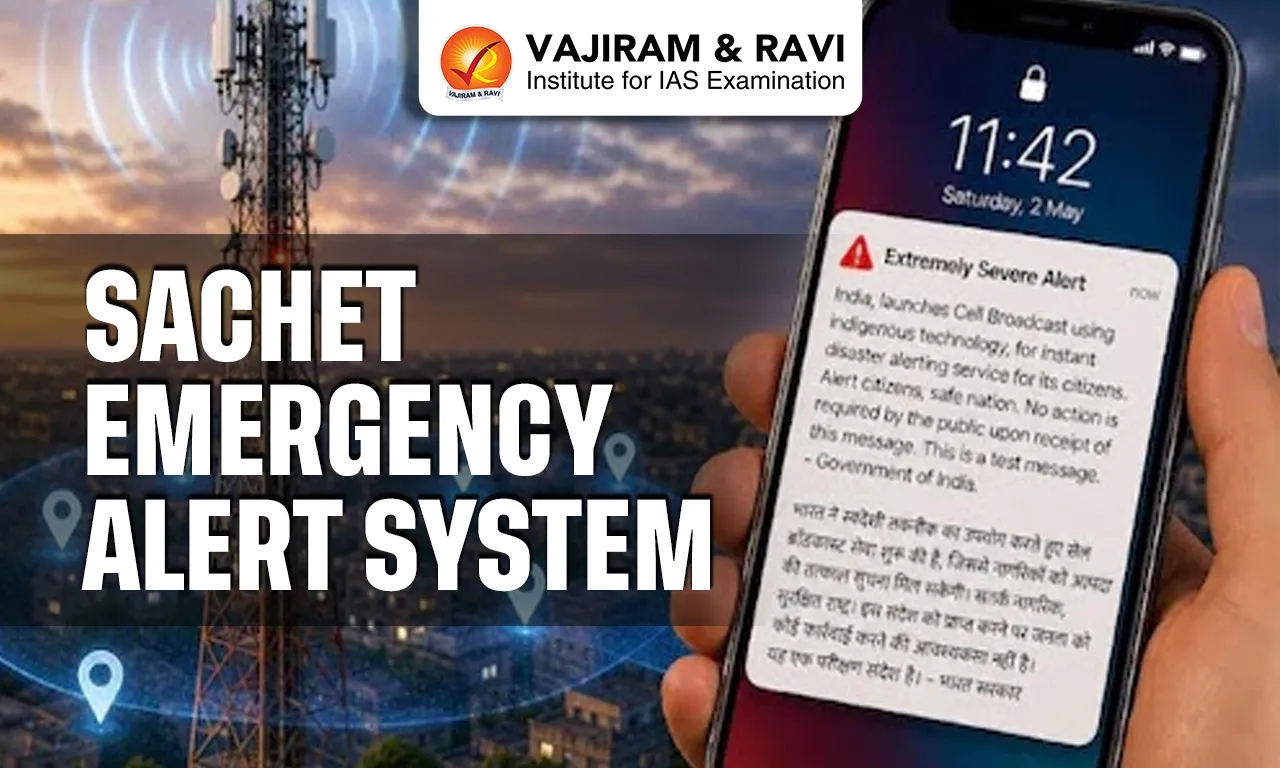
SACHET Emergency Alert System Latest News
- India has introduced the SACHET Cell Broadcast system, an indigenous emergency messaging service designed to deliver instant alerts to citizens during crises such as natural disasters, wars, or other emergencies.
- As part of testing, the government sent a nationwide notification with a siren sound, clarifying that no action was required as it was only a test message.
- The initiative aims to strengthen India’s disaster response framework by ensuring timely alerts, thereby enhancing public safety and building a more resilient communication ecosystem.
SACHET: India’s Integrated Emergency Alert System
- SACHET (meaning “alert”) is an Integrated Alert System designed to deliver disaster and emergency warnings directly to mobile users in geo-targeted areas via SMS.
Institutional Framework
- Launched by the Department of Telecommunications (DoT)
- Developed in collaboration with the National Disaster Management Authority (NDMA)
- Aims to strengthen real-time disaster communication across India
Purpose and Scope
- Provides timely alerts during:
- Natural disasters (cyclones, earthquakes, floods)
- Man-made emergencies (gas leaks, chemical hazards, wars)
- Ensures rapid dissemination of critical information to citizens
How the System Works
- Uses cellular network towers to broadcast alerts
- Works as a one-way communication system
- Does not require internet connectivity
- Can deliver messages to billions of users within seconds (if connected to network)
- Alerts can be nationwide or location-specific
Coverage and Reach
- Operational across all 36 States and Union Territories
- Has delivered over 134 billion SMS alerts
- Supports communication in 19 Indian languages
Test Use in India
- Around 11:40 AM on May 2, 2026, smartphones across India emitted a loud alert sound with vibrations and a pop-up message titled “extremely severe alert”, as part of a nationwide test of the cell broadcast system.
- Similar systems are already used in countries like Japan for tsunami and disaster warnings.
- India’s recent test marks one of the largest-scale implementations of this technology.
Significance
- Enhances disaster preparedness and response
- Under the UN’s “Early Warnings for All” initiative, which International Telecommunication Union (ITU) helps implement, cell broadcast is seen as a key tool to ensure people receive timely, accurate alerts.
- Improves last-mile connectivity of emergency alerts
- Builds a more resilient and responsive public communication system in India


Cell Broadcast Technology: A Powerful Tool for Emergency Alerts
- Cell Broadcast is a communication method that enables authorities to send short messages simultaneously to multiple mobile phones within a specific geographic area.
- It can target either a large population or a limited set of users in a hazard-affected zone, ensuring precise and efficient dissemination of alerts.
- A major advantage of cell broadcast technology is its ability to bypass network congestion, allowing messages to be delivered instantly even during peak traffic conditions.
- It does not rely on internet connectivity and can be customised based on user preferences such as language, making it highly effective for mass communication.
Origin and Global Adoption
- Developed in the early 1990s by the European Telecommunications Standards Institute and first demonstrated in Paris in 1997, the technology has since been adopted globally.
- Today, it is used by over 30 countries as a best practice for issuing timely warnings during natural disasters.
How Cell Broadcast Technology Works
- Cell broadcast operates through the routine communication between mobile network towers and phones within their coverage area.
- These towers continuously transmit network-related information to connected devices, which usually remains invisible to users.
- Authorities utilise this existing one-way communication system to send emergency alerts.
- Instead of relying on individual messaging, the system enables a single alert to be transmitted from a cell tower to all connected devices simultaneously.
- By broadcasting one message to multiple users at once, cell broadcast ensures instant, wide-scale delivery without network congestion, making it highly effective for real-time alerts during disasters and emergencies.
Cell Broadcast vs SMS: Key Differences
- So far, India relied on an SMS-based disaster alert system operational across all 36 States and Union Territories.
- Now it has developed cell broadcast technology as a more advanced alert mechanism.
- It is not clear when the full rollout of this technology will take place.
- Cell Broadcast (CB) is a one-to-many system, allowing a single message to reach millions of devices simultaneously, whereas SMS operates on a one-to-one basis, sending messages individually to each recipient.
- CB sends alerts through specific cell towers, targeting users within a geographic area.
- Unlike SMS, it does not require phone numbers, enabling precise, location-specific messaging without tracking individuals.
- Cell Broadcast is more privacy-friendly, as it does not rely on user data. It can also reach visitors and foreign users in the area, often delivering messages in multiple languages.
- CB alerts are highly conspicuous, featuring loud sounds and pop-ups, making them difficult to ignore. In contrast, SMS messages can be missed or overlooked more easily.

 Last updated on Oct, 2026
→ UPSC 2027 Notification will be released on 13 January 2027 at upsconline.nic.in.
→ Check Nobel Prize 2026 Winners List here.
→ Download PIB PRiSM Monthly Magazine 2026 here.
→ Check UPSC Monthly Current Affairs Magazine The Recitals here.
→ Check out the latest UPSC Syllabus here.
→ Download UPSC Model Answers for Mains 2026
→ UPSC Mains Question Paper 2026 is out now for Essay & GS Paper 1, 2, 3 & 4.
→ UPSC Calendar 2027 has been released.
→ Enroll in Vajiram & Ravi’s UPSC Mains Test Series 2027 for structured answer writing practice, expert evaluation, and exam-oriented feedback.
→ Join Vajiram & Ravi’s UPSC Mentorship Program 2027 for personalized guidance, strategy planning, and one-to-one support from experienced mentors.
→ Go through the UPSC Mains Previous Year Papers to enhance your preparation.
→ UPSC has released UPSC Toppers List 2025 with the Civil Services final result on its official website.
→ Also check Best UPSC Coaching in India
SACHET Emergency Alert System FAQs
Q1. What is the SACHET emergency alert system?+
Q2. How does the SACHET emergency alert system work?+
Q3. Why is the SACHET emergency alert system important?+
Q4. How is the SACHET emergency alert system different from SMS alerts?+
Q5. What is the coverage of the SACHET emergency alert system in India?+
Tags: mains articles SACHET emergency alert system upsc current affairs upsc mains current affairs