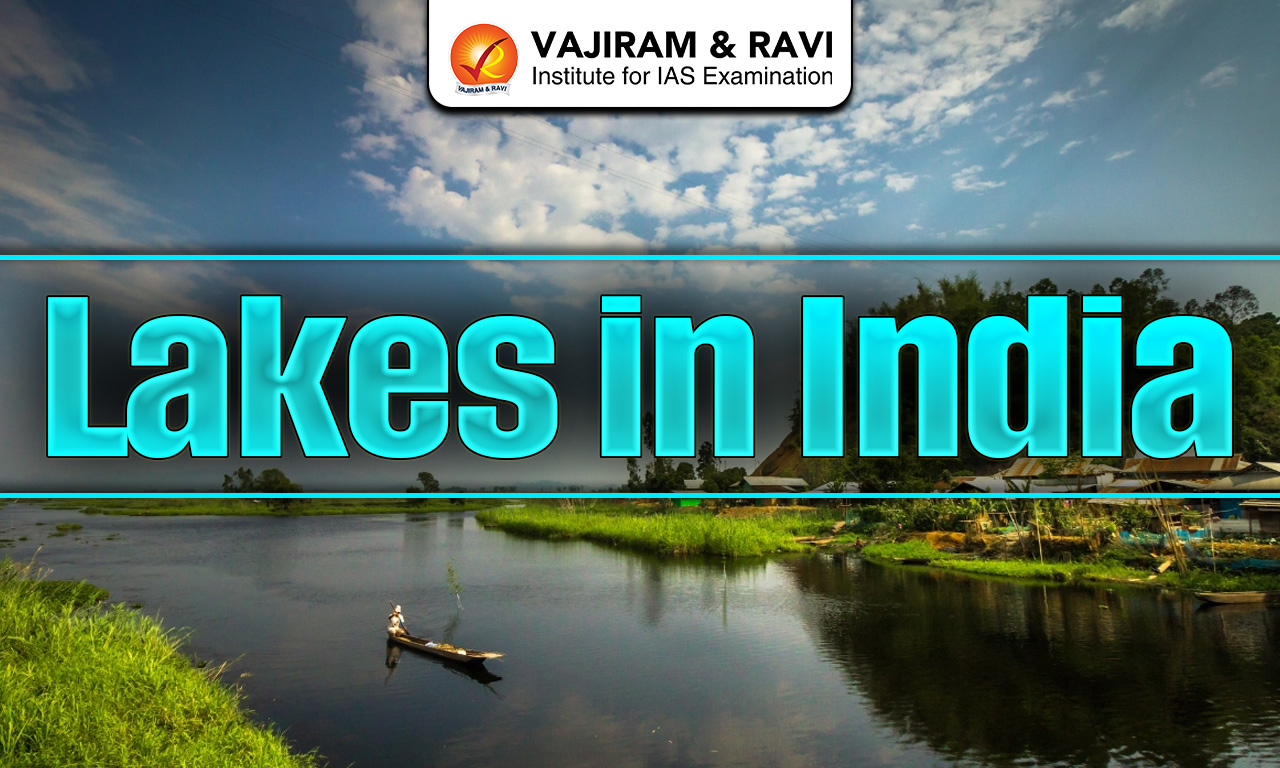
Lakes are important natural water bodies found across India, playing a crucial role in ecology, climate regulation, agriculture, and human life. India has a wide variety of lakes due to its diverse geography, from the Himalayas to coastal plains and plateaus. These lakes differ in origin, size, water type, and usage.
This article provides a clear insight into Important Lakes in India, including their types, formation, distribution, and significance.
What is a Lake?
A lake is a large natural body of water surrounded by land. It can contain either freshwater or saltwater and is usually bigger and deeper than a pond. Lakes are formed by natural processes like tectonic movements, glaciers, or river changes, and some are also man-made. They serve as an important source of water, support wildlife, and help maintain the environment.
Types of Lakes in India
Lakes in India are classified based on their origin and physical characteristics, which explain how they were formed. Each type of lake has distinct features and is found in specific geographical regions of the country.
1. Tectonic Lakes
- Formed due to movements of the Earth’s crust such as faulting, folding, or subsidence, creating large depressions
- Generally deep, elongated, and stable water bodies with long geological history
- Mostly located in tectonically active regions like the Himalayas
- Water is usually freshwater, but depth and clarity vary
- Important for irrigation, fisheries, and local climate regulation
- Example: Wular Lake
2. Glacial Lakes
- Formed by the melting of glaciers that carve out basins or leave behind depressions (cirques and moraines)
- Found at high altitudes in the Himalayan region and often surrounded by snow-covered peaks
- Water is cold, clear, and mainly freshwater
- Many are seasonal and depend on glacial melt; some pose risks of Glacial Lake Outburst Floods (GLOFs)
- Important for freshwater supply and scientific study of climate change
- Examples: Dal Lake, Pangong Lake
3. Oxbow Lakes
- Formed when a meandering river cuts off a loop, leaving behind a crescent-shaped water body
- Common in floodplains where rivers frequently change course
- Usually shallow and may dry up over time due to silt deposition
- Rich in nutrients, making them suitable for agriculture and fishing nearby
- Often seen along major river systems
- Example: Oxbow lakes along the Ganga River plains
4. Lagoon (Coastal) Lakes
- Formed when sandbars, spits, or barrier beaches separate a portion of seawater from the ocean
- Typically shallow and contain brackish water (mix of fresh and saltwater)
- Influenced by tides and seasonal freshwater inflow from rivers
- Support rich biodiversity including migratory birds and marine species
- Important for fisheries, salt production, and tourism
- Examples: Chilika Lake, Pulicat Lake
5. Saltwater Lakes
- Formed in inland basins where water evaporates faster than it drains, leaving salts behind
- Found mainly in arid and semi-arid regions like Rajasthan
- High salinity limits biodiversity but supports salt-tolerant organisms
- Economically important for salt extraction and mineral resources
- Water is not suitable for drinking or irrigation
- Example: Sambhar Lake
6. Freshwater Lakes
- Contain low levels of dissolved salts and are suitable for human consumption and agriculture
- Can be formed by various processes such as tectonic activity, glacial action, or river systems
- Support diverse aquatic life including fish, plants, and birds
- Serve as major sources of drinking water, irrigation, and hydroelectric power
- Widely distributed across India in hills, plains, and plateaus
- Example: Bhimtal Lake
7. Artificial (Man-made) Lakes
- Created by constructing dams across rivers to store water
- Used for irrigation, hydroelectric power generation, flood control, and drinking water supply
- Usually large reservoirs with controlled water levels
- Play a key role in regional development and agriculture
- Also support fisheries and tourism activities
- Examples: Gobind Sagar Lake, Nagarjuna Sagar Lake
8. Crater/Volcanic Lakes
- Formed in volcanic craters or depressions created by meteorite impacts
- Usually circular in shape with steep sides
- Rare in India but scientifically significant for geological studies
- Water may contain unique minerals and chemical properties
- Provide insights into Earth’s geological history
- Example: Lonar Lake


Distribution of Lakes in India
The distribution of lakes in India reflects the country’s diverse physical geography, from the Himalayan mountains to coastal plains and arid deserts. Different regions have distinct types of lakes based on geological processes, climate, and river systems.
| Distribution of Lakes in India | ||||
|
Lake Name |
Type of Lake |
State/Region |
Associated River |
Significance |
|
Wular Lake |
Tectonic (Freshwater) |
Jammu & Kashmir |
One of the largest freshwater lakes; helps in flood control and supports fisheries |
|
|
Dal Lake |
Glacial (Freshwater) |
Jammu & Kashmir |
Jhelum River system |
Famous for tourism, houseboats, and floating gardens |
|
Pangong Lake |
Glacial (Saltwater) |
Ladakh |
No major river (endorheic basin) |
High-altitude lake; strategic and ecological importance |
|
Chilika Lake |
Lagoon (Brackish) |
Odisha |
Daya River (distributary of Mahanadi) |
Largest brackish water lake; major bird sanctuary and Ramsar site |
|
Pulicat Lake |
Lagoon (Brackish) |
Andhra Pradesh & Tamil Nadu |
Second-largest brackish water lake; important for fisheries and bird habitat |
|
|
Vembanad Lake |
Lagoon (Brackish) |
Kerala |
Periyar River |
Longest lake in India; supports backwater tourism and agriculture |
|
Sambhar Lake |
Saltwater Lake |
Rajasthan |
No river (inland drainage) |
Largest inland salt lake; major source of salt production |
|
Lonar Lake |
Crater Lake |
Maharashtra |
No river |
Formed by meteorite impact; unique geological and ecological site |
|
Kolleru Lake |
Freshwater Lake |
Andhra Pradesh |
Between Krishna & Godavari rivers |
Important wetland and bird sanctuary |
|
Loktak Lake |
Freshwater (Floating lake) |
Manipur |
Manipur River |
Famous for floating phumdis; supports Keibul Lamjao National Park |
|
Bhimtal Lake |
Freshwater Lake |
Uttarakhand |
Fed by small streams |
Important for tourism and drinking water supply |
|
Gobind Sagar Lake |
Artificial (Reservoir) |
Himachal Pradesh |
Sutlej River |
Created by Bhakra Dam; used for irrigation and hydropower |
|
Nagarjuna Sagar Lake |
Artificial (Reservoir) |
Telangana & Andhra Pradesh |
One of the largest man-made lakes; irrigation and power generation |
|
Importance of Lakes in India
- Freshwater Source: Lakes provide water for drinking, irrigation, and domestic use, especially in areas facing water scarcity
- Biodiversity Support: They act as habitats for fish, aquatic plants, and migratory birds, seen in Chilika Lake
- Climate Regulation: Lakes help maintain local temperature, humidity, and microclimate, reducing extreme weather conditions
- Flood Control: They store excess rainwater and reduce flood risks; reservoirs like Gobind Sagar Lake help regulate water flow
- Economic Benefits: Support fisheries, tourism, and livelihoods, generating income for local communities
- Hydropower Generation: Artificial lakes are used for electricity production, such as Nagarjuna Sagar Lake
- Cultural Significance: Many lakes have religious and cultural importance, like Pushkar Lake
- Groundwater Recharge: Lakes help in replenishing underground water levels, improving water availability in nearby regions
- Soil Conservation: They reduce soil erosion and surface runoff, helping maintain soil fertility
- Scientific Value: Lakes are useful for research in climate change, hydrology, and geology, with examples like Lonar Lake
Environmental Issues Related to Lakes in India
- Water Pollution: Discharge of untreated sewage, industrial effluents, and plastic waste degrades water quality and harms aquatic life, as seen in Dal Lake
- Eutrophication: Excess nutrients (nitrogen and phosphorus) from fertilizers and waste lead to algal blooms, reducing oxygen levels and killing fish
- Encroachment: Rapid urbanization and illegal construction shrink lake areas and disrupt natural drainage systems
- Siltation: Continuous deposition of sediments from soil erosion reduces lake depth and storage capacity, affecting water availability
- Invasive Species: Growth of non-native plants like water hyacinth disturbs aquatic ecosystems and blocks sunlight and oxygen
- Overexploitation of Resources: Excessive water extraction, fishing, and tourism activities disturb ecological balance
- Climate Change: Changing rainfall patterns and rising temperatures affect water levels, especially in high-altitude lakes like Pangong Lake
- Loss of Biodiversity: Pollution and habitat destruction lead to decline in fish species, birds, and aquatic plants, impacting ecosystems like Chilika Lake
- Salinization: Increased salt concentration due to evaporation and reduced freshwater inflow affects lakes such as Sambhar Lake
- Unplanned Tourism: Activities like boating, littering, and construction of resorts cause environmental degradation and disturb natural habitats
Conservation of Lakes in India
Conservation of lakes in India is essential to protect water resources, biodiversity, and ecological balance in the face of increasing pollution and urban pressure. The government has launched several initiatives and policies to restore and sustainably manage these vital water bodies.
- National Plan for Conservation of Aquatic Ecosystems (NPCA): Focuses on restoration, pollution control, and biodiversity conservation of lakes and wetlands, including sites like Dal Lake
- Wetlands (Conservation and Management) Rules, 2017: Provides a legal framework for protection, prohibits encroachment and industrial activities in notified wetlands
- National Lake Conservation Plan (NLCP): Aims at improving water quality, desilting, and sewage treatment in urban and semi-urban lakes
- Ramsar Convention Sites Protection: International recognition helps conserve ecologically important lakes like Chilika Lake
- Atal Mission for Rejuvenation and Urban Transformation (AMRUT): Supports urban water body rejuvenation, sewage management, and green spaces
- Swachh Bharat Mission: Reduces solid waste and sewage pollution entering lakes through sanitation improvements
- State-Level Lake Development Authorities: Bodies like Lake Development Authorities work on local conservation, monitoring, and restoration projects
- Community Participation: Encourages public awareness, local involvement, and sustainable practices to protect lakes
- Afforestation and Catchment Treatment: Plantation activities reduce soil erosion and siltation in lakes
- Pollution Control Measures: Establishment of sewage treatment plants (STPs) and strict regulation of industrial discharge

 Last updated on Oct, 2026
→ UPSC 2027 Notification will be released on 13 January 2027 at upsconline.nic.in.
→ Check Nobel Prize 2026 Winners List here.
→ Download PIB PRiSM Monthly Magazine 2026 here.
→ Check UPSC Monthly Current Affairs Magazine The Recitals here.
→ Check out the latest UPSC Syllabus here.
→ Download UPSC Model Answers for Mains 2026
→ UPSC Mains Question Paper 2026 is out now for Essay & GS Paper 1, 2, 3 & 4.
→ UPSC Calendar 2027 has been released.
→ Enroll in Vajiram & Ravi’s UPSC Mains Test Series 2027 for structured answer writing practice, expert evaluation, and exam-oriented feedback.
→ Join Vajiram & Ravi’s UPSC Mentorship Program 2027 for personalized guidance, strategy planning, and one-to-one support from experienced mentors.
→ Go through the UPSC Mains Previous Year Papers to enhance your preparation.
→ UPSC has released UPSC Toppers List 2025 with the Civil Services final result on its official website.
→ Also check Best UPSC Coaching in India
Lakes in India FAQs
Q1. Which is the largest lake in India?+
Q2. Which is the largest freshwater lake in India?+
Q3. Which is the largest saltwater lake in India?+
Q4. Which is the longest lake in India?+
Q5. What type of lake is Lonar Lake?+
Tags: geography geography notes lakes in india