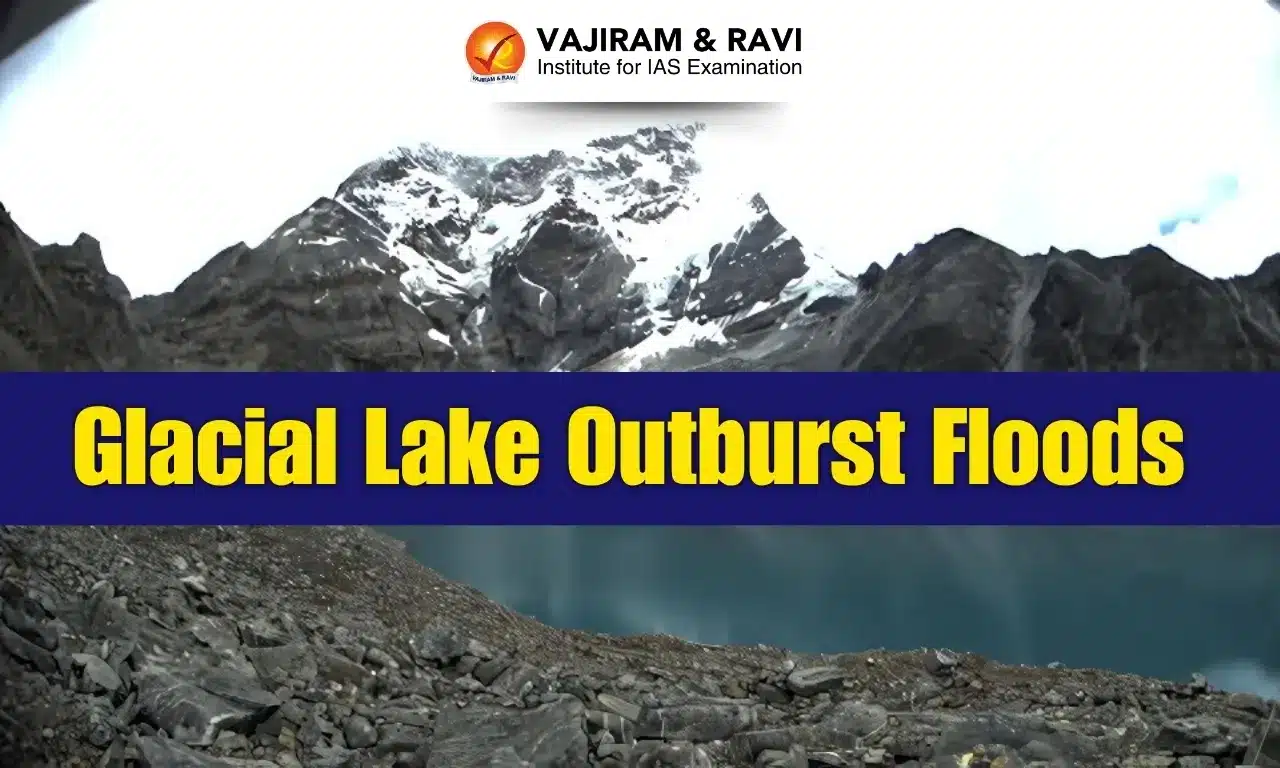
Glacial Lake Outburst Flood (GLOF) is a sudden and destructive flood caused by the failure of a glacial lake dam made of ice or moraine debris. Rapid glacier melting, climate change, earthquakes, avalanches and intense rainfall are increasing the frequency of such floods globally. A recent international study estimated that nearly 15 million people are exposed to GLOF threats, especially in High Mountain Asia and the Himalayan region, where vulnerable settlements, hydropower projects and transport infrastructure lie downstream of unstable glacial lakes.
What are Glacial Lakes?
Glacial lakes are formed by glacier erosion and accumulation of meltwater in depressions blocked by ice or moraine material.
- Formation Process: Glacial lakes form when retreating glaciers carve depressions through abrasion and glacial plucking, which later fill with meltwater. Moraine deposits and terminal moraines often act as natural barriers holding the water.
- Moraine-Dammed Lakes: Moraine-dammed lakes are highly unstable because their dams consist of loose rocks, sediments, sand and ice residue. South Lhonak Lake in Sikkim is a classic example of a moraine-dammed glacial lake.
- Glacier Retreat: Rapid glacier retreat due to warming temperatures has accelerated glacial lake formation across the Hindu Kush Himalaya. ICIMOD reported over 40% glacial mass loss in the region during the last four decades.
- Himalayan Expansion: Around 25 glacial lakes in the Himalayas have recorded increased water spread since 2009. India, Nepal and China together witnessed nearly 40% expansion in glacial lake surface area.
- Scale in India: ISRO identified more than 5,000 glacial lakes in the Indian Himalayan region. Many lakes are situated near densely populated river valleys and hydropower infrastructure, increasing disaster vulnerability.
- Global Exposure: Nearly 9.3 million people, representing about 62% of the globally exposed population, live in High Mountain Asia where glacial lakes continue expanding because of climate induced warming.
Glacial Lake Outburst Flood Causes
Glacial Lake Outburst Flood occurs because natural or human induced disturbances suddenly breach glacial lake boundaries and release enormous water discharge downstream.
- Climate Change: Rising temperatures are accelerating glacier retreat and increasing meltwater accumulation. The Himalayan region warmed by nearly 0.28°C per decade between 1951 and 2020, intensifying glacial lake formation and instability.
- Heavy Rainfall and Cloudbursts: Intense rainfall and cloudbursts weaken moraine dams and rapidly increase lake volume. A cloudburst can produce more than 10 cm rainfall within one hour over a limited mountainous area.
- Avalanches and Rockfalls: Ice avalanches, landslides and rockfalls entering glacial lakes create massive displacement waves capable of breaching weak moraine barriers. The 2021 Chamoli disaster was linked to an ice-rock avalanche.
- Earthquakes: Himalayan states fall within seismic zones IV and V where earthquakes frequently trigger landslides and destabilise moraine dams, increasing the possibility of sudden glacial lake failure and flash floods.
- Unstable Moraine Structure: Moraine dams are naturally weak because they consist of unconsolidated rocks, sediments and buried ice. Continuous melting reduces structural stability and increases chances of catastrophic breach formation.
- Rapid Water Accumulation: Sudden inflow from glacier melting, rainfall or snowmelt increases pressure on glacial lakes. Peak discharges during GLOFs have reached nearly 15,000 cubic metres per second in extreme events globally.
- Infrastructure Pressure: Unscientific road widening, tunnels, hydropower projects and excessive tourism increase ecological stress in fragile mountain regions, raising risks of slope instability, erosion and GLOF triggering events.


Glacial Lake Outburst Flood in India
India’s Himalayan region is among the world’s most vulnerable zones for Glacial Lake Outburst Flood because of expanding glacial lakes and increasing climate related disasters.
- Himalayan Vulnerability: The Himalayan states located along the Hindukush-Himalayan ranges face high GLOF risk because of rapid glacier retreat, unstable terrain, seismic activity and increasing human settlements downstream of glacial lakes.
- Eastern Himalaya Risk: Scientific studies indicate the Eastern Himalayas face nearly double the GLOF risk compared to the Western Himalayas because warmer temperatures accelerate glacier melting and glacial lake expansion more rapidly.
- South Lhonak Disaster: The South Lhonak Lake burst in Sikkim caused devastating floods in the Teesta basin, damaging Sikkim, Assam and West Bengal through sudden rise in river discharge after heavy rainfall and cloudburst activity.
- Human and Infrastructure Loss: The Sikkim GLOF caused more than 90 deaths, over 100 missing persons, destruction of 14 bridges and severe damage to the 1,200 MW Teesta III hydropower project at Chungthang.
- Displacement Impact: Nearly 2,563 people were shifted to 21 relief camps after the Sikkim disaster, showing how GLOFs cause sudden displacement and humanitarian emergencies in remote Himalayan regions.
- Chamoli Floods 2021: Flash floods in Uttarakhand’s Chamoli district were linked to glacier collapse and GLOF like conditions involving the Nanda Devi glacier system, severely damaging hydropower projects and settlements downstream.
- Kedarnath Floods 2013: The Chorabari Lake outburst combined with extreme rainfall caused massive flooding in the Mandakini basin, leading to more than 5,000 deaths and widespread destruction across Uttarakhand.
- Himachal Pradesh Threats: Gephang Gath Lake in Himachal Pradesh is considered highly vulnerable because of rapid expansion, permafrost melting and unstable surrounding topography capable of triggering future flash floods.
- Global Risk Ranking: India, Pakistan, Peru and China together account for more than half of the global population exposed to GLOF hazards, highlighting India’s major vulnerability in global mountain disaster assessments.
- Future Hotspots: ICIMOD studies reported formation of 203 new glacial lakes in northern Sikkim because of warming conditions, indicating that future GLOF hotspots may continue expanding westward across the Himalayas by 2050.
Glacial Lake Outburst Flood Impacts
Glacial Lake Outburst Flood creates severe environmental, economic and humanitarian damage because of their sudden onset and extreme flood discharge in mountain valleys.
- Loss of Lives: GLOFs move rapidly with little warning time, causing heavy casualties among downstream populations. Settlements located within 10–15 km of source lakes face the highest immediate danger during sudden breaches.
- Infrastructure Destruction: Floodwaters destroy bridges, roads, tunnels, hydropower stations and communication networks. The Teesta III hydropower project and multiple bridges were destroyed during the South Lhonak flood disaster.
- Agricultural Damage: Floods deposit debris, sediments and boulders over agricultural land, damaging horticulture and reducing soil productivity in mountain valleys dependent on farming and allied livelihoods.
- Economic Disruption: Tourism, transport, industries and local businesses suffer prolonged setbacks after GLOFs because damaged infrastructure interrupts economic activities and reduces visitor movement into mountain regions.
- Environmental Degradation: Glacial Lake Outburst Flood uproot forests, disturb river ecosystems, alter river chemistry and increase sedimentation. Floods also threaten biodiversity rich protected areas and ecologically sensitive Himalayan landscapes.
- Water Crisis: Flood contamination damages drinking water sources and creates shortages for affected populations. Sediment laden floodwaters also degrade water quality and aquatic ecosystems downstream.
- Energy Insecurity: Damage to hydropower projects creates regional electricity shortages and disrupts renewable energy generation in Himalayan states heavily dependent on river based hydropower infrastructure.
Glacial Lake Outburst Flood NDMA Guidelines
The National Disaster Management Authority has recommended scientific monitoring, preparedness and structural measures to reduce Glacial Lake Outburst Flood risks across Himalayan regions.
- Identification of Dangerous Lakes: NDMA recommends identifying high risk lakes through field observations, geomorphological studies, historical records, bathymetric surveys and geotechnical assessment of surrounding moraine structures and terrain conditions.
- Synthetic Aperture Radar Use: NDMA promotes Synthetic Aperture Radar imagery for automatic monitoring of glacial lakes, especially during monsoon months, to detect water spread changes and newly formed lakes in inaccessible regions.
- Controlled Water Reduction: The authority recommends reducing lake volume through controlled breaching, pumping, siphoning and tunnel construction beneath moraine dams to minimise sudden flood discharge during potential breaches.
- Early Warning Systems: NDMA emphasises installation of sensor based monitoring systems, automated weather stations and communication networks because existing operational Glacial Lake Outburst Flood Early Warning Systems remain extremely limited in the Himalayan region.
- Uniform Construction Codes: Infrastructure development in vulnerable mountain zones should follow scientific land use planning, environmental safeguards and regulated excavation practices to reduce ecological instability and disaster risks.
- Local Community Training: NDMA stresses training local communities because more than 80% of search and rescue operations in mountain disasters are initially carried out by residents before specialised teams arrive.
- Modern Alarm Systems: Smartphone alerts, mobile communication and digital warning systems should complement traditional siren based alarm infrastructure for rapid evacuation and emergency communication during flash flood situations.
Glacial Lake Outburst Flood Mitigation Measures
Effective mitigation requires combining scientific monitoring, engineering solutions, local preparedness and sustainable development practices in Himalayan ecosystems.
- Hazard Mapping: Detailed hazard zonation and glacial lake mapping using satellite imagery, field investigations and remote sensing help identify vulnerable river basins and downstream settlements facing high GLOF exposure.
- Lake Lowering Measures: Lowering water levels through siphoning, pumping and drainage channels reduces flood volume and pressure on moraine dams, thereby decreasing chances of catastrophic outburst floods.
- Structural Protection: Retention basins, diversion channels and reinforced moraine dams help reduce flood intensity. Peru successfully strengthened over 35 vulnerable glacial lakes using stone faced protective structures during recent decades.
- Remote Sensing Technology: Satellite monitoring, drones, SAR interferometry and Electrical Resistivity Tomography are increasingly used to monitor slope stability, lake expansion and buried ice beneath moraine dams.
- Community Preparedness: Mock drills, awareness campaigns and volunteer based local response systems improve evacuation efficiency and help remote Himalayan communities respond quickly during sudden flood emergencies.
- Sustainable Infrastructure: Scientific Environmental Impact Assessment and strict carrying capacity evaluation are necessary before approving hydropower projects, tunnels, highways and tourism infrastructure in fragile Himalayan regions.
- Cross Border Cooperation: Real time information sharing among India, Nepal, Bhutan and China is essential because glacial river systems and associated disaster risks frequently extend across national boundaries.
Glacial Lake Outburst Flood Government Initiatives
India has adopted a multi layered strategy involving scientific agencies, disaster authorities and technological monitoring systems to reduce Glacial Lake Outburst Flood related risks.
- National GLOF Risk Mitigation Programme: India launched a dedicated programme with nearly 20 million dollar allocation, initially covering 56 glacial lakes and later expanded to 195 lakes classified into four risk categories.
- NDMA Led Preventive Approach: The disaster management strategy has shifted from post disaster relief towards proactive mitigation involving hazard assessment, early warning systems and scientific monitoring of vulnerable Himalayan lakes.
- Automated Monitoring Systems: Automated Weather and Water Stations are being installed near vulnerable glacial lakes for real time hydrological monitoring and rapid dissemination of flood warnings to downstream communities.
- Research Initiatives: Programmes such as the National Mission for Sustaining the Himalayan Ecosystem support scientific research on glacier retreat, climate impacts and long term mountain ecosystem sustainability.
- Institutional Coordination: Multiple agencies including GSI, IMD, ISRO, DRDO, NRSA and Central Water Commission monitor glaciers, hydrology, avalanches, rainfall and remote sensing aspects related to GLOF management.
- Indigenous Technology Promotion: Experts recommended launching innovation based programmes under initiatives like Start up India to develop low cost sensors and monitoring systems suitable for extreme Himalayan conditions.
- Capacity Building Efforts: ITBP personnel, local volunteers and disaster response teams are being trained for emergency evacuation, manual warning dissemination and rescue operations in isolated mountain settlements vulnerable to GLOFs.

 Last updated on Oct, 2026
→ UPSC 2027 Notification will be released on 13 January 2027 at upsconline.nic.in.
→ Check Nobel Prize 2026 Winners List here.
→ Download PIB PRiSM Monthly Magazine 2026 here.
→ Check UPSC Monthly Current Affairs Magazine The Recitals here.
→ Check out the latest UPSC Syllabus here.
→ Download UPSC Model Answers for Mains 2026
→ UPSC Mains Question Paper 2026 is out now for Essay & GS Paper 1, 2, 3 & 4.
→ UPSC Calendar 2027 has been released.
→ Enroll in Vajiram & Ravi’s UPSC Mains Test Series 2027 for structured answer writing practice, expert evaluation, and exam-oriented feedback.
→ Join Vajiram & Ravi’s UPSC Mentorship Program 2027 for personalized guidance, strategy planning, and one-to-one support from experienced mentors.
→ Go through the UPSC Mains Previous Year Papers to enhance your preparation.
→ UPSC has released UPSC Toppers List 2025 with the Civil Services final result on its official website.
→ Also check Best UPSC Coaching in India
Glacial Lake Outburst Flood FAQs
Q1. What is Glacial Lake Outburst Flood (GLOF)?+
Q2. Which Indian states are most vulnerable to Glacial Lake Outburst Flood?+
Q3. What caused the South Lhonak Lake disaster in Sikkim?+
Q4. How does climate change increase Glacial Lake Outburst Flood risk?+
Q5. What measures has India taken to reduce Glacial Lake Outburst Flood risks?+
Tags: geography geography notes glacial lake outburst flood