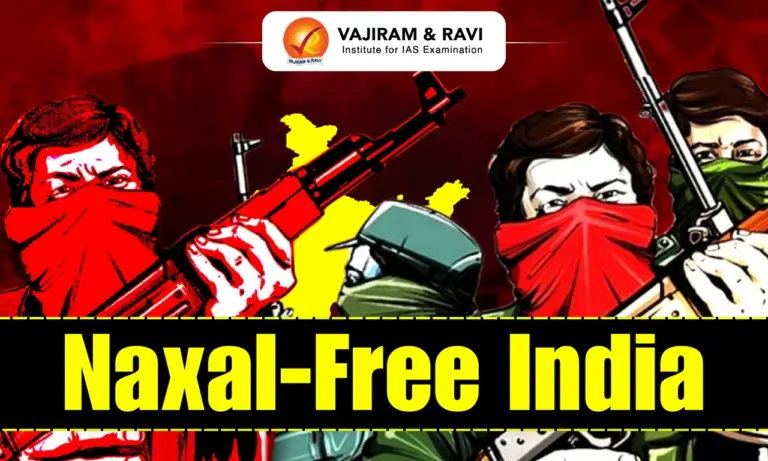
India’s emergence as a Naxal-free nation on 31 March 2026 marks a significant milestone in its internal security journey. It reflects the success of a comprehensive approach that combined effective security operations with development, better governance, tribal welfare and rehabilitation, helping transform regions once affected by Left-Wing Extremism (LWE) into active participants in India’s growth and development.
About Naxalism
Naxalism, officially referred to as Left-Wing Extremism (LWE), is an armed insurgency inspired by Maoist ideology that seeks to overthrow the Indian State through violent revolution. It originated from the Naxalbari uprising in West Bengal in 1967 and gradually spread across the tribal and forested regions of central and eastern India, popularly known as the Red Corridor, emerging as one of India’s most serious internal security challenges.
Naxalism Reasons
The spread of Naxalism or Left-Wing Extremism was driven by a combination of governance deficits, socio-economic deprivation and geographical isolation.
- Historical Underdevelopment: Tribal and remote regions remained deprived of quality education, healthcare, roads and other essential public services for decades.
- Economic Deprivation: Persistent poverty, unemployment and limited livelihood opportunities created fertile ground for extremist recruitment.
- Alienation of Tribal Communities: Inadequate protection of land and forest rights, displacement and weak participation in governance generated resentment among tribal populations.
- For example: Poor implementation of Forest Rights Act, 2006 generated resentment among tribal populations.
- Weak State Presence: Difficult terrain and limited administrative reach enabled extremist groups to establish parallel influence in several regions.
- Poor Infrastructure and Connectivity: Lack of roads, banking facilities, telecommunications and digital connectivity isolated communities from mainstream development.
- Ideological Radicalisation: Maoist groups exploited local grievances and propagated armed struggle as an alternative to democratic institutions.
- Governance Deficit: Weak implementation of welfare schemes and delayed access to justice reduced public confidence in the State.


Naxal-Free India
India became effectively Naxal-free on 31 March 2026 after nearly six decades of Left-Wing Extremism. It signifies that Naxal violence has been reduced to a negligible level, with the State regaining control and governance restored across almost all previously affected regions.
- Sharp Decline in Affected Districts: The number of LWE-affected districts declined from 126 in 2014 to just 0 in 2026, while the number of most-affected districts fell from 35 to zero.
- Major Reduction in Violence: Naxal-related incidents decreased from 870 in 2014 to 234 in 2025, indicating a significant weakening of extremist activities.
- Decline in Fatalities: Fatalities reduced from 310 in 2014 to 100 in 2025, compared to the peak of 1,005 deaths in 2010.
- Weakened Maoist Networks: Intelligence-led operations, stronger security coordination and rehabilitation policies considerably reduced the operational strength of Maoist groups.
- Improved Governance and Connectivity: Expansion of roads, mobile connectivity, banking and public services restored the State’s presence in previously affected regions.
- Greater Peace and Development: Improved law and order enabled better implementation of welfare programmes and accelerated socio-economic development in former Naxal-affected areas.
The Three Pillars of Naxal-Free India
Over the last twelve years, India’s strategy to eliminate Left-Wing Extremism was built on three interconnected pillars – Vishwaas, Nirman and Jan Kalyan. Together, these pillars combined security, development and welfare to address both the violence and the underlying causes of Naxalism.
Vishwaas (Restoring Faith in the State)
Vishwaas focused on restoring public confidence through stronger security, effective governance and community participation.
- National Policy and Action Plan (2015): Introduced a whole-of-government approach based on Dialogue, Security and Coordination, replacing the earlier fragmented response.
- Strengthened Security Grid: Constructed 597 fortified police stations, established 408 CAPF camps, built 68 night-landing helipads, and deployed 400 bullet-proof vehicles and five hospitals for security personnel.
- Specialised Security Forces: Integrated CoBRA, CRPF, District Reserve Guard (DRG), Special Task Forces (STF), Greyhounds and other elite units through joint operations and training.
- Technology-Based Operations: Used UAVs, drones, satellite imagery, AI-based intelligence, mobile-data analytics and social-media monitoring to improve surveillance and operational efficiency.
- Trace, Target, Neutralise Doctrine: Adopted an intelligence-led strategy to trace Maoist movements, target their strongholds and neutralise their operational networks through operations such as Operation Black Forest, Operation Double Bull, Operation Octopus, Operation Thunderstorm, Operation Bhimbarg and Operation Chakrabandha.
- Disrupting Financial Networks: Established a dedicated National Investigation Agency (NIA) vertical to target Naxal financing, supported by action from the Enforcement Directorate and State agencies.
- As of December 2025, the NIA had seized assets worth over ₹40 crore. The Enforcement Directorate (ED) attached assets worth ₹12 crore.
- Red Carpet for Surrender: Encouraged Naxal cadres to surrender by providing financial assistance (₹5 lakh for higher-ranked cadres and ₹2.5 lakh for others), a ₹10,000 monthly stipend for 36 months, incentives for depositing weapons, and rehabilitation and livelihood support to facilitate their reintegration into mainstream society.
Nirman (Building Infrastructure and Connectivity)
Nirman focused on improving connectivity, expanding governance and creating economic opportunities in formerly affected regions.
- Road Connectivity: Constructed over 12,249 km of roads and approved projects covering 17,319 km under LWE-specific connectivity schemes.
- Digital Connectivity: Installed more than 9,600 mobile towers, extending mobile coverage to 96% of villages in the most affected areas.
- Financial Inclusion: Expanded banking infrastructure through 1,804 bank branches, 1,321 ATMs, 74,720 banking correspondents and 6,025 post offices.
- Education Infrastructure: Sanctioned 259 Eklavya Model Residential Schools, with 179 schools developed, to improve educational access for tribal children.
- Skill Development: Established 46 Industrial Training Institutes (ITIs) and 49 Skill Development Centres, providing training to over 90,000 youth and women.
- Community Outreach: Implemented Civic Action Programmes, Tribal Youth Exchange Programmes and the Media Plan Scheme to strengthen engagement between communities and the State.
Jan Kalyan (People’s Welfare and Dignity)
Jan Kalyan ensured that peace was sustained through inclusive welfare, tribal empowerment and long-term socio-economic development.
- Rehabilitation of Surrendered Cadres: Supported reintegration through skill development, livelihood assistance, self-employment support and housing under Pradhan Mantri Awas Yojana (PMAY), while providing free education up to Class XII for their children.
- Special Central Assistance (SCA): Funded critical infrastructure and development projects in the most affected districts.
- Aspirational Districts Programme: Improved outcomes in health, education, financial inclusion, infrastructure and governance through convergence of welfare schemes.
- PM-JANMAN: Enhanced access to housing, drinking water, healthcare, education and connectivity for Particularly Vulnerable Tribal Groups (PVTGs).
- Dharti Aaba Janjatiya Gram Utkarsh Abhiyan: Reduced infrastructure gaps and expanded development opportunities in tribal villages through coordinated interventions across multiple ministries.
- Strengthening Tribal Livelihoods: Improved access to education, healthcare, housing, livelihoods and democratic institutions, helping integrate tribal communities into the mainstream development process.
Case Study: Bastar’s Transformation
Bastar in Chhattisgarh was once one of India’s most Naxal-affected regions because of poor connectivity, weak governance and difficult terrain. Over the last twelve years, it has witnessed significant transformation through a strategy combining security, development and tribal participation.
- The Bastariya Battalion (2017), comprising many local tribal youth, improved security and strengthened trust between communities and the administration.
- More than 3,240 km of roads and 889 mobile towers connected remote villages with schools, healthcare, markets and government services.
- Around 3,000 surrendered Naxalites were supported through rehabilitation, skill development and livelihood programmes.
- In 2026, the Shaheed Veer Gunda Dhur Seva Dera initiative began converting around 70 CAPF camps into centres providing healthcare, banking, agricultural support and welfare services.
- Cultural initiatives such as Bastar Pandum and the Bastar Olympics also promoted tribal identity and community participation.
Bastar’s experience shows that security combined with development, welfare and community empowerment can successfully transform conflict-affected regions.
Naxal-Free India Significance
The elimination of Left-Wing Extremism represents not only a major internal security achievement but also a significant milestone in India’s democratic and developmental journey.
- Strengthens Internal Security: Eliminates one of India’s longest-running internal security challenges and enhances national stability.
- Deepens Democratic Governance: Restores the authority of constitutional institutions and expands the reach of democratic governance.
- Promotes Inclusive Development: Enables infrastructure, welfare programmes and public services to reach previously inaccessible tribal regions.
- Empowers Tribal Communities: Improves education, healthcare, livelihoods and financial inclusion while strengthening tribal participation in governance.
- Boosts Economic Growth: Better connectivity encourages investment, agriculture, mining, tourism and local entrepreneurship.
- Strengthens Cooperative Federalism: Demonstrates the effectiveness of coordinated action between the Union Government and State Governments.
- Advances National Integration: Integrates remote regions mor closely into India’s social, economic and political mainstream.
Naxal Free India Challenges
Despite major progress, sustaining a Naxal-Free India requires addressing the underlying socio-economic issues in vulnerable regions.
- Preventing Revival: Residual extremist elements and sleeper networks may attempt to regain influence in isolated areas.
- Sustaining Development: Continued delivery of infrastructure, livelihoods and public services is necessary to prevent the re-emergence of grievances.
- Tribal Rights Protection: Effective implementation of land, forest and rehabilitation policies remains essential for maintaining public trust.
- Administrative Capacity: Strengthening governance and ensuring regular service delivery in remote areas continues to be a challenge.
- Rehabilitation of Former Cadres: Long-term livelihood opportunities and social reintegration are required for surrendered extremists.
Way Forward
The long-term success of Naxal-Free India depends on consolidating security gains with inclusive and sustainable development.
- Strengthen the Vishwaas-Nirman-Jan Kalyan approach through continued coordination between security, development and welfare initiatives.
- Expand livelihood and skill-development opportunities for tribal youth to reduce the risk of extremist recruitment.
- Ensure effective implementation of tribal welfare and forest rights programmes to strengthen confidence in democratic institutions.
- Improve last-mile governance through better healthcare, education, banking, digital connectivity and public service delivery.
- Sustain intelligence-led security operations while promoting community participation and rehabilitation to prevent the resurgence of Left-Wing Extremism.
India’s journey to becoming Naxal-free demonstrates that lasting internal security is achieved not merely through force, but by combining effective policing with development, good governance, rehabilitation and the empowerment of local communities.

 Last updated on Oct, 2026
→ UPSC 2027 Notification will be released on 13 January 2027 at upsconline.nic.in.
→ Check Nobel Prize 2026 Winners List here.
→ Download PIB PRiSM Monthly Magazine 2026 here.
→ Check UPSC Monthly Current Affairs Magazine The Recitals here.
→ Check out the latest UPSC Syllabus here.
→ Download UPSC Model Answers for Mains 2026
→ UPSC Mains Question Paper 2026 is out now for Essay & GS Paper 1, 2, 3 & 4.
→ UPSC Calendar 2027 has been released.
→ Enroll in Vajiram & Ravi’s UPSC Mains Test Series 2027 for structured answer writing practice, expert evaluation, and exam-oriented feedback.
→ Join Vajiram & Ravi’s UPSC Mentorship Program 2027 for personalized guidance, strategy planning, and one-to-one support from experienced mentors.
→ Go through the UPSC Mains Previous Year Papers to enhance your preparation.
→ UPSC has released UPSC Toppers List 2025 with the Civil Services final result on its official website.
→ Also check Best UPSC Coaching in India
Naxal-Free India FAQs
Q1. What is Naxal-Free India?+
Q2. What is Left-Wing Extremism (LWE)?+
Q3. How was Naxal-Free India achieved?+
Q4. Why is Naxal-Free India significant for India?+
Q5. What are the key challenges after achieving Naxal-Free India?+
Tags: naxal free india