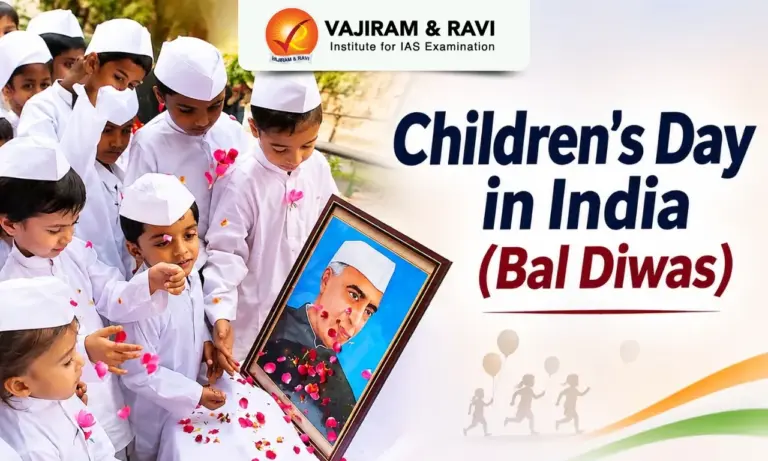
Children’s Day in India 2026 will be celebrated on 14 November to honour childhood and recognise the importance of children’s rights, education and welfare. The occasion also commemorates the Birth Anniversary of Pandit Jawaharlal Nehru. He was India’s first Prime Minister and popularly known as Chacha Nehru.
Children’s Day in India 2026
Children’s Day in India 2026, also known as Bal Diwas 2026, will fall on Saturday, 14 November. The day highlights the importance of quality education, healthcare, nutrition, child protection and equal opportunities for the overall development of every child.
Bal Diwas History
The history of Children’s Day in India is closely associated with Jawaharlal Nehru and his affection for children.
- Earlier Observance: Before 1964, India observed Children’s Day on 20 November, following the date of Universal Children’s Day recognised by the United Nations.
- Association with Nehru: Pandit Jawaharlal Nehru’s birthday, 14 November 1889, became significant because of his affection for children and his vision of empowering young generations.
- Change of Date: Following Nehru’s death in 1964, the Indian Parliament decided to observe Children’s Day on his birth anniversary instead of 20 November.
- Beginning of Celebration: India had started celebrating Children’s Day on Nehru’s birth anniversary in 1957, recognising his special connection with children.


Pandit Jawahar Lal Nehru Jayanti 2026
Pandit Jawahar Lal Nehru Jayanti 2026 will be observed on 14 November, marking his 137th Birth Anniversary. Nehru served as India’s first Prime Minister from 1947 to 1964. His birthday is celebrated as Children’s Day to remember his affection for children and commitment to education. He believed children were the foundation of the nation’s future and can be seen in his famous quote- “The children of today will make the India of tomorrow. The way we bring them up will determine the future of the country.”
Pandit Jawahar Lal Nehru Biography
Pandit Jawaharlal Nehru was an important leader of India’s freedom struggle and the first Prime Minister of independent India.
- Birth: Jawaharlal Nehru was born on 14 November 1889 in Allahabad, in an influential Kashmiri Pandit family.
- Parents: His father, Motilal Nehru, was a prominent barrister and served twice as President of the Indian National Congress.
- Education: He studied at Harrow School, Trinity College, Cambridge and the Inner Temple in London, where he pursued law.
- Freedom Struggle: He participated in major movements, including the Non Cooperation Movement, Civil Disobedience Movement and Quit India Movement.
- Congress Presidency: He became Congress President at the 1929 Lahore Session, where the Purna Swaraj resolution was adopted.
- Prime Minister: Nehru became India’s first Prime Minister in 1947 and served until his death on 27 May 1964.
Pandit Jawahar Lal Nehru Contributions
Jawaharlal Nehru contributed to India’s political, economic, educational and international development through several important initiatives.
- Industrial Development: He promoted heavy industries, including steel, iron, coal and power, to strengthen India’s industrial foundation and encourage economic self reliance.
- Educational Institutions: His government established important institutions such as IITs, AIIMS, IIMs and NITs to advance higher education, science and technical learning.
- Economic Planning: He supported a mixed economy in which public and private sectors worked together to promote industrial growth and economic development.
- Foreign Policy: He introduced the policy of Non Alignment, allowing India to maintain an independent position during the Cold War.
- Democratic Values: He supported secularism, democracy and social justice while helping establish the institutional foundations of independent India.
- Literary Contributions: His notable books include The Discovery of India, An Autobiography, Glimpses of World History and Letters from a Father to His Daughter.
Also Read:- Important Days in November 2026
Status of Children in India 2026
The Status of Children in India reflects improvements in health, education and nutrition, although social and economic inequalities continue to affect their overall development and protection.
- Child Population: According to UNICEF, India has nearly 253 million adolescents aged 10-19 years, representing every fifth person in this age group, making adolescent welfare important for future human capital development.
- Infant Mortality: India’s Infant Mortality Rate (IMR) declined to 25 deaths per 1,000 live births, compared with 44 in 2011, indicating improvements in maternal and child healthcare.
- Immunisation Coverage: Full immunisation coverage increased from 83.8% to 87.1%, while over 95.6% of children received vaccinations through public healthcare facilities, strengthening preventive healthcare.
- Nutritional Challenges: Malnutrition remains a concern, particularly among disadvantaged communities. However, stunting has declined by 17% and severe wasting by 32%, supported by targeted nutritional interventions.
- Educational Development: School dropout rates declined to 1.8% at the preparatory stage and 7% at the secondary stage, reflecting improvements in school participation and retention.
- Child Marriage: Child marriage remains a concern, particularly for adolescent girls. The percentage of women aged 20-24 married before 18 declined from 26.8% to 23.3%.
- Social Inequalities: Children from rural areas, urban slums, Scheduled Castes, tribal communities and economically weaker households face multiple disadvantages, including inadequate sanitation, healthcare, nutrition and educational opportunities.
Government Initiatives for Children in India
- POSHAN Abhiyaan: Launched on 8 March 2018, this national nutrition mission addresses malnutrition through technology, community participation and coordination among departments. It was subsequently integrated into Mission Poshan 2.0.
- Mission Saksham Anganwadi and Poshan 2.0: This integrated programme supports nutritional requirements, early childhood care, education and adolescent welfare while upgrading Anganwadi infrastructure through improved facilities and learning resources.
- Poshan Tracker: Launched in March 2021, this digital platform monitors nutrition services, beneficiary coverage and child growth. By May 2026, it covered all 28 States and 8 Union Territories, registering over 8.93 crore beneficiaries.
- Nutrition Monitoring: By May 2026, Poshan Tracker monitored nutritional indicators for over 7.7 crore children and enabled growth assessment of more than 6.3 crore children aged 0-5 years.
- Supplementary Nutrition: Under the Supplementary Nutrition Programme, over 5.5 crore beneficiaries received nutritional support for at least 15 days, while 5.17 crore received it for at least 21 days in May 2026.
- PM POSHAN Scheme: This programme strengthens school nutrition and attendance by providing hot cooked meals to over 11.20 crore students, supporting nutritional well being and educational participation.
- Child Protection: The National Commission for Protection of Child Rights (NCPCR) conducts coordinated rescue and rehabilitation initiatives against hazardous child labour and exploitation, while legal adoption numbers have also shown consistent growth.

 Last updated on Nov, 2026
→ UPSC 2027 Notification will be released on 13 January 2027 at upsconline.nic.in.
→ Check Nobel Prize 2026 Winners List here.
→ Download PIB PRiSM Monthly Magazine 2026 here.
→ Check UPSC Monthly Current Affairs Magazine The Recitals here.
→ Check out the latest UPSC Syllabus here.
→ Download UPSC Model Answers for Mains 2026
→ UPSC Mains Question Paper 2026 is out now for Essay & GS Paper 1, 2, 3 & 4.
→ UPSC Calendar 2027 has been released.
→ Enroll in Vajiram & Ravi’s UPSC Mains Test Series 2027 for structured answer writing practice, expert evaluation, and exam-oriented feedback.
→ Join Vajiram & Ravi’s UPSC Mentorship Program 2027 for personalized guidance, strategy planning, and one-to-one support from experienced mentors.
→ Go through the UPSC Mains Previous Year Papers to enhance your preparation.
→ UPSC has released UPSC Toppers List 2025 with the Civil Services final result on its official website.
→ Also check Best UPSC Coaching in India
Children's Day in India 2026 FAQs
Q1. Why is Children's Day Celebrated in India?+
Q2. When is Children’s Day Celebrated in India?+
Q3. What is Bal Diwas 2026 and when will it be celebrated?+
Q4. Why was Jawaharlal Nehru called Chacha Nehru?+
Q5. What is the difference between Children's Day in India and World Children's Day?+
Tags: children's day children's day in india children's day in india 2026