Gorge Landform refers to a deep, narrow valley with steep, rocky sides, generally formed by river erosion. Gorges are important erosional landforms that develop through the gradual cutting of rocks by rivers, often aided by geological uplift and glacial activity. In India, several prominent Gorges occur along Himalayan and Peninsular rivers, influencing drainage patterns and regional physical geography.
What are Gorge Landforms?
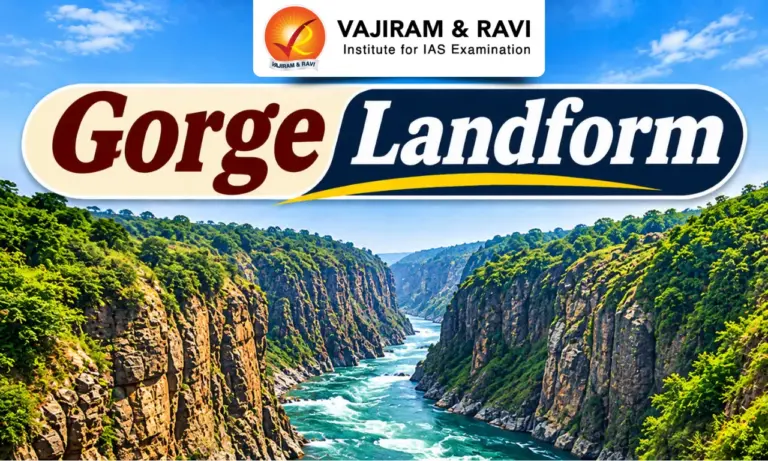
A Gorge is a narrow, deep valley situated between hills or mountains, characterised by steep or nearly vertical sides. It generally develops when a river cuts through resistant rock formations over time. Gorges are usually narrower than canyons and commonly have rivers flowing along their floors.
Gorge Landform Features
Gorges have distinct physical characteristics that help identify their formation, geographical distribution and relationship with river erosion.
- Narrow and Deep Structure: Gorges are deep valleys with steep, rocky walls and a relatively narrow width, often remaining almost equal in width at the top and bottom.
- River Association: Most Gorges develop along existing or former river courses, where continuous water flow gradually cuts through underlying rock formations.
- Resistant Rock Formation: They commonly develop in hard rock regions, where prolonged erosion creates deep channels with steep sides.
- Steep Escarpments: Their sides are generally steep or nearly vertical, distinguishing them from ordinary valleys with gentler slopes.
- Geographical Distribution: Gorges occur between mountain ranges, hills and elevated plateaus. They are also found in regions influenced by geological uplift and glacial activity.
- Exposure of Rock Layers: Deep river cutting exposes older geological formations, making Gorges important locations for understanding the geological history of an area.


How are Gorges Formed?
Gorges develop through different natural processes, mainly involving river erosion, vertical uplift and glacial activity, which gradually deepen and shape valleys.
- River Erosion: Continuous river flow erodes the underlying rocks and carries away sediments. Over long periods, this downward cutting creates deep, narrow valleys with steep sides.
- Geological Uplift: The upward movement of the Earth’s surface increases the gradient of rivers, encouraging vertical erosion. Himalayan rivers cut deep Gorges as the mountains gradually rise.
- Waterfall Erosion: Geological uplift can create waterfalls along river courses. Their continuous erosive action weakens underlying rocks and may cause the riverbed to collapse, forming a Gorge.
- Glacial Activity: Moving glaciers carve deep valleys into the landscape. When glaciers melt or retreat, the resulting steep sided valleys become exposed.
- Flooding and Weathering: Floods increase the erosive power of rivers, while weathering weakens exposed rocks. Together, these processes contribute to the widening and deepening of Gorges.
- Underground Cave Collapse: The erosion of underground limestone formations can weaken cave structures. Their eventual collapse may produce deep surface depressions and Gorge like landforms.
Gorge Landform Examples
Several prominent examples of Gorges occur across the world, while India has important river Gorges associated with Himalayan and Peninsular drainage systems.
- Narmada Gorge, Madhya Pradesh: Located near Jabalpur, the Narmada flows through the Marble Rocks, forming a deep and narrow Gorge associated with Dhuandhar Falls.
- Satkosia Gorge, Odisha: Formed by the Mahanadi cutting through the Eastern Ghats near Tikarpara, this Gorge extends for approximately 22 km and forms part of the Satkosia Tiger Reserve.
- Papi Hills Gorge, Andhra Pradesh: The Godavari forms a narrow Gorge of approximately 60 km while passing through the Eastern Ghats, creating an important geographical feature known as Papikondalu.
- Indus Gorge, Ladakh (Gilgit Baltistan, PoK): The Indus River cuts through the Himalayan mountain region, forming a remarkably deep Gorge near Bunji, north of Nanga Parbat.
- Chenab Gorge, Jammu and Kashmir: The Chenab River flows through deep mountainous terrain, forming a Gorge reaching depths of approximately 1,000 metres near Kishtwar.
- Dihang Gorge, Arunachal Pradesh: The Dihang, the upper course of the Brahmaputra, cuts through the Eastern Himalayas below Namcha Barwa, forming one of the deepest river Gorges, the Yarlung Tsangpo / Dihang Gorge System.
Difference Between Gorges and Canyons
Gorges and Canyons are deep erosional valleys, but they differ in their typical shape, width, geological setting and formation characteristics.
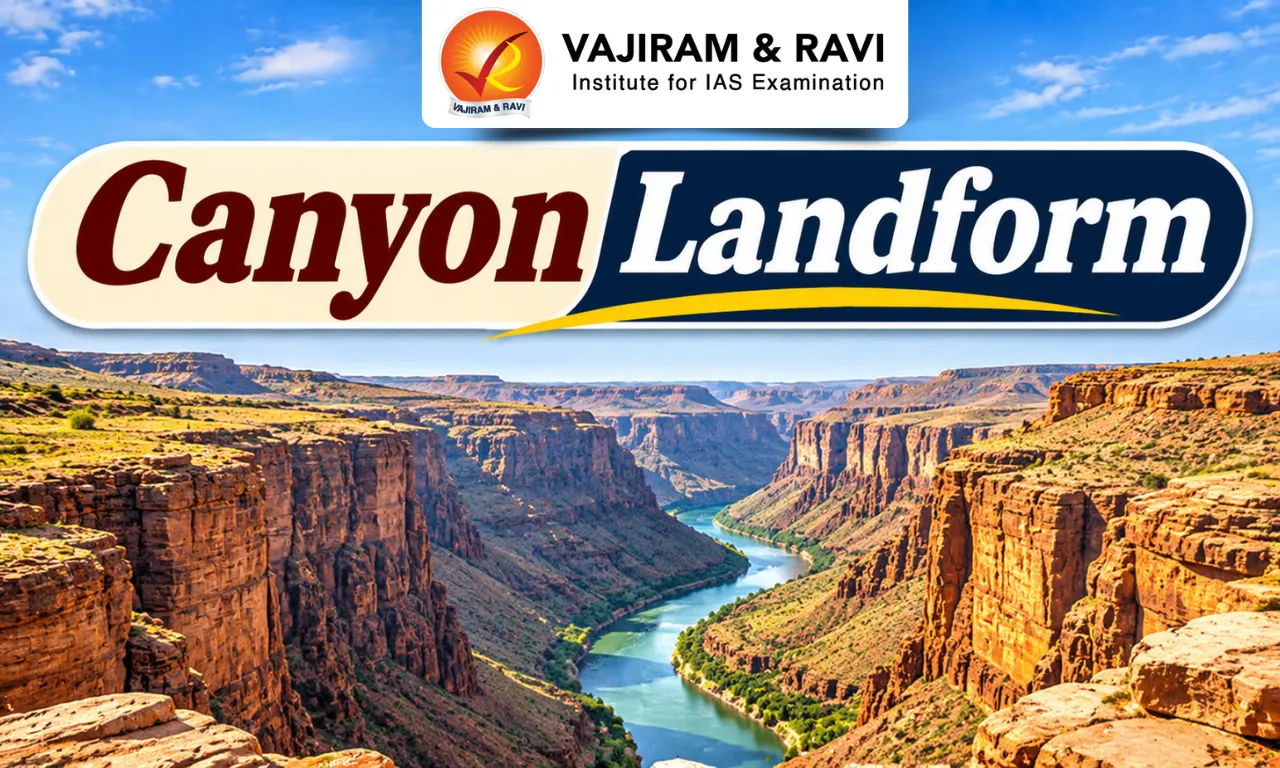
- Size and Width: Gorges are generally narrower and smaller, whereas canyons are usually larger and wider, although both can reach considerable depths.
- Shape: Gorges generally have steep or nearly straight sides with relatively similar widths at the top and bottom. Canyons commonly have step like sides and wider upper sections.
- Rock Formation: Gorges commonly develop in resistant rock formations, whereas canyons are frequently associated with horizontally layered sedimentary rocks.
- Geographical Setting: Gorges are commonly found between hills and mountain ranges, while canyons are particularly prominent in arid regions and elevated plateaus.
- Formation Process: Gorges are mainly associated with river erosion, geological uplift and glacial activity. Canyons commonly develop through prolonged erosion and weathering of elevated land surfaces.
- Indian Examples: The Narmada Gorge near Jabalpur, Madhya Pradesh, is a prominent Gorge, whereas Gandikota Canyon in Andhra Pradesh is a notable example of a canyon.
Gorges UPSC CSE PYQ
When you travel in Himalayas, you will see the following:
- Deep Gorges
- U turn river courses
- Parallel mountain ranges
- Steep gradients causing land sliding
Which of the above can be said to be the evidence for Himalayas being young fold mountains? [UPSC Prelims 2012]
(A) 1 and 2 only
(B) 1, 2 and 4 only
(C) 3 and 4 only
(D) 1, 2, 3 and 4
Answer (D) 1, 2, 3 and 4

 Last updated on Nov, 2026
→ UPSC Interview 2026 is scheduled from 7 December 2026 to 12 February 2027.
→ UPSC Interview Guidance Programme (IGP) 2026 by Vajiram & Ravi helps aspirants prepare confidently for the UPSC Personality Test.
→ UPSC DAF 2026 application form is available from 11 to 25 November 2026, till 6:00 PM.
→ UPSC 2027 Notification will be released on 13 January 2027 at upsconline.nic.in.
→ Download PIB PRiSM Monthly Magazine 2026 here.
→ Check UPSC Monthly Current Affairs Magazine The Recitals here.
→ Check out the latest UPSC Syllabus here.
→ UPSC Calendar 2027 has been released.
→ Enroll in Vajiram & Ravi’s UPSC Mains Test Series 2027 for structured answer writing practice, expert evaluation, and exam-oriented feedback.
→ Join Vajiram & Ravi’s UPSC Mentorship Program 2027 for personalized guidance, strategy planning, and one-to-one support from experienced mentors.
→ Go through the UPSC Mains Previous Year Papers to enhance your preparation.
→ UPSC has released UPSC Toppers List 2025 with the Civil Services final result on its official website.
→ Also check Best UPSC Coaching in India
Gorge Landform FAQs
Q1. What is a Gorge Landform?+
Q2. How are Gorges formed?+
Q3. What is the difference between a Gorge and a Canyon?+
Q4. What are the important Gorges in India?+
Q5. Which river forms the Satkosia Gorge and the Narmada Gorge?+
Tags: gorge landform