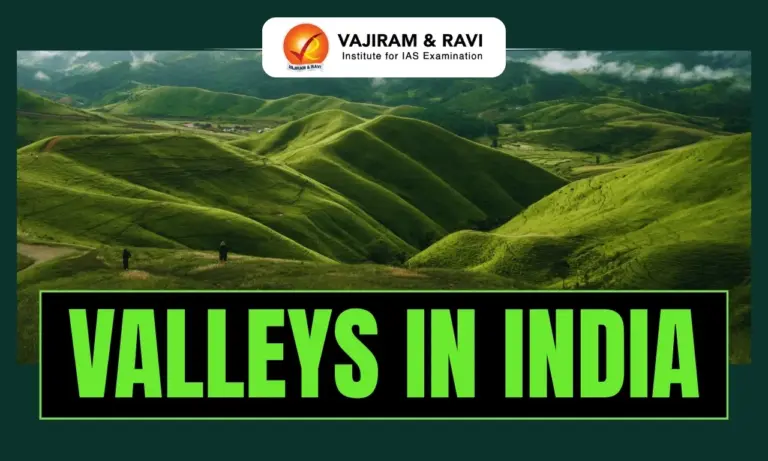
Valleys in India are important physical features formed mainly through river erosion, glacial action and tectonic movements. They occur across the Himalayas, Northeast India, Peninsular India and plateau regions. Major examples include Kashmir Valley, Spiti Valley, Kangra Valley, Narmada Valley, Brahmaputra Valley, Zanskar Valley and Valley of Flowers. Their origin, drainage, relief and geological setting make them important geographical features.
What are Valleys?
A Valley is an elongated low lying depression between hills or mountains, usually extending along a river or stream. Valleys are generally longer than their width. Their floors may contain river sediments, while their sides vary according to the processes that formed them. River Valleys commonly have V shaped profiles, whereas glacial Valleys generally have U shaped profiles. Rift Valleys develop mainly because of tectonic movements.
How are Valleys Formed?
Valleys in India develop over long geological periods through erosion, glaciation, tectonic activity and deposition. The process determines their shape, depth, drainage pattern and surrounding landforms.
- River Erosion: Flowing rivers gradually deepen and widen Valleys through corrasion, abrasion, pot holing, corrosion and weathering. Upper courses generally form steep V shaped Valleys, while lower courses become wider.
- Glacial Erosion: Moving glaciers erode mountain Valleys by abrasion and pressure. Glacial Valleys usually develop broad floors, steep sides and a characteristic U shaped cross section.
- Tectonic Activity: Some Valleys originate from movements within the Earth’s crust. Rift Valleys are mainly associated with crustal expansion and tectonic activity rather than prolonged surface erosion.
- Deposition and Sediments: Rivers transport and deposit sediments along Valley floors. Deposition becomes more important where river gradients decline, creating broader Valley floors and floodplains.
- Combined Processes: A Valley may develop through more than one process over geological time. River erosion, glacial action, tectonic uplift and weathering can collectively modify its final form.


Types of Valleys
Valleys are classified mainly according to their shape, geological origin and dominant erosional process. Their major forms include river, glacial, rift, hanging, box and trough shaped Valleys in India.
- V Shaped Valley: River erosion is strongest in the upper course, producing narrow Valleys with steep sides. Down cutting by flowing water is the dominant process.
- U Shaped Valley: Glaciers widen and deepen earlier river Valleys. The resulting Valley generally has steep sides and a broad, relatively flat floor.
- Rift Valley: Tectonic forces cause portions of the Earth’s crust to expand or move apart. This produces elongated depressions such as the Albertine Rift and Gregory Rift.
- Hanging Valley: A tributary Valley remains at a higher elevation than the main Valley. Glacial landscapes commonly contain waterfalls near the junction of both Valleys.
- Box Valley: Box Valleys have comparatively wide and level floors with steep sides. They commonly occur in periglacial areas and can also develop in tropical and arid regions.
- Trough Shaped Valley: Severe downslope denudation produces gently sloping sides and an indistinct transition between the Valley sides and floor. Such Valleys occur mainly in periglacial and tropical regions.
Important Valleys in India State Wise List
Valleys in India are associated with major rivers, mountain systems, glaciers and tectonic landscapes. Their distribution reflects the country’s varied geological and physiographic conditions. Some of the major important Valleys of India are listed below:
- Andhra Pradesh: Araku Valley, Godavari Valley, Visalakshi Nagar
- Arunachal Pradesh: Upper Dibang Valley, Lower Dibang Valley, Dihing Valley, Sangti Valley
- Assam: Barak Valley, Brahmaputra Valley
- Chhattisgarh: Mahanadi Valley
- Himachal Pradesh: Baspa Valley, Bhakra Nangal Valley, Chamba Valley, Gwass-Bagi Valley, Habban Valley, Joginder Nagar Valley, Kangra Valley, Kharahal Valley, Kullu Valley, Kunihar Valley, Lahaul Valley, Lug Valley, Pangi Valley, Parvati Valley, Pin Valley, Sangla Valley, Satluj Valley, Shiladesh, Solang Valley, Spiti Valley
- Jharkhand: Patratu Valley
- Jammu and Kashmir: Bangus Valley, Betaab Valley, Bhal Padri Valley, Breng Valley, Chenab Valley, Gurais Valley, Gurez Valley, Jai Valley, Kashmir Valley, Lidder Valley, Lolab Valley, Mushkoh Valley, Sind Valley, Tosa Maidan, Zoji La Valley
- Karnataka: Kaveri Valley, Krishna Valley
- Kerala: Silent Valley National Park
- Ladakh: Dah Hanu Valley, Markha Valley, Nubra Valley, Sham Valley, Suru Valley, Zanskar Valley
- Madhya Pradesh: Chambal Valley, Narmada Valley
- Maharashtra: Godavari Valley, Krishna Valley, Sandhan Valley
- Manipur: Imphal Valley, Kabaw Valley
- Mizoram: Tlawng Valley
- Nagaland: Dzüko Valley
- Odisha: Mahanadi Valley
- Sikkim: Chumbi Valley, Nathang Valley, Yumthang Valley
- Tamil Nadu: Cumbum Valley, Kambam Valley, Ketti Valley, Kaveri Valley
- Telangana: Godavari Valley, Krishna Valley, Nagarjunasagar
- Uttarakhand: Darma Valley, Doon Valley, Johar Valley, Kuthi Valley, Mandakini Valley, Pindar Valley, Saur Valley, Tons Valley, Valley of Flowers
- Uttar Pradesh: (no prominent mountain Valleys) River Valleys present- Belan Valley, Betwa River Valley
- West Bengal: Damodar Valley, Neora Valley
List of Top 10 Valleys in India 2026
The major Valleys in India listed below represent important Himalayan, northeastern and peninsular landscapes with distinctive geological, ecological and geographical characteristics.
- Dzüko Valley: Located between Manipur and Nagaland, Dzüko Valley is associated with the Dzüko and Japfu rivers. The Valley is particularly known for the rare Dzüko Lily.
- Tirthan Valley: Located in Himachal Pradesh at about 1,400 metres elevation, Tirthan Valley is associated with the Tirthan River and lies near the Great Himalayan National Park.
- Ziro Valley: Located in Arunachal Pradesh, Ziro Valley is associated with the Apatani tribe, pine forests and rice fields. It represents the distinctive geographical and cultural landscape of Northeast India.
- Spiti Valley: Located in Himachal Pradesh and extending towards Tibet, Spiti Valley is a high altitude cold desert landscape known for snow capped mountains, glaciers, lakes and monasteries.
- Valley of Flowers: Located in Chamoli district of Uttarakhand, this Himalayan Valley contains nearly 300 species of wildflowers. Snow leopards, Himalayan brown bears and blue sheep also occur here.
- Nubra Valley: Located in Ladakh, Nubra Valley develops around the confluence of the Shyok and Nubra rivers. Its cold desert landscape includes distinctive sand dunes and Bactrian camels.
- Kangra Valley: Located in Himachal Pradesh and surrounded by the Dhauladhar mountains, Kangra Valley contains rivers, forests and settlements. The Dhauladhar range rises to 15,956 feet.
- Kashmir Valley: Located between the Pir Panjal Range and Karakoram, Kashmir Valley contains major landscapes around Srinagar and is associated with lakes, rivers and surrounding mountain systems.
- Zanskar Valley: Located in the Ladakh region, Zanskar Valley is associated with the Zanskar River and reaches about 13,154 feet above sea level. Its landscape remains heavily influenced by mountain relief.
- Parvati Valley: Located in Himachal Pradesh, Parvati Valley extends from Bhuntar towards Spiti. The Parvati River is its major drainage feature, while pine forests cover substantial areas.

 Last updated on Oct, 2026
→ UPSC 2027 Notification will be released on 13 January 2027 at upsconline.nic.in.
→ Asian Games 2026 are being held in Aichi-Nagoya, Japan, from 19 September to 4 October.
→ Check Nobel Prize 2026 Winners List here.
→ Download PIB PRiSM Monthly Magazine 2026 here.
→ Check UPSC Monthly Current Affairs Magazine The Recitals here.
→ Check out the latest UPSC Syllabus here.
→ Download UPSC Model Answers for Mains 2026
→ UPSC Mains Question Paper 2026 is out now for Essay & GS Paper 1, 2, 3 & 4.
→ UPSC Calendar 2027 has been released.
→ Enroll in Vajiram & Ravi’s UPSC Mains Test Series 2027 for structured answer writing practice, expert evaluation, and exam-oriented feedback.
→ Join Vajiram & Ravi’s UPSC Mentorship Program 2027 for personalized guidance, strategy planning, and one-to-one support from experienced mentors.
→ Go through the UPSC Mains Previous Year Papers to enhance your preparation.
→ UPSC has released UPSC Toppers List 2025 with the Civil Services final result on its official website.
→ Also check Best UPSC Coaching in India
Valleys in India FAQs
Q1. What is a Valley?+
Q2. How are Valleys formed?+
Q3. Which is the most famous Valley in India?+
Q4. Which Indian Valley is formed by glaciers?+
Q5. What are the main types of Valleys?+
Tags: valleys valleys in india