


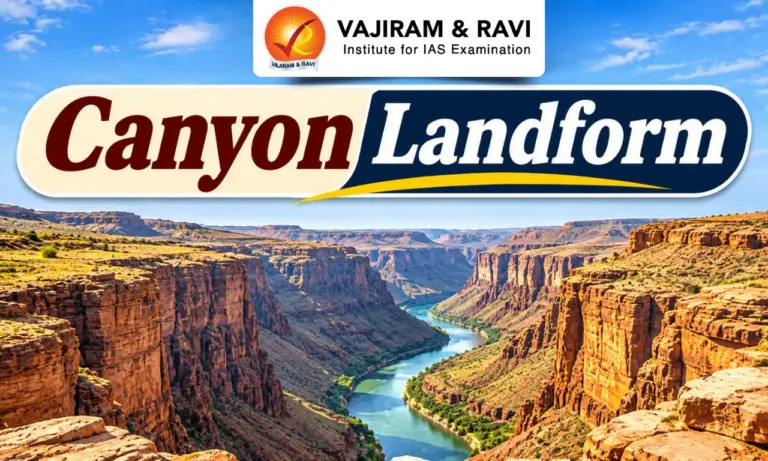
Canyon Landform is a deep, narrow valley with steep sides, generally formed by river erosion over millions of years. Canyons are important erosional landforms that develop in plateaus, mountains and areas of resistant rocks. Their formation involves running water, weathering, erosion and tectonic uplift, making them significant for understanding landscape evolution and physical geography.
What are Canyon Landforms?
A Canyon is a deep, steep sided valley, usually characterised by a wider upper portion and a relatively narrow bottom. It commonly develops when rivers cut through resistant rocks over long periods. Canyons are particularly common in elevated and relatively dry regions where powerful rivers cause continuous vertical erosion.
Canyon Landform Features
Canyons have distinct physical characteristics that distinguish them from ordinary river valleys and other erosional landforms.
- Steep Sides: Canyons have steep, often nearly vertical walls formed through prolonged erosion of underlying rocks by rivers and other weathering processes.
- Narrow Bottom: Their lower sections are generally narrower than the upper portions, creating a deep and elongated valley like structure.
- Greater Depth: Canyons can extend hundreds or thousands of metres below the surrounding landscape, depending on geological conditions and erosion.
- River Erosion: Most major Canyons develop through continuous river action, particularly vertical erosion in elevated regions.
- Rock Layers: Exposed rock strata along Canyon walls reveal geological formations and provide evidence of changes in the Earth’s landscape over time.
- Step like Slopes: Some Canyons develop terraces, cliffs and ledges when softer surface rocks erode while harder underlying rock layers remain resistant.


Types of Canyon
Canyons are classified according to their physical structure, location and processes responsible for their formation.
- River Canyons: These develop when rivers continuously erode their beds and carry sediments downstream, creating deep valleys with steep sides. They are commonly found in elevated plateaus and mountainous regions.
- Mountain Canyons: These form when rivers cut through elevated mountain ranges, creating deep channels between mountainous slopes. Provo Canyon in Utah, USA, is an example of this type.
- Slot Canyons: These are extremely narrow and deep Canyons with smooth, steep walls. They commonly develop in softer rocks such as sandstone through concentrated water erosion and weathering.
- Box Canyons: These are enclosed Canyons with steep rock walls and an opening at only one end. Their natural structure makes them distinct from other Canyon formations.
- Submarine Canyons: These are deep, steep sided valleys found along continental shelves and continental slopes beneath oceans. They develop through underwater erosion, sediment movements and powerful ocean currents.
How are Canyons Formed?
Canyons develop through prolonged erosion and geological changes that gradually remove rocks and deepen the landscape.
- River Erosion: Rivers continuously erode their beds through flowing water and sediment movement. Over geological timescales, this vertical erosion creates deep and narrow valleys.
- Weathering: Water enters cracks in rocks and freezes during cold conditions. Its expansion widens the cracks, gradually breaking rocks into smaller fragments.
- Tectonic Uplift: Movement of tectonic plates can raise plateaus and mountain regions. Rivers subsequently cut through these elevated surfaces, producing deep Canyons.
- Differential Erosion: Softer rocks erode faster than resistant rock layers. This creates steep cliffs, ledges and step like structures along Canyon walls.
- Limestone Erosion: Water gradually dissolves limestone and creates underground caves. When their ceilings and walls collapse, deep valleys and Canyon like landforms develop.
- Underwater Erosion: Submarine Canyons develop through powerful ocean currents, underwater landslides and sediment flows that gradually cut into the continental shelf and slope.
Canyon Landform Examples
Canyons occur across different continents, including Asia, North America, Africa and Australia. India also has several notable Canyon formations. Some of the major examples of Canyons in India and the World include:
- Gandikota Canyon (Andhra Pradesh, India): Located in Kadapa district, it is carved by the Pennar River through the Erramala Hills and is popularly known as the Grand Canyon of India.
- Gangani Danga Canyon (West Bengal, India): Located in Garbeta, Paschim Medinipur, it has been carved by the Silabati River through laterite formations and reaches approximately 22 metres in depth.
- Chambal River Canyon (Rajasthan, India): This Canyon has developed along the Chambal River between Chaurasigarh and Kota, extending approximately 96 km.
- Raneh Falls Canyon (Madhya Pradesh, India): Located near Khajuraho, it has been formed by the Ken River and extends approximately 5 km, with depths reaching 30 metres.
- Laitlum Canyon (Meghalaya, India): Located in the East Khasi Hills, it is known for its deep valleys and steep surrounding slopes. Its name means the end of hills.
- Grand Canyon (USA): Located in Arizona, it was carved by the Colorado River through the Colorado Plateau. It extends approximately 447 km in length and reaches a depth of around 1.8 km.
- Yarlung Zangbo Grand Canyon (Tibet, China): Formed by the Yarlung Zangbo River, it is recognised as the world’s deepest Canyon, reaching depths of more than 6,009 metres.
How are Canyons different from Gorges and Valleys?
Canyons, Gorges and Valleys are erosional landforms, but they differ in their shape, width, geological structure and formation characteristics.
- Canyon: A Canyon is generally wider at the top than at the bottom, with steep, often step like sides. It commonly develops in horizontally layered sedimentary rocks.
- Gorge: A gorge is a deep and narrow valley with very steep or nearly vertical sides. Its width remains relatively uniform from the upper portion to the bottom.
- Valley: A valley is a broader geographical depression between hills or mountains, generally containing a river or stream. It may have a V shaped or U shaped cross section.
- Formation: Canyons and gorges commonly develop through prolonged river erosion, whereas valleys can form through running water, glacial activity and other erosional processes.
- Rock Structure: Canyons frequently develop in horizontally bedded rocks, while gorges are commonly associated with hard and resistant rock formations.
- Relative Shape: Canyons generally have wider upper sections and narrower bottoms, whereas gorges have comparatively uniform widths and valleys may have broader floors and gentler slopes.
Canyons UPSC CSE PYQ
Gandikota canyon of South India was created by which one of the following rivers? [UPSC Prelims 2022]
(A) Cauvery
(B) Manjira
(C) Pennar
(D) Tungabhadra
Answer- (C) Pennar

 Last updated on Nov, 2026
→ UPSC Interview 2026 is scheduled from 7 December 2026 to 12 February 2027.
→ UPSC Interview Guidance Programme (IGP) 2026 by Vajiram & Ravi helps aspirants prepare confidently for the UPSC Personality Test.
→ UPSC DAF 2026 application form is available from 11 to 25 November 2026, till 6:00 PM.
→ UPSC 2027 Notification will be released on 13 January 2027 at upsconline.nic.in.
→ Download PIB PRiSM Monthly Magazine 2026 here.
→ Check UPSC Monthly Current Affairs Magazine The Recitals here.
→ Check out the latest UPSC Syllabus here.
→ UPSC Calendar 2027 has been released.
→ Enroll in Vajiram & Ravi’s UPSC Mains Test Series 2027 for structured answer writing practice, expert evaluation, and exam-oriented feedback.
→ Join Vajiram & Ravi’s UPSC Mentorship Program 2027 for personalized guidance, strategy planning, and one-to-one support from experienced mentors.
→ Go through the UPSC Mains Previous Year Papers to enhance your preparation.
→ UPSC has released UPSC Toppers List 2025 with the Civil Services final result on its official website.
→ Also check Best UPSC Coaching in India
Canyon Landform FAQs
Q1. What is a Canyon Landform?+
Q2. How are Canyons formed?+
Q3. Which is the Deepest Canyon in the World?+
Q4. Which Canyon is known as the Grand Canyon of India?+
Q5. What is the difference between a Canyon and a Gorge?+
Tags: canyon landform