3D Microscope Latest News
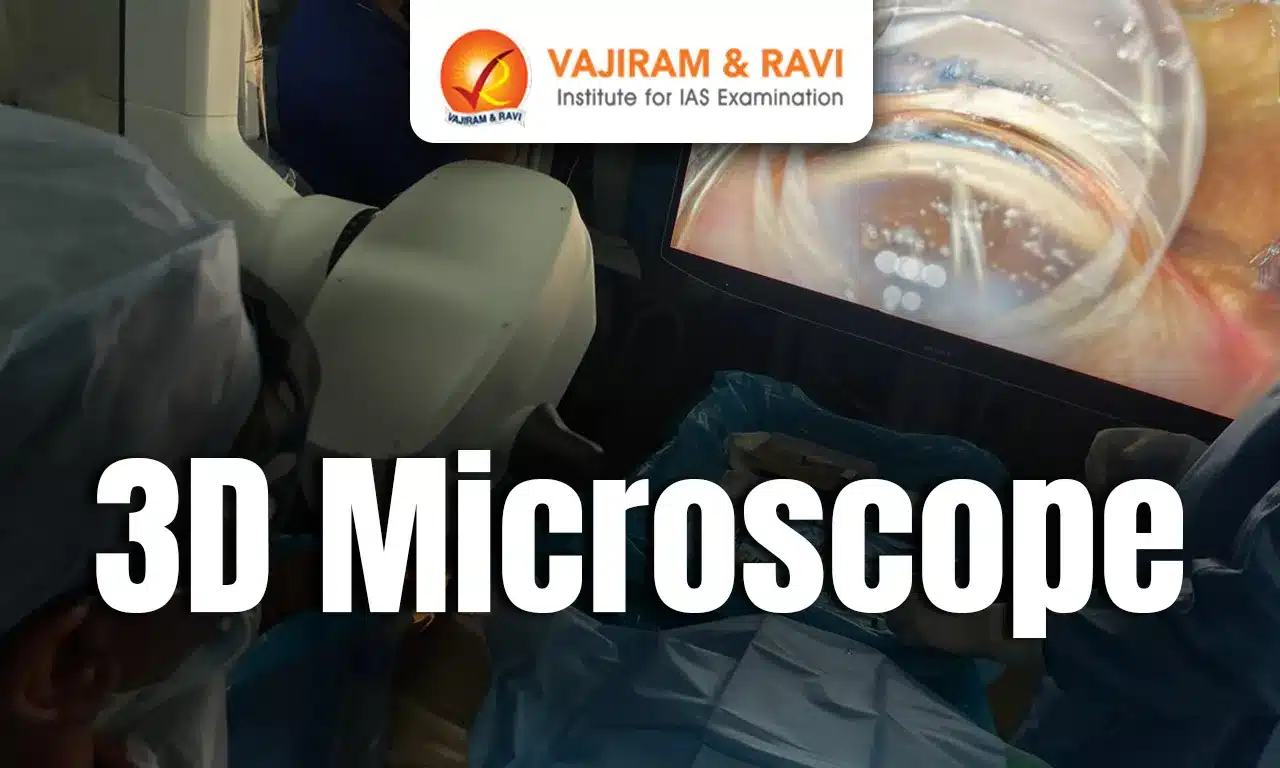
For the first time, the Indian Army’s Department of Ophthalmology at Army Hospital (Research and Referral), New Delhi, has successfully performed Minimally Invasive Glaucoma Surgery (MIGS) using a 3D Microscope.
What is a Microscope?
- A microscope is an instrument that magnifies small objects, making them visible to the naked eye by bending (refracting) light rays through curved lenses.
- The most commonly used microscopes are optical microscopes, where visible light is focused through lenses to create an enlarged image.


What is a 3D Microscope?
- A 3D microscope produces images with depth information (X, Y, and Z axes), allowing researchers to visualize and measure the topography, volume, and internal structures of samples.
- Unlike traditional light microscopes, which provide flat, 2D images, 3D microscopes use advanced optical, electron, or computational techniques to capture and reconstruct three-dimensional data.
- This is particularly useful for studying complex biological or environmental samples, such as soil microbes, aquatic organisms, or microplastics.
Features of the 3D Microscope
- The 3D Microscope uses advanced three-dimensional visualisation, assisting in complex eye surgeries such as treatment for squint, cataract, corneal diseases, glaucoma, and retinal conditions.
- It employs special 3D polarisation glasses for surgeons and a 55-inch 4K ultra-HD display.
- Key advantages include:
- Reduced surgical time and lower complication rates compared to conventional microscopes.
- Decreased endoilluminator power requirements, thereby reducing photo-toxicity risks.
- Ease of performing surgeries in complex and rare cases.
3D Microscope FAQs
Q1: What is a 3D Microscope?
Ans: A 3D Microscope is an advanced imaging tool that creates three-dimensional, highly detailed visualizations of microscopic samples, enhancing depth perception.
Q2: Which technologies are used in 3D Microscopy?
Ans: Techniques like confocal microscopy, two-photon microscopy, and light-sheet fluorescence microscopy are commonly used for 3D imaging.
Q3: How does a 3D Microscope differ from a traditional microscope?
Ans: Unlike traditional microscopes that provide flat, two-dimensional images, 3D microscopes generate volumetric images that can be rotated and analysed from different angles.
Source: PIB

 Last updated on Oct, 2026
→ UPSC 2027 Notification will be released on 13 January 2027 at upsconline.nic.in.
→ Check Nobel Prize 2026 Winners List here.
→ Download PIB PRiSM Monthly Magazine 2026 here.
→ Check UPSC Monthly Current Affairs Magazine The Recitals here.
→ Check out the latest UPSC Syllabus here.
→ Download UPSC Model Answers for Mains 2026
→ UPSC Mains Question Paper 2026 is out now for Essay & GS Paper 1, 2, 3 & 4.
→ UPSC Calendar 2027 has been released.
→ Enroll in Vajiram & Ravi’s UPSC Mains Test Series 2027 for structured answer writing practice, expert evaluation, and exam-oriented feedback.
→ Join Vajiram & Ravi’s UPSC Mentorship Program 2027 for personalized guidance, strategy planning, and one-to-one support from experienced mentors.
→ Go through the UPSC Mains Previous Year Papers to enhance your preparation.
→ UPSC has released UPSC Toppers List 2025 with the Civil Services final result on its official website.
→ Also check Best UPSC Coaching in India
Tags: 3d microscope prelims pointers upsc current affairs upsc prelims current affairs