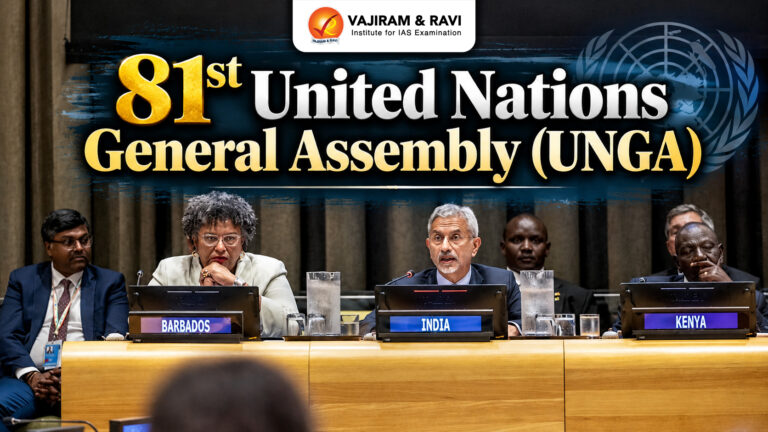
81st United Nations General Assembly (UNGA) Latest News
- External Affairs Minister S. Jaishankar called for stronger and reformed multilateralism amid growing geopolitical competition, conflicts and pressures on international cooperation.
- He made the remarks while co-chairing the inaugural Partners for Multilateralism, International Law, Peace & Prosperity (P4M) Summit with European Council President Antonio Costa on the sidelines of the 81st UNGA in New York.
- The summit comes at a time when the global order is experiencing strategic rebalancing, geopolitical tensions and conflicts, while the UN system faces criticism over limited representation and decision-making effectiveness.
Global Order Under Stress
- Jaishankar argued that the long-term rebalancing of global power has acquired a more difficult character because of intense strategic competition.
- If these pressures remain unchecked, they could weaken the spirit of international cooperation.
- Therefore, multilateralism needs to assert itself more strongly to address common global challenges.
- He stressed that cooperation is essential in areas such as –
- Peace and international security
- Climate action and climate justice
- Emerging technologies
- Development finance
- Counter-terrorism
- Global supply chains
- Disaster resilience
- Pandemic preparedness


The 4F Crisis
- A major concern highlighted by Jaishankar was the vulnerability of global systems to disruptions in essential supplies.
- He referred to the “4F crisis” — fuel, food, fertiliser and finance.
- He called for –
- Frameworks and guardrails for emerging technologies and capabilities.
- De-risking and diversification where countries face dependence on strategic chokepoints.
- International cooperation to prevent disruptions in critical supply chains.
- Greater resilience against geopolitical shocks.
- This approach is particularly significant for countries such as India, which seek to maintain strategic autonomy while reducing excessive dependence on any single country or supply source.
- The emphasis on diversification is consistent with India’s broader approach of building resilient supply chains and maintaining multiple strategic partnerships rather than relying excessively on any single geopolitical bloc.
Reformed Multilateralism
- India advocated “reformed multilateralism” based on –
- More participative deliberations
- Transparent decision-making
- Greater representation of contemporary global realities
- Respect for international law, rules and norms
- India argues that institutions created in an earlier geopolitical era need to become more representative of the present distribution of economic and political power.
- This is particularly relevant to UN Security Council (UNSC) reform, where India has been seeking permanent membership.
India and Visegrad Group
- Slovakia backed India’s bid for permanent membership of the UNSC, describing India as an important country of the Global South and an emerging power in the Indo-Pacific.
- Jaishankar also participated in the first V4+India Foreign Ministers’ Meeting.
- The Visegrád Group (V4) consists of Czechia (Czech Republic), Hungary, Poland, and Slovakia.
- The meeting focused on strengthening cooperation in political and diplomatic affairs, economy and trade, defence and security, technology, space, connectivity, and people-to-people (P2P) relations.
- The new V4+India format expands India’s engagement with Central Europe and provides another platform for cooperation beyond traditional bilateral relationships.
Bilateral and Regional Engagements
- During his UNGA visit, Jaishankar held meetings with foreign ministers of France, Ukraine, Hungary and Moldova.
- With France, discussions covered the Ukraine and Gulf crises, bilateral strategic cooperation and reform of the UN Security Council.
- With Ukraine, discussions included peace efforts, bilateral cooperation and the Black Sea, including the importance of freedom of navigation for global food security.
- These engagements demonstrate India’s effort to maintain dialogue with multiple stakeholders while pursuing its independent foreign-policy interests.
Significance for India
- Strategic autonomy: Maintaining independent decision-making amid competing geopolitical blocs.
- Global South leadership: Advocating greater representation and voice for developing countries.
- Multilateral reform: Seeking institutions that are more representative, participatory and transparent.
- Supply-chain resilience: Reducing vulnerability arising from excessive dependence and geopolitical chokepoints.
- Rules-based international order: Supporting international law, norms and peaceful resolution of disputes.
Way Forward
- A more effective multilateral system requires representative institutions, transparent decision-making, respect for international law and greater cooperation on transnational challenges.
- India’s advocacy of reformed multilateralism seeks to move global governance beyond bloc politics towards a system capable of addressing emerging challenges such as –
- Climate change,
- Technological disruption,
- Pandemics,
- Terrorism,
- Food and energy insecurity.

 Last updated on Oct, 2026
→ UPSC 2027 Notification will be released on 13 January 2027 at upsconline.nic.in.
→ Check Nobel Prize 2026 Winners List here.
→ Download PIB PRiSM Monthly Magazine 2026 here.
→ Check UPSC Monthly Current Affairs Magazine The Recitals here.
→ Check out the latest UPSC Syllabus here.
→ Download UPSC Model Answers for Mains 2026
→ UPSC Mains Question Paper 2026 is out now for Essay & GS Paper 1, 2, 3 & 4.
→ UPSC Calendar 2027 has been released.
→ Enroll in Vajiram & Ravi’s UPSC Mains Test Series 2027 for structured answer writing practice, expert evaluation, and exam-oriented feedback.
→ Join Vajiram & Ravi’s UPSC Mentorship Program 2027 for personalized guidance, strategy planning, and one-to-one support from experienced mentors.
→ Go through the UPSC Mains Previous Year Papers to enhance your preparation.
→ UPSC has released UPSC Toppers List 2025 with the Civil Services final result on its official website.
→ Also check Best UPSC Coaching in India
81st United Nations General Assembly (UNGA) FAQs
Q1. What is meant by ‘Reformed Multilateralism’?+
Q2. How can de-risking and diversification strengthen global supply-chain resilience?+
Q3. What are the major concerns associated with the ‘4F crisis’?+
Q4. How does India’s advocacy of reformed multilateralism reflect its foreign-policy priorities? +
Q5. What is the significance of the V4+India framework for India’s foreign policy? +
Tags: 81st United Nations General Assembly