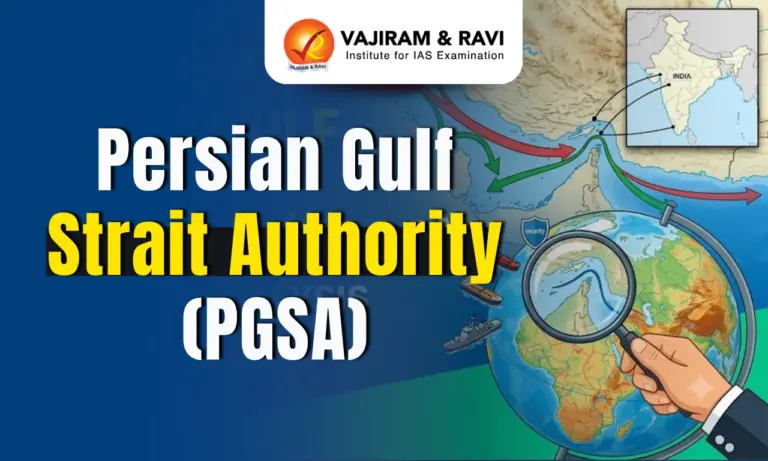
Iran has recently announced the establishment of a new maritime regulatory mechanism called the Persian Gulf Strait Authority (PGSA) to manage and monitor vessel movement through the strategically vital Strait of Hormuz.
About Persian Gulf Strait Authority (PGSA)
- The Persian Gulf Strait Authority (PGSA) is a newly introduced maritime regulatory body announced by Iranian authorities as a mechanism for managing vessel movement through the Strait of Hormuz.
- The PGSA describes itself as the legal entity and representative authority of Iran responsible for managing passage and transit through the Strait of Hormuz.
- The authority has also launched an official presence on social media platform X.
- The Strait of Hormuz is a critical global energy chokepoint through which around one-fifth of global oil trade passes, making any regulatory change highly significant for global energy security.
Key Features of the PGSA Framework
Based on official announcements and media reports, the PGSA framework includes the following elements:
- The authority has been designated to oversee and regulate maritime traffic passing through the Strait of Hormuz, including coordination of vessel movement.
- Shipping operators are expected to comply with formal communication and regulatory instructions issued under the new system.
- Reports indicate that vessels may be required to provide detailed operational information, including ship identification, cargo details, origin, destination, and crew-related information, as part of transit procedures.
- The mechanism has been described as introducing a permit-based approach to maritime passage, where compliance with Iranian-issued instructions is required for transit.
- Iranian officials have suggested the possibility of service-related charges or fees for vessels using the route, although no standardized tariff has been officially confirmed.
- Iran has reportedly stated that unauthorized passage may be treated as illegal, indicating a stricter enforcement mechanism under the PGSA framework.
However, detailed operational guidelines and uniform global implementation standards have not yet been fully clarified in public domain reports.


 Last updated on Oct, 2026
→ UPSC 2027 Notification will be released on 13 January 2027 at upsconline.nic.in.
→ Check Nobel Prize 2026 Winners List here.
→ Download PIB PRiSM Monthly Magazine 2026 here.
→ Check UPSC Monthly Current Affairs Magazine The Recitals here.
→ Check out the latest UPSC Syllabus here.
→ Download UPSC Model Answers for Mains 2026
→ UPSC Mains Question Paper 2026 is out now for Essay & GS Paper 1, 2, 3 & 4.
→ UPSC Calendar 2027 has been released.
→ Enroll in Vajiram & Ravi’s UPSC Mains Test Series 2027 for structured answer writing practice, expert evaluation, and exam-oriented feedback.
→ Join Vajiram & Ravi’s UPSC Mentorship Program 2027 for personalized guidance, strategy planning, and one-to-one support from experienced mentors.
→ Go through the UPSC Mains Previous Year Papers to enhance your preparation.
→ UPSC has released UPSC Toppers List 2025 with the Civil Services final result on its official website.
→ Also check Best UPSC Coaching in India
Persian Gulf Strait Authority (PGSA) FAQs
Q1. What is the Persian Gulf Strait Authority (PGSA)?+
Q2. What is the objective of the PGSA?+
Q3. What type of system is introduced under PGSA?+
Q4. What are the key operational requirements under PGSA?+
Q5. What is the legal implication of non-compliance under PGSA?+
Tags: persian gulf strait authority