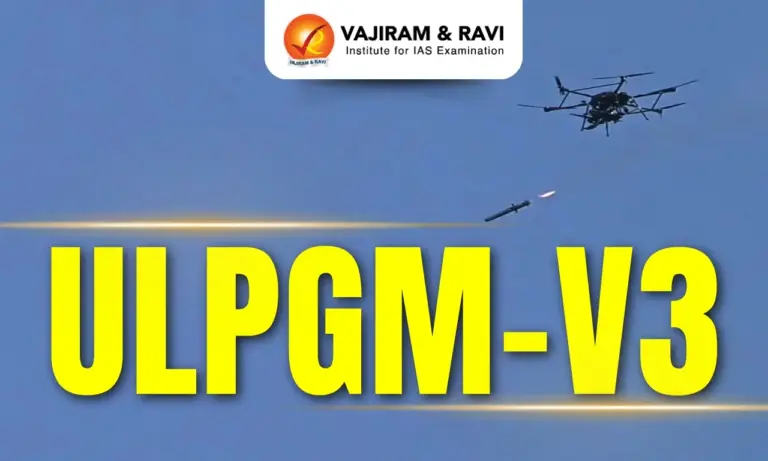
ULPGM-V3 Latest News
- The Defence Research and Development Organisation (DRDO) successfully completed the final development trials of the UAV-Launched Precision Guided Missile (ULPGM)-V3.
- The trials were conducted in both air-to-ground and air-to-air modes, paving the way for critical user trials by the armed forces.
- The term “deliverable configuration” used by DRDO suggests that not much will change in subsequent trials — signalling near-readiness for induction.
Evolution of ULPGM — From V1 to V3
- The ULPGM has undergone significant technological evolution across three generations:
- V1 – Basic free-fall precision missile
- V2- Added propulsion, longer range, and mid-course target updates
- V3 – Air-to-ground AND air-to-air capability, advanced seekers, multiple warheads, day-night combat
- The V3 represents a generational leap — transforming the ULPGM from a basic drone-launched weapon into a highly versatile, multi-role precision missile suited for modern drone warfare.


Key Technical Features of ULPGM-V3
- Fitted with a high-definition dual-channel seeker — an advanced guidance system using multiple sensors to accurately track both ground and aerial targets.
- Equipped with a two-way data link — enabling operators to change or update the target even after the missile has been launched — a critical capability in fast-moving combat environments.
- Can engage both stationary and moving targets with precision in all-weather, day-and-night conditions.
Operational Versatility
- Can be deployed in both plains and high-altitude regions — making it suitable for diverse Indian operational theatres including the Himalayan frontier.
- Capable of engaging a wide range of targets — tanks, armoured vehicles, bunkers, fortified structures, drones, helicopters, and other airborne threats.
Three Warhead Options
- The missile can be fitted with three different warheads depending on mission requirements:
- Anti-Armour Warhead — Designed to destroy heavily protected tanks and armoured vehicles, including those fitted with Rolled Homogeneous Armour (RHA) and Explosive Reactive Armour (ERA) — special protection layers used in modern battle tanks.
- Penetration-cum-Blast Warhead — Designed to pierce and destroy bunkers and fortified structures — critical for counter-insurgency and conventional warfare against entrenched positions.
- Pre-Fragmentation Warhead — Disperses high-speed metal fragments over a large area to maximise damage — effective against personnel and light vehicles.
Production and Development Ecosystem
- The ULPGM-V3 has been developed and produced entirely within India’s defence ecosystem — a strong demonstration of Aatmanirbhar Bharat in defence.
- Nodal Development Lab — Research Centre Imarat (RCI), Hyderabad.
- UAV Integration — Currently integrated on UAVs developed by Newspace Research and Technologies, Bengaluru. DRDO is actively pursuing integration with long-range and high-endurance UAVs from several other Indian companies.
Strategic Significance — Drones in Modern Warfare
- The Drone Revolution
- Experts described systems like ULPGM-V3 as critical given that drones are increasingly becoming central to modern warfare worldwide.
- The ongoing conflicts — from Ukraine to West Asia — have demonstrated that drones now play decisive roles in surveillance, precision strikes, and counter-drone operations — in both conventional conflicts and asymmetric warfare.
- Network-Centric Warfare
- The ULPGM-V3 reflects the growing shift toward network-centric warfare — where drones, sensors, and command systems work together in real time to detect and strike targets with precision.
- The missile’s post-launch target update capability is particularly valuable in fast-moving drone combat environments where targets change rapidly.
Why Drones Are the Future
- Significantly reduced risk to human soldiers and pilots.
- Persistent real-time surveillance and precision strike capability.
- Rapid mass production and scalability compared to conventional manned weapon systems.
- DRDO has identified drone-launched weapon development as one of its key focus areas going forward.
Source: IE

 Last updated on Oct, 2026
→ UPSC 2027 Notification will be released on 13 January 2027 at upsconline.nic.in.
→ Check Nobel Prize 2026 Winners List here.
→ Download PIB PRiSM Monthly Magazine 2026 here.
→ Check UPSC Monthly Current Affairs Magazine The Recitals here.
→ Check out the latest UPSC Syllabus here.
→ Download UPSC Model Answers for Mains 2026
→ UPSC Mains Question Paper 2026 is out now for Essay & GS Paper 1, 2, 3 & 4.
→ UPSC Calendar 2027 has been released.
→ Enroll in Vajiram & Ravi’s UPSC Mains Test Series 2027 for structured answer writing practice, expert evaluation, and exam-oriented feedback.
→ Join Vajiram & Ravi’s UPSC Mentorship Program 2027 for personalized guidance, strategy planning, and one-to-one support from experienced mentors.
→ Go through the UPSC Mains Previous Year Papers to enhance your preparation.
→ UPSC has released UPSC Toppers List 2025 with the Civil Services final result on its official website.
→ Also check Best UPSC Coaching in India
ULPGM-V3 FAQs
Q1. What is ULPGM-V3 and why is it important for India’s defence?+
Q2. How does ULPGM-V3 improve India’s drone warfare capability?+
Q3. What makes ULPGM-V3 strategically significant in modern warfare?+
Q4. How has ULPGM-V3 evolved from earlier versions?+
Q5. Why does ULPGM-V3 support India’s defence self-reliance goals?+
Tags: mains articles ULPGM-V3 upsc current affairs upsc mains current affairs