Ferrocene Latest News
- Researchers from IIT Madras and IISc Bengaluru have synthesised a stable carbon-free molecule resembling ferrocene, solving a long-standing chemistry puzzle spanning over seven decades.
Understanding Ferrocene and Its Importance
- The recent scientific breakthrough has renewed interest in ferrocene, a unique molecule that transformed modern chemistry after its discovery in the 1950s.
- Ferrocene belongs to a class of compounds called organometallic compounds, which contain bonds between a metal and carbon-containing molecules.
- It has a distinctive structure where an iron atom is positioned between two flat carbon-ring molecules, resembling a “sandwich”.
- This unusual arrangement made the ferrocene one of the most important discoveries in chemistry because it challenged conventional theories of chemical bonding and expanded understanding of molecular structures.
- The molecule contains:
- An iron atom (Fe) at the centre.
- Two cyclopentadienyl carbon rings surround the metal atom.
- Strong and stable bonding that gives it exceptional chemical stability.
- Its structure is often referred to as a “sandwich complex” because the metal atom is placed between two ring-shaped molecules.


Scientific Importance of Ferrocene
- Ferrocene is important because of both its scientific significance and practical applications.
- In chemistry, it helped scientists understand how metals interact with ring-based molecules, leading to advances in organometallic chemistry and molecular design.
- Its practical applications include:
- Medicines and pharmaceuticals.
- Rechargeable batteries and energy systems.
- Electronics and advanced materials.
- Catalysts used in industrial chemical reactions.
- Because ferrocene is highly stable, scientists became interested in understanding whether this stability came only because of carbon-based rings or whether similar structures could be created using entirely different elements.
- This question remained unresolved for more than 70 years.
The Long-Standing Chemistry Puzzle
- For decades, scientists across the world tried to create a molecule similar to ferrocene without using carbon rings.
- The challenge existed because carbon possesses exceptional bonding properties. It can easily form stable, large, and complex molecular structures, making it central to chemistry.
- In fact, an entire branch called organic chemistry focuses on carbon compounds.
- Researchers attempted various combinations of metals and non-carbon elements. However, creating a stable carbon-free sandwich structure proved extremely difficult.
- The key scientific question was “could the famous ferrocene structure exist without carbon?”
- Until now, the answer remained uncertain.
The Indian Breakthrough in Chemistry
- Researchers at IIT Madras, led by Prof. Sundargopal Ghosh and Stutee Mohapatra, in collaboration with Prof. Eluvathingal Jemmis from IISc Bengaluru, have successfully solved this scientific challenge.
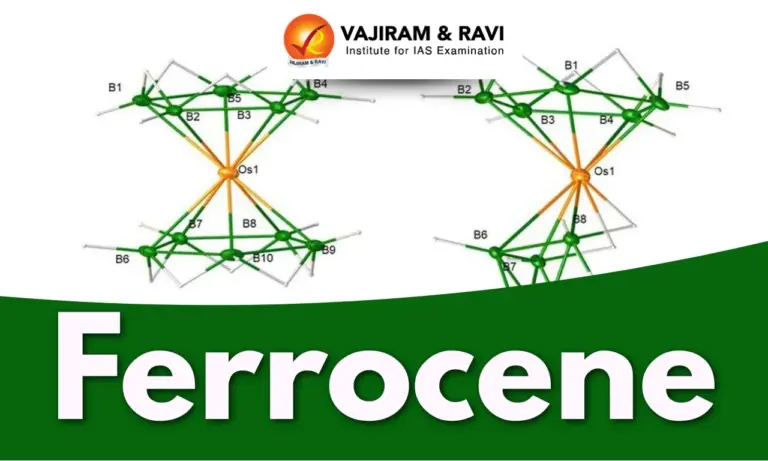
- The researchers developed a completely carbon-free molecule that closely resembles ferrocene in both structure and stability.
- Instead of iron and carbon rings, the new molecule contains:
- Osmium metal at the centre instead of iron.
- Boron-based rings instead of carbon rings.
- Like ferrocene, the new molecule forms a sandwich-like arrangement, where osmium remains positioned between two ring structures.
- Most importantly, researchers found the molecule to be highly stable, with strong bonding between osmium and boron rings.
- Early investigations suggest that the molecule may even prove more robust than ferrocene under certain conditions.
- The findings have been published in the prestigious scientific journal Science, highlighting the global importance of the discovery.
Significance of This Discovery
- Although the research is currently viewed as a fundamental scientific breakthrough, it carries important long-term implications.
- First, it answers a major theoretical question that scientists had struggled with for decades regarding the uniqueness of carbon in forming stable sandwich structures.
- Second, the discovery could expand possibilities for designing novel materials with specialised properties.
- Such materials may eventually find applications in:
- Electronics and semiconductors
- Energy storage systems
- Catalysis and industrial chemistry
- Advanced materials science
- At present, researchers are investigating the molecule’s possible technological uses.
Conclusion
- The successful synthesis of a carbon-free ferrocene-like molecule marks a significant achievement in modern chemistry.
- By demonstrating that stable sandwich structures can exist without carbon, Indian researchers have solved a seven-decade-old scientific puzzle.
- While practical applications may take time to emerge, the breakthrough has expanded the boundaries of chemical science and opened new avenues for material innovation.

 Last updated on Sep, 2026
→ UPSC 2027 Notification will be released on 13 January 2027 at upsconline.nic.in.
→ Asian Games 2026 are being held in Aichi-Nagoya, Japan, from 19 September to 4 October.
→ Check out the latest UPSC Syllabus here.
→ Download UPSC Model Answers for Mains 2026
→ UPSC Mains Question Paper 2026 is out now for Essay & GS Paper 1, 2, 3 & 4.
→ UPSC Calendar 2027 has been released.
→ Enroll in Vajiram & Ravi’s UPSC Mains Test Series 2027 for structured answer writing practice, expert evaluation, and exam-oriented feedback.
→ Join Vajiram & Ravi’s UPSC Mentorship Program 2027 for personalized guidance, strategy planning, and one-to-one support from experienced mentors.
→ Go through the UPSC Mains Previous Year Papers to enhance your preparation.
→ UPSC has released UPSC Toppers List 2025 with the Civil Services final result on its official website.
→ Also check Best UPSC Coaching in India
Ferrocene FAQs
Q1. What is ferrocene?+
Q2. Why is ferrocene called a sandwich molecule?+
Q3. What breakthrough did Indian researchers achieve?+
Q4. Which elements were used in the new molecule?+
Q5. Why is this discovery important?+
Tags: ferrocene mains articles upsc current affairs upsc mains current affairs