Cheque Bounce vs Insolvency Latest News
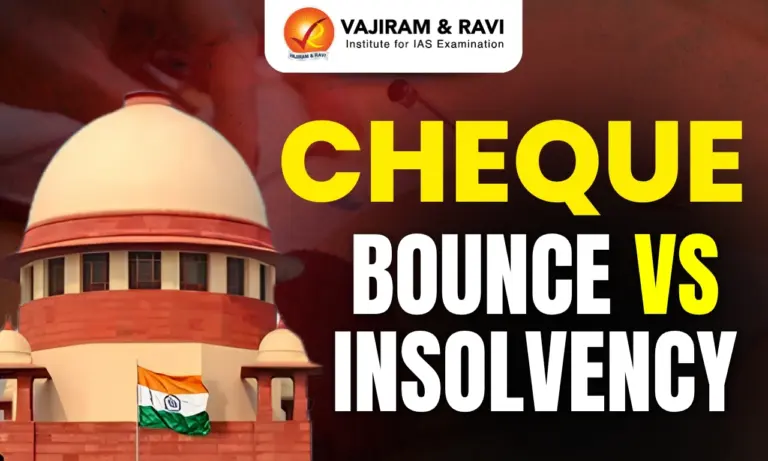
- The Supreme Court has referred to a larger bench a significant legal question: Can a person undergoing insolvency proceedings use those proceedings to pause or stop a cheque bounce case against them?
- Recently, a bench of Justices JB Pardiwala and KV Viswanathan referred the matter in the case of Dineshchand Surana v. UCO Bank, noting a clear conflict in existing Supreme Court judgments.
- The matter now awaits constitution of an appropriate bench by the Chief Justice of India.
The Insolvency and Bankruptcy Code (IBC), 2016
- When a person files for personal insolvency under the IBC, the law immediately puts a moratorium — a legal pause — on all proceedings related to that person’s debts.
- This serves a clear purpose: while a debtor’s assets are being restructured and distributed among creditors, no single creditor should be allowed to grab assets ahead of others.
- Two sections govern this moratorium:
- Section 96 — An interim moratorium kicks in from the day the insolvency application is filed.
- Section 101 — A full statutory moratorium begins once the court formally accepts the application.


Section 138 of the Negotiable Instruments Act
- Section 138 makes dishonoured cheques — commonly called cheque bounce — a criminal offence.
- The punishment can be imprisonment, a fine, or both. The law was designed to ensure people take cheque payments seriously.
- However, over time courts have also recognised a compensatory dimension — a convicted person can be directed to pay the cheque amount to the complainant.
- The offence is also compoundable, meaning the parties can settle and the case ends. This dual nature — part criminal, part compensatory — is what creates the legal tension.
The Core Legal Conflict
- The fundamental question is: What is a cheque bounce case at its heart — a criminal prosecution or a debt recovery mechanism?
- The answer to that question determines whether the IBC moratorium applies to it.
- If it is primarily criminal, the moratorium has no business touching it — the IBC is a debt resolution framework, not a shield against crime.
- But if its real purpose is to recover money owed, then it looks more like a debt proceeding, and the moratorium could logically apply.
- An earlier Supreme Court judgment captured this tension perfectly, describing Section 138 as a “civil sheep in criminal wolf’s clothing” — meaning it wears the costume of criminal law but its real purpose is recovering money.
The Conflict in Precedents
- The Supreme Court’s own judgments on this question point in opposite directions:
- P Mohanraj v. Shah Bros Ispat (2021) – Called Section 138 a “civil sheep in criminal wolf’s clothing.” Since its real purpose is money recovery, the moratorium should logically cover it.
- Rakesh Bhanot v. Gurdas Agro (2025) – Moratorium is meant to pause civil debt recovery, not stall criminal prosecution. Accused cannot use insolvency to escape Section 138 proceedings.
- The 2026 bench noted a critical problem:
- the 2025 judgment did not engage with the detailed analysis in the 2021 case, and
- the 2021 case had not fully examined the criminal dimensions of Section 138.
- Neither ruling resolved the conflict cleanly. Hence the referral to a larger bench.
What the Court Suggested: A Possible Way Forward
- While referring the matter, the bench offered a preliminary framework — splitting the cheque bounce case into two distinct parts and treating each differently.
- On the criminal aspect — trial, conviction, imprisonment, and penal fine — the bench said the moratorium cannot apply. The IBC itself defines “debt” in a way that excludes court-imposed fines. A person cannot use insolvency to escape personal criminal accountability.
- On the compensatory aspect — the court’s power to direct payment of the cheque amount to the complainant — the bench said the moratorium should apply. Allowing one creditor to recover money from an insolvent person’s assets during restructuring would undermine the entire logic of the IBC, which is to ensure fair and orderly distribution among all creditors.
- In short, the court drew a clean line: punish the crime, but pause the compensation.
Why This Matters
- The outcome of this case will have far-reaching consequences. Creditors, accused persons, and company directors who are simultaneously facing insolvency and cheque bounce proceedings all have a stake in how this question is resolved.
- If moratorium fully covers Section 138, insolvent debtors could use IBC proceedings to stall cheque bounce cases — effectively using insolvency as a legal escape route.
- If moratorium is fully excluded, creditors in cheque bounce cases could recover money ahead of other creditors, disrupting the orderly insolvency process.
- The court’s suggested middle path — separating the criminal and compensatory aspects — tries to balance both concerns. But its final acceptance depends on the larger bench.
Source: IE

 Last updated on Oct, 2026
→ UPSC 2027 Notification will be released on 13 January 2027 at upsconline.nic.in.
→ Asian Games 2026 are being held in Aichi-Nagoya, Japan, from 19 September to 4 October.
→ Check Nobel Prize 2026 Winners List here.
→ Download PIB PRiSM Monthly Magazine 2026 here.
→ Check UPSC Monthly Current Affairs Magazine The Recitals here.
→ Check out the latest UPSC Syllabus here.
→ Download UPSC Model Answers for Mains 2026
→ UPSC Mains Question Paper 2026 is out now for Essay & GS Paper 1, 2, 3 & 4.
→ UPSC Calendar 2027 has been released.
→ Enroll in Vajiram & Ravi’s UPSC Mains Test Series 2027 for structured answer writing practice, expert evaluation, and exam-oriented feedback.
→ Join Vajiram & Ravi’s UPSC Mentorship Program 2027 for personalized guidance, strategy planning, and one-to-one support from experienced mentors.
→ Go through the UPSC Mains Previous Year Papers to enhance your preparation.
→ UPSC has released UPSC Toppers List 2025 with the Civil Services final result on its official website.
→ Also check Best UPSC Coaching in India
Cheque Bounce vs Insolvency FAQs
Q1. What is the Cheque Bounce vs Insolvency dispute?+
Q2. Why is the Supreme Court hearing the Cheque Bounce vs Insolvency issue?+
Q3. How does the IBC relate to the Cheque Bounce vs Insolvency debate?+
Q4. What is the core legal question in the Cheque Bounce vs Insolvency case?+
Q5. What solution has the Court suggested in the Cheque Bounce vs Insolvency matter? +
Tags: Cheque Bounce vs Insolvency mains articles upsc current affairs upsc mains current affairs