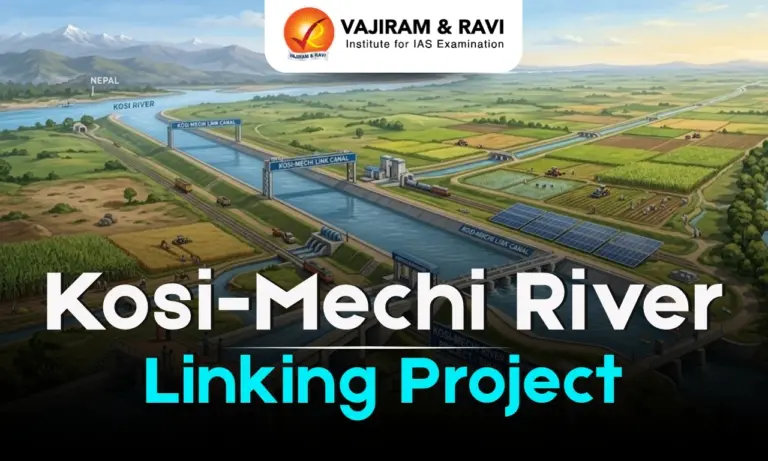
The Kosi-Mechi River Linking Project is one of India’s important river interlinking initiatives aimed at improving irrigation facilities and water resource management in eastern India. The project seeks to transfer surplus water from the Kosi River to the Mechi River, a tributary of the Mahananda River, benefiting parts of Bihar and neighboring regions. The project is being implemented under the broader framework of the National Perspective Plan for Interlinking of Rivers and is supervised by the National Water Development Agency (NWDA) under the Ministry of Jal Shakti.
Kosi-Mechi River Linking Project Objectives
The Kosi-Mechi River Linking Project has been planned with multiple objectives related to water management and agricultural development.
- To expand irrigation facilities and improve access to water for agricultural activities.
- To enhance agricultural productivity in water-scarce and drought-prone areas.
- To provide a reliable source of water for domestic and industrial needs.
- To ensure better utilization of surplus monsoon water that would otherwise flow unused.
- To support the livelihood and income of farmers by improving irrigation infrastructure.
- To promote sustainable agricultural practices and increase crop production.
- To reduce farmers’ dependence on erratic monsoon rainfall for cultivation.
- To strengthen integrated water resource management in the river basin.
- To improve water security for both rural and urban populations.
- To contribute to regional economic development through better water availability and agricultural growth.
Kosi-Mechi River Linking Project Features
The Kosi-Mechi River Linking Project is an important river interlinking initiative aimed at improving irrigation and water management in eastern India.
- Connects the Kosi River with the Mechi River, a tributary of the Mahananda River.
- Forms part of India’s National Perspective Plan for Interlinking of Rivers.
- Covers regions in Bihar and Nepal, making it a transboundary water management project.
- Implemented under the supervision of the National Water Development Agency (NWDA).
- Operates under the Ministry of Jal Shakti, Government of India.
- Designed primarily to improve irrigation facilities and enhance agricultural productivity.
- Facilitates the transfer of surplus monsoon water from the Kosi basin to water-deficient areas.
- Supports water availability during the Kharif season, benefiting agricultural activities.
- Provides water for domestic, industrial, and agricultural purposes.
- Aims to promote efficient utilization of river water resources and reduce water wastage.
- Helps strengthen regional water security and sustainable water resource management.
- Seeks to improve the livelihoods of farmers by ensuring a more dependable supply of irrigation water.
- Contributes to the overall development of the Mahananda River basin through improved water distribution infrastructure.


Concerns Associated with the Kosi-Mechi River Linking Project
While the Kosi-Mechi River Linking Project is expected to improve irrigation and water availability, several concerns have been raised regarding its effectiveness in addressing the region’s long-standing flood and erosion problems.
- Limited Flood Control Benefits: The project is primarily designed for irrigation and water supply and does not have a significant flood management component.
- Minimal Reduction in Kosi Water Flow: The additional water release proposed under the project is relatively small compared to the massive discharge capacity of the Kosi River, limiting its impact on flood prevention.
- Recurring Floods Remain Unaddressed: North Bihar experiences devastating floods almost every year, and critics argue that the project does not offer a comprehensive solution to this challenge.
- Continued Riverbank Erosion: The Kosi River’s tendency to shift its course and erode riverbanks is a major concern that the project does not directly address.
- Impact on Local Livelihoods: Flooding and erosion continue to damage agricultural land, homes, and infrastructure, affecting the livelihoods of local communities.
- Focus on Irrigation Over Disaster Management: The project emphasizes irrigation benefits while giving comparatively less attention to flood control, rehabilitation, and disaster mitigation measures.
- Environmental Concerns: Alteration of natural river flows may affect local ecosystems, sediment movement, and biodiversity in the river basin.
- Dependence on Cross-Border Coordination: Since the project involves river systems flowing through Nepal and India, effective implementation requires sustained bilateral cooperation and coordination.
Kosi-Mechi River Linking Project Benefits
The Kosi-Mechi River Linking Project is expected to improve water resource management, enhance agricultural productivity, and support regional development by facilitating the transfer of water from the Kosi basin to the Mechi and Mahananda river basins.
- Improved Irrigation Facilities: Expands irrigation coverage in water-deficit areas, ensuring a more reliable water supply for agricultural activities.
- Enhanced Agricultural Productivity: Availability of assured irrigation can increase crop yields and support the cultivation of multiple crops throughout the year.
- Better Utilization of Surplus Water: Helps utilize excess monsoon water from the Kosi River that might otherwise flow unused into the Ganga.
- Reduced Dependence on Monsoon Rainfall: Farmers can rely on a more stable source of water, reducing risks associated with irregular rainfall patterns.
- Support for Farmers’ Livelihoods: Improved irrigation infrastructure can boost farm incomes and strengthen rural livelihoods.
- Domestic and Industrial Water Supply: Enhances water availability for household consumption and industrial activities, supporting regional development.
- Promotion of Water Security: Contributes to long-term water security by ensuring a more balanced distribution of water resources across river basins.
- Development of the Mahananda Basin: Provides additional water resources to the Mahananda river basin, supporting agriculture and economic activities in the region.
- Boost to Rural Economy: Increased agricultural output can generate employment opportunities and stimulate economic growth in rural areas.
National Perspective Plan for Interlinking of Rivers
The National Perspective Plan for Interlinking of Rivers is a nationwide water resource management initiative launched by the Government of India to transfer water from surplus river basins to water-deficit regions through a network of river links.
- Formulated in 1980 by the Government of India to address regional disparities in water availability and support long-term water security.
- Aims to transfer surplus water from flood-prone river basins to drought-prone and water-scarce regions through a network of river links.
- Consists of two components – the Himalayan Rivers Development Component and the Peninsular Rivers Development Component.
- Seeks to expand irrigation facilities, increase agricultural productivity, and strengthen food security across the country.
- Provides water for domestic and industrial use, helping meet the growing water demands of urban and rural areas.
- Promotes flood and drought management by redistributing water resources between surplus and deficit river basins.
- Implemented through the National Water Development Agency (NWDA), which conducts feasibility studies and prepares project reports for river-linking projects.
- Supports integrated water resource management and balanced regional development while contributing to hydropower generation and economic growth.

 Last updated on Oct, 2026
→ UPSC 2027 Notification will be released on 13 January 2027 at upsconline.nic.in.
→ Asian Games 2026 are being held in Aichi-Nagoya, Japan, from 19 September to 4 October.
→ Check Nobel Prize 2026 Winners List here.
→ Download PIB PRiSM Monthly Magazine 2026 here.
→ Check UPSC Monthly Current Affairs Magazine The Recitals here.
→ Check out the latest UPSC Syllabus here.
→ Download UPSC Model Answers for Mains 2026
→ UPSC Mains Question Paper 2026 is out now for Essay & GS Paper 1, 2, 3 & 4.
→ UPSC Calendar 2027 has been released.
→ Enroll in Vajiram & Ravi’s UPSC Mains Test Series 2027 for structured answer writing practice, expert evaluation, and exam-oriented feedback.
→ Join Vajiram & Ravi’s UPSC Mentorship Program 2027 for personalized guidance, strategy planning, and one-to-one support from experienced mentors.
→ Go through the UPSC Mains Previous Year Papers to enhance your preparation.
→ UPSC has released UPSC Toppers List 2025 with the Civil Services final result on its official website.
→ Also check Best UPSC Coaching in India
Kosi-Mechi River Linking Project FAQs
Q1. What is the Kosi-Mechi River Linking Project?+
Q2. Which rivers are linked under the project?+
Q3. What is the main objective of the Kosi-Mechi River Linking Project?+
Q4. Which agency is responsible for implementing the project?+
Q5. Which states and regions will benefit from the project?+
Q6. Is the Kosi-Mechi River Linking Project part of a larger river-linking programme?+
Tags: economy economy notes geography geography notes kosi-mechi river linking project