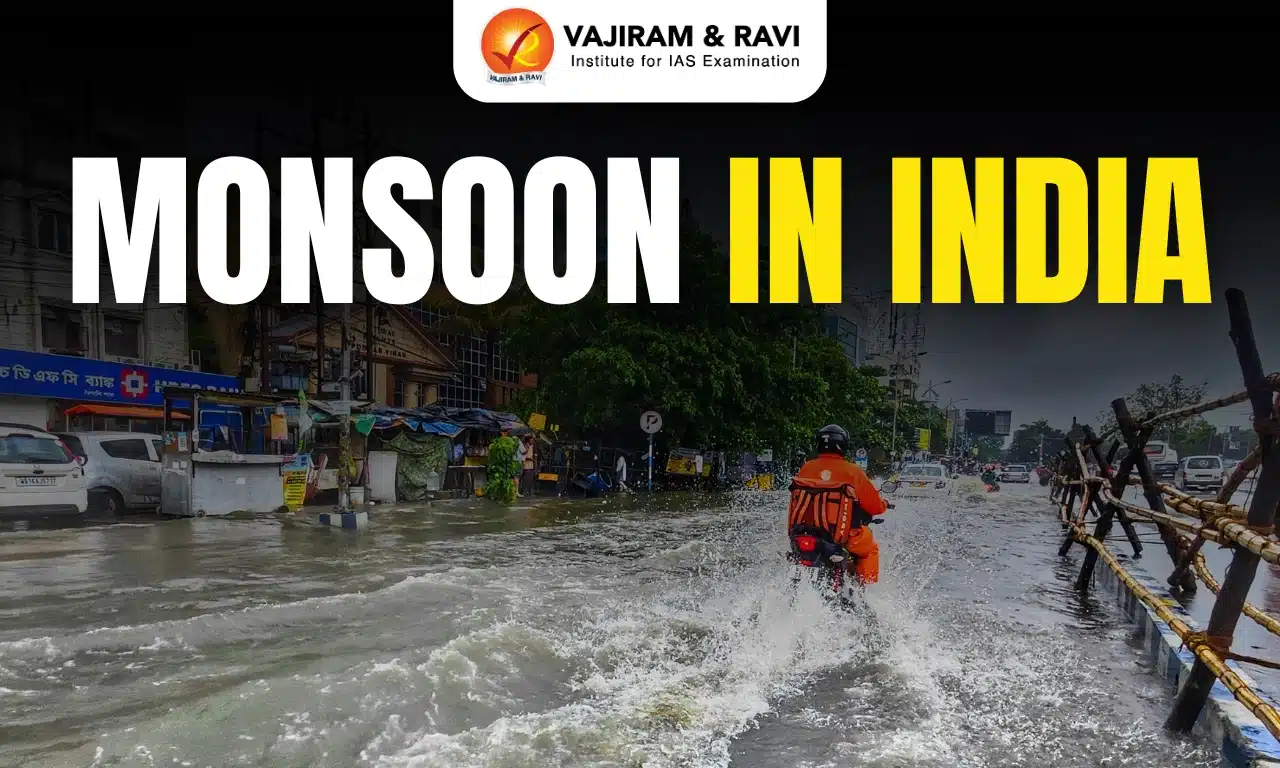
The Monsoon in India is one of the most defining climatic phenomena of the subcontinent. It shapes not only the weather patterns but also the socio-economic fabric of the country. Bringing life-giving rainfall, the monsoon is important for agriculture, water resources, and daily life. Understanding the monsoon’s origins, mechanisms, variations, and impacts is important for appreciating how this seasonal wind system influences India’s environment, economy, and society. In this article, we are going to cover about the Indian Monsoon, its characteristics, types, driving forces, regional variations, historical importance, impacts, challenges and measures taken to manage it effectively.
What is Monsoon?
The term monsoon is derived from the Arabic word mausim, meaning “season.” In meteorological terms, a monsoon is a seasonal reversal of wind direction accompanied by significant changes in precipitation. It is not just a period of heavy rain but a complex climatic phenomenon involving interactions between land, ocean, and atmosphere. Monsoon systems exist in many parts of the world, including Southeast Asia, West Africa, and Australia, but the Indian monsoon is particularly significant due to its scale and socio-economic impact.
In India, the monsoon represents a lifeline that sustains the agricultural economy and replenishes rivers, lakes, and groundwater reserves. The monsoon is closely tied to the livelihoods of millions of people, as around 60% of India’s population depends on agriculture, much of which is rain-fed. Additionally, the monsoon influences hydroelectric power generation, industrial production, and food security.
Monsoon in India 2026
The Indian monsoon is characterized by seasonal wind reversals that bring heavy rainfall to different parts of the subcontinent. Broadly, Monsoon in India is divided into two major systems: Southwest Monsoon (June to September), this phase brings moisture-laden winds from the Indian Ocean to the Indian mainland, marking the onset of the primary rainy season. Northeast Monsoon (October to December) which is also known as the retreating monsoon, it mainly affects southeastern India, bringing rainfall to regions like Tamil Nadu, Andhra Pradesh, and parts of Kerala.
The monsoon is important not only for agriculture but also for maintaining water resources, influencing rural and urban livelihoods, and impacting economic growth. In years of deficient monsoon, India has historically experienced droughts, famine-like situations, and economic setbacks, whereas a good monsoon leads to record harvests, stable food prices, and improved rural incomes.


Characteristics of Monsoon in India
The major important Features of Monsoon in India include:
- Seasonal Rainfall: Heavy rainfall occurs predominantly from June to September during the southwest monsoon.
- Two Distinct Phases: Southwest and Northeast monsoons mark the two major phases, with differing wind patterns, rainfall intensity, and regional impacts.
- Geographical Influence: The Himalayas, the Thar Desert, the Indian Ocean, and the Western Ghats influence rainfall distribution and wind directions.
- Rainfall Diversity: Coastal regions and the Western Ghats receive extremely high rainfall, while arid and semi-arid regions such as Rajasthan receive sparse rain.
- Wind Reversal: The hallmark of the monsoon is the seasonal reversal of wind direction, bringing moisture-laden winds during the wet season and dry winds during the retreating phase.
- Sudden Onset and Withdrawal: The southwest monsoon typically arrives in Kerala by early June and withdraws from northern India by late September. The retreating monsoon in the south is comparatively gradual.
Factors Affecting the Monsoon in India
The Indian monsoon is influenced by atmospheric pressure differences, global wind patterns and ocean temperature variations. These factors affect its onset, intensity, duration and distribution of rainfall.
- Inter-Tropical Convergence Zone (ITCZ): The ITCZ is a low-pressure belt where trade winds converge. During summer, it shifts northward towards India, helping establish the monsoon trough and draw moisture-laden winds towards the subcontinent.
- Tibetan Plateau: The Tibetan Plateau heats up during summer, influencing upper-atmospheric circulation and monsoon development. It also affects the position of the subtropical westerly jet stream.
- Jet Streams: These are fast-flowing air currents in the upper atmosphere. The seasonal movement of the subtropical westerly jet and the development of the tropical easterly jet influence monsoon circulation and rainfall patterns.
- Somali Jet: This strong low-level southwesterly wind system develops over the western Indian Ocean during summer. It transports moisture from the Arabian Sea towards India and contributes to rainfall along the western coast.
- El Niño and La Niña: El Niño involves unusual warming of the central and eastern equatorial Pacific Ocean and is often associated with weaker Indian summer monsoon rainfall. La Niña involves cooling in these regions and is often associated with stronger rainfall. However, neither relationship is absolute.
- Indian Ocean Dipole (IOD): The IOD refers to differences in sea-surface temperatures between the western and eastern tropical Indian Ocean. A positive IOD can sometimes support Indian monsoon rainfall, including by offsetting some of El Niño’s influence.
Types of Monsoon in India
India experiences two types of monsoon:
- Southwest Monsoon
- Northeast Monsoon
Southwest Monsoon in India
The Southwest Monsoon in India is the primary rainy season, occurring mainly from June to September. It brings moisture-laden winds from the Indian Ocean and accounts for approximately 75–80% of India’s annual rainfall.
- Formation: During summer, intense heating over the Indian landmass creates low-pressure conditions. The northward shift of the Inter-Tropical Convergence Zone (ITCZ) and the pressure difference between Asia and the southern Indian Ocean help draw winds towards India.
- Onset and advance: The southwest monsoon usually reaches Kerala in early June and gradually advances across the country. Its arrival often brings a sudden increase in rainfall, known as the burst of the monsoon.
- Two branches: The Arabian Sea branch brings heavy rainfall to the western coast and the windward slopes of the Western Ghats. The Bay of Bengal branch brings rainfall to northeastern India and moves westward along the Himalayan foothills.
- Characteristics: Rainfall is unevenly distributed and occurs in active and break periods. The Western Ghats and northeastern India receive heavy rainfall, while western Rajasthan and rain-shadow regions receive comparatively less.
- Agricultural importance: The southwest monsoon supports kharif crops such as rice, maize, cotton and pulses. Its variability affects agricultural production, reservoir levels and rural incomes.
Northeast Monsoon in India
The Northeast Monsoon in India occurs mainly from October to December and is particularly important for southeastern India, especially Tamil Nadu. It is associated with the retreating phase of the southwest monsoon.
- Formation: As the southwest monsoon withdraws, seasonal wind circulation changes and northeasterly winds become prominent. These winds initially originate over land but collect moisture while crossing the Bay of Bengal.
- Rainfall distribution: The moisture-laden winds bring rainfall mainly to the Coromandel Coast, particularly Tamil Nadu and parts of southern Andhra Pradesh. Bay of Bengal depressions and cyclonic storms can further intensify rainfall.
- Characteristics: Unlike the southwest monsoon, which brings widespread rainfall to India, the northeast monsoon has a stronger regional concentration over southeastern India.
- Agricultural importance: Northeast monsoon rainfall supports paddy cultivation, replenishes reservoirs and contributes to groundwater recharge in Tamil Nadu and neighbouring regions.
- Economic significance: Its variability affects water availability and agricultural output, while excessive rainfall and cyclonic storms can cause floods and coastal damage.
Tamil Nadu receives a substantial share of its annual rainfall during October–December, making the northeast monsoon particularly important for the state’s water security.
The Difference Between Southwest Monsoon and Northeast Monsoon in India lies in their season, wind direction, rainfall distribution and regional significance. While the southwest monsoon brings widespread rainfall from June to September, the northeast monsoon occurs mainly from October to December and is particularly important for southeastern India, especially Tamil Nadu.
|
Basis |
Southwest Monsoon |
Northeast Monsoon |
|---|---|---|
|
Season |
June to September |
October to December |
|
Wind direction |
Southwesterly winds |
Northeasterly winds |
|
Origin and moisture |
Winds cross the Indian Ocean, Arabian Sea and Bay of Bengal, carrying moisture towards India. |
Winds blow from the land towards the Bay of Bengal and gain moisture before reaching southeastern India. |
|
Main rainfall regions |
Most of India, particularly the Western Ghats and northeastern states |
Mainly Tamil Nadu and parts of southeastern India |
|
Rainfall pattern |
Widespread, but unevenly distributed across India |
Concentrated mainly over southeastern India |
|
Major weather systems |
Monsoon troughs and low-pressure systems |
Bay of Bengal depressions and cyclonic storms |
|
Agricultural importance |
Supports the kharif cropping season |
Important for paddy cultivation and other crops in southeastern India |
|
Other significance |
Replenishes reservoirs and supports water availability across much of India |
Crucial for Tamil Nadu’s water security and groundwater recharge |
Monsoon in India Regional Variations
The Indian monsoon witnesses many important regional variations due to topography and proximity to water bodies:
- Western Ghats and Coastal Areas: Receive heavy rainfall due to orographic lift. Some regions, like Mawsynram and Cherrapunji in Meghalaya, are among the wettest places on Earth, receiving more than 11,000 mm of rain annually.
- Northern Plains: Moderate to heavy rainfall influenced by monsoon progression from the southwest. States like Uttar Pradesh, Bihar, and Punjab benefit from monsoon-fed rivers like the Ganges and Yamuna.
- Northeast India: Extremely high rainfall due to Bay of Bengal proximity and Himalayan foothills, supporting lush forests and fertile soils.
- Deccan Plateau: Receives lower rainfall as monsoon winds weaken while crossing the plateau. Regions like Telangana and Karnataka experience moderate rainfall suitable for crops like millets and pulses.
- Arid and Semi-Arid Regions: Rajasthan and parts of Gujarat receive minimal and erratic rainfall, making them highly dependent on water conservation and irrigation practices.
Monsoon in India Impacts
Monsoon in India has the following impact on different sectors like agriculture, economy, health and infrastructure:
- Agriculture: The monsoon is critical for agriculture, influencing crop selection, sowing, and irrigation. A good monsoon ensures abundant harvests of staples such as rice, wheat, and pulses, while a poor monsoon can lead to drought, crop failures, and food insecurity.
- Water Resources: Monsoon rains replenish rivers, lakes, reservoirs, and groundwater, essential for irrigation, drinking water, and hydroelectric power generation.
- Economy: Agriculture-dependent rural areas are particularly sensitive to monsoon performance. A robust monsoon can boost rural incomes, food supply, and overall GDP growth, whereas deficient rainfall may negatively affect economic stability and inflation.
- Health: Monsoon brings both benefits and risks to public health. While rainfall is essential for water supply and sanitation, stagnant water can lead to outbreaks of waterborne diseases like cholera, dengue, and malaria. Proper sanitation and public health measures are crucial.
- Infrastructure: Excessive rainfall can damage roads, bridges, and urban infrastructure, highlighting the importance of effective drainage systems and resilient planning.
- Environment: Monsoon sustains ecological balance, replenishing soil moisture, supporting flora and fauna, and maintaining wetland ecosystems. However, extreme rainfall events can lead to soil erosion, landslides, and habitat loss.
Prediction of Monsoon in India 2026
Advanced weather forecasting systems help improve monsoon prediction, rainfall monitoring, flood preparedness, agricultural planning, and disaster management across India during 2026.
- According to the India Meteorological Department (IMD), the Southwest Monsoon reached Kerala in May 2026, earlier than normal, and covered the entire country by June 2026.
- During July 2026, the monsoon remained active over most parts of the country. The monsoon trough persisted near its normal position, while multiple upper-air cyclonic circulations and western disturbances continued to strengthen rainfall activity across northern, eastern and northeastern India.
- Rainfall distribution during July 2026 remained uneven across the country. East and Northeast India recorded about 330.9 mm rainfall against the normal 513.2 mm, while India as a whole received around 222.4 mm compared with the normal 275.7 mm, showing nearly 19% below normal rainfall.
- The active monsoon phase brought heavy to very heavy rainfall over Assam, Meghalaya, Bihar, Odisha, Jharkhand, West Bengal, Sub-Himalayan West Bengal and Sikkim.
- The IMD also highlighted the possibility of extremely heavy rainfall at isolated locations, especially across Bihar, Odisha, Assam and Meghalaya, increasing the risk of flooding, waterlogging and disruption of transport and agricultural operations in vulnerable areas.
- Despite the active monsoon, heat and humid weather conditions continued over isolated parts of Odisha, Rayalaseema, Tamil Nadu and Puducherry, reflecting the seasonal transition where monsoon rainfall and high humidity occurred simultaneously across different regions.
- Strong thunderstorms accompanied by lightning and gusty winds reaching 30-40 kmph remained likely over parts of Bihar, Jharkhand, Gangetic West Bengal and Northeast India, while squally winds over the Arabian Sea and Bay of Bengal continued to influence maritime weather conditions.
- The July 2026 monsoon pattern remained significant for kharif crop sowing, reservoir replenishment, groundwater recharge and water resource management, while highlighting the importance of continuous weather monitoring, flood preparedness and climate-resilient agricultural planning across India.

 Last updated on Oct, 2026
→ UPSC 2027 Notification will be released on 13 January 2027 at upsconline.nic.in.
→ Check Nobel Prize 2026 Winners List here.
→ Download PIB PRiSM Monthly Magazine 2026 here.
→ Check UPSC Monthly Current Affairs Magazine The Recitals here.
→ Check out the latest UPSC Syllabus here.
→ Download UPSC Model Answers for Mains 2026
→ UPSC Mains Question Paper 2026 is out now for Essay & GS Paper 1, 2, 3 & 4.
→ UPSC Calendar 2027 has been released.
→ Enroll in Vajiram & Ravi’s UPSC Mains Test Series 2027 for structured answer writing practice, expert evaluation, and exam-oriented feedback.
→ Join Vajiram & Ravi’s UPSC Mentorship Program 2027 for personalized guidance, strategy planning, and one-to-one support from experienced mentors.
→ Go through the UPSC Mains Previous Year Papers to enhance your preparation.
→ UPSC has released UPSC Toppers List 2025 with the Civil Services final result on its official website.
→ Also check Best UPSC Coaching in India
Monsoon in India FAQs
Q1. What is the duration of Southwest Monsoon in India?+
Q2. What is the duration of Northeast Monsoon in India?+
Q3. What is Somali Jet?+
Q4. What are jet streams?+
Q5. What is El Nino Effect?+
Tags: geography monsoon in india