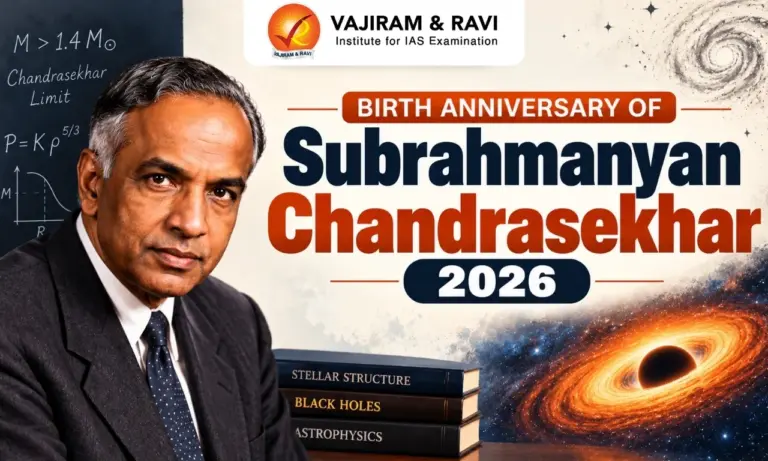
The birth anniversary of Subrahmanyan Chandrasekhar is observed on 19 October every year. Born in 1910, he was an Indian-born American astrophysicist known for his pioneering research on the structure and evolution of stars. His work on the maximum mass of white dwarf stars led to the formulation of the Chandrasekhar Limit, which helped scientists understand the final stages of stellar evolution. He received the 1983 Nobel Prize in Physics for his theoretical studies of physical processes important to the structure and evolution of stars. In 2026, his 116th birth anniversary will be observed on 19 October.
Subrahmanyan Chandrasekhar Early Life and Education
Subrahmanyan Chandrasekhar was born on 19 October 1910 in Lahore, then part of British India and now in Pakistan.
- He studied physics at Presidency College in Madras and later pursued higher studies at the University of Cambridge in the United Kingdom.
- He earned his PhD in 1933 and subsequently held a fellowship at Trinity College, Cambridge.
- In the late 1930s, he joined the University of Chicago, where he continued his research and teaching until his death on 21 August 1995.
- He was the nephew of C. V. Raman, who received the Nobel Prize in Physics in 1930.
Subrahmanyan Chandrasekhar Major Contributions
Subrahmanyan Chandrasekhar made important contributions to the study of stars, black holes and other objects in space. His research helped scientists understand how stars behave, change over time and eventually reach the end of their lives.
- Stellar structure and evolution: He studied how stars work, how they change over time and what happens to them as they grow older.
- White dwarf stars: He calculated the maximum mass a white dwarf star can have while remaining stable.
- Black holes: He used mathematical methods to improve scientific understanding of black holes and their physical properties.
- Radiative transfer: He studied how energy travels through the outer layers of stars in the form of radiation.
- Hydrodynamic stability: He examined how fluids and electrically conducting fluids behave and remain stable, helping scientists understand processes inside stars and other astronomical objects.


What Is the Chandrasekhar Limit?
The Chandrasekhar Limit is the maximum mass a white dwarf star can have while remaining stable. It is approximately 1.4 times the mass of the Sun. Chandrasekhar calculated this limit by studying how gravity affects matter under the extremely high densities found inside stars.
To understand the importance of this limit, it is useful to know what happens when a star grows old.
- How stars produce energy: Stars generate energy through nuclear fusion, a process in which hydrogen combines to form helium.
- Formation of a white dwarf: When a star like the Sun uses up most of its nuclear fuel, it expands and sheds its outer layers. Its remaining core can become a white dwarf, a small but extremely dense star.
- Why the mass limit matters: A white dwarf remains stable because the behaviour of electrons inside it creates pressure that resists gravity. If its mass exceeds the Chandrasekhar Limit, this pressure is no longer sufficient to support it.
- What happens next: The star may collapse further. Depending on its mass and physical conditions, this process can lead to a supernova, a neutron star or, in some cases, a black hole.
Chandrasekhar’s work helped scientists understand why some stars remain as white dwarfs while others undergo further collapse. It established an important theoretical foundation for studying the final stages of stellar evolution.
Awards and Recognition of Subrahmanyan Chandrasekhar
Subrahmanyan Chandrasekhar received several prestigious awards in recognition of his contributions to astrophysics and our understanding of stars and other celestial objects.
- Nobel Prize in Physics (1983): He shared the prize with William A. Fowler for theoretical studies of physical processes important to the structure and evolution of stars.
- Gold Medal of the Royal Astronomical Society (1953): Awarded in recognition of his contributions to astronomy.
- Royal Medal (1962): Awarded by the Royal Society for his scientific work.
- Copley Medal (1984): One of the Royal Society’s highest honours, recognising his scientific contributions.
Important Books by Subrahmanyan Chandrasekhar
Subrahmanyan Chandrasekhar also authored several influential books on astrophysics and mathematical physics.
- An Introduction to the Study of Stellar Structure (1939)
- Principles of Stellar Dynamics (1942)
- Radiative Transfer (1950)
- Hydrodynamic and Hydromagnetic Stability (1961)
- The Mathematical Theory of Black Holes (1983)
- Truth and Beauty: Aesthetics and Motivations in Science (1987)
- Newton’s Principia for the Common Reader (1995)

 Last updated on Oct, 2026
→ UPSC 2027 Notification will be released on 13 January 2027 at upsconline.nic.in.
→ Check Nobel Prize 2026 Winners List here.
→ Download PIB PRiSM Monthly Magazine 2026 here.
→ Check UPSC Monthly Current Affairs Magazine The Recitals here.
→ Check out the latest UPSC Syllabus here.
→ Download UPSC Model Answers for Mains 2026
→ UPSC Mains Question Paper 2026 is out now for Essay & GS Paper 1, 2, 3 & 4.
→ UPSC Calendar 2027 has been released.
→ Enroll in Vajiram & Ravi’s UPSC Mains Test Series 2027 for structured answer writing practice, expert evaluation, and exam-oriented feedback.
→ Join Vajiram & Ravi’s UPSC Mentorship Program 2027 for personalized guidance, strategy planning, and one-to-one support from experienced mentors.
→ Go through the UPSC Mains Previous Year Papers to enhance your preparation.
→ UPSC has released UPSC Toppers List 2025 with the Civil Services final result on its official website.
→ Also check Best UPSC Coaching in India
Birth Anniversary of Subrahmanyan Chandrasekhar 2026 FAQs
Q1. When is the birth anniversary of Subrahmanyan Chandrasekhar observed?+
Q2. What is Subrahmanyan Chandrasekhar famous for?+
Q3. What is the Chandrasekhar Limit?+
Q4. When did Subrahmanyan Chandrasekhar receive the Nobel Prize in Physics?+
Q5. Who was C. V. Raman in relation to Subrahmanyan Chandrasekhar?+
Tags: subrahmanyan chandrasekhar subrahmanyan chandrasekhar’s birth anniversary