Zojila Tunnel Latest News
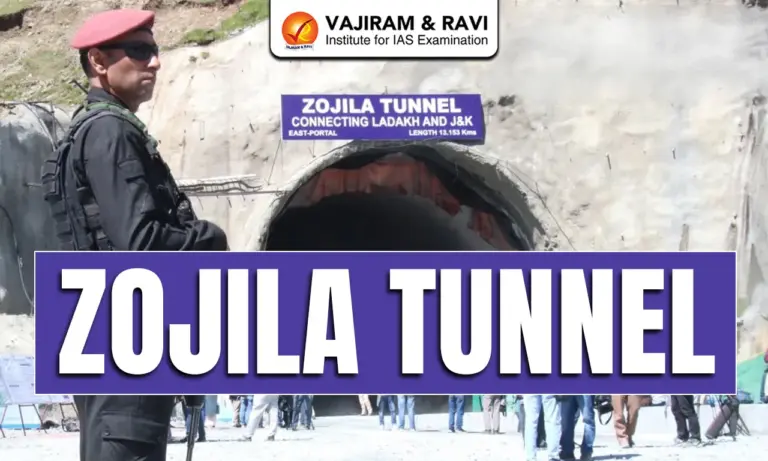
- The Zojila Tunnel, a strategically significant infrastructure project connecting Sonmarg in Jammu & Kashmir with Minamarg in Ladakh, has achieved a major milestone with over 13 km of excavation completed.
- Situated at an altitude of 11,578 feet, the tunnel is expected to provide year-round connectivity across the Zojila Pass and become operational by 2028.
- The project highlights India’s efforts to strengthen border infrastructure, regional development, and strategic mobility in the Himalayas.
Zojila Tunnel
- About:
- It will be India’s longest road tunnel and is expected to be Asia’s longest bi-directional road tunnel, with a length of 14.15 km. It is being constructed at an estimated cost of ₹6,500–6,800 crore.
- The project forms part of a larger 33-km connectivity corridor spanning Jammu & Kashmir and Ladakh.
- It includes expansion and development of the 18.475-km Z-Morh–Zojila highway stretch, two twin-tube tunnels, five bridges, and two snow galleries.
- The tunnel is one among 19 tunnels being built in the region under projects worth nearly ₹25,000 crore.
- Need:
- Overcoming seasonal isolation:
- The Srinagar–Leh route currently passes through the Zojila Pass, one of the most difficult mountain passes in the Himalayas.
- Heavy snowfall, avalanches, landslides, and slippery roads force closure of the pass for nearly five months annually.
- During winter, Ladakh remains dependent largely on air connectivity, leading to extremely high transportation costs.
- Strategic importance:
- Ladakh shares sensitive borders with both China and Pakistan.
- The tunnel will ensure uninterrupted movement of troops, military equipment, and essential supplies.
- It strengthens India’s border management and logistical preparedness.
- Overcoming seasonal isolation:
- Expected benefits:
- Improved connectivity:
- Provides all-weather and perennial connectivity between Kashmir and Ladakh.
- Travel time from Ganderbal to Kargil will be reduced from about three hours to around 20 minutes.
- The distance between Baltal and Minamarg will shrink from nearly 40 km to 13 km.
- Enhanced safety: The existing route witnesses frequent accidents due to steep gradients, poor visibility, snow and landslides. Tunnel-based travel will significantly reduce weather-related risks.
- Integrated regional development: Better connectivity is expected to boost tourism, promote trade and investment, generate employment, and reduce outmigration from remote regions.
- Improved connectivity:


Challenges of Tunneling Through the Himalayas
- Extreme climatic conditions: High altitude, where temperatures can plunge to –30°C, affecting both workers and machinery. Frequent avalanches pose serious risks to life and infrastructure.
- Geological complexity of the Himalayas:
- Young and active mountains: The Himalayas are a young fold mountain system, formed by the collision of the Indian and Eurasian tectonic plates. They remain tectonically active and geologically unstable.
- Highly variable rock strata: Rock formations can change dramatically within short distances. Engineers encounter soft sedimentary rocks, hard boulders, cavities, faults, shear zones, and water-bearing fractures.
- Water ingress risks: The mountains contain large quantities of groundwater and snowmelt channels. Sudden water inflows can flood excavation sites, destabilize rock formations, and increase collapse risks.
Engineering Solution
- New Austrian Tunnelling Method (NATM):
- The Zojila Tunnel is being excavated using the NATM, widely regarded as suitable for difficult geological conditions.
- Key features:
- Selective and controlled blasting.
- Excavation in stages (upper half first, lower half later).
- Continuous monitoring of rock behaviour.
- Immediate structural support through shotcrete (sprayed concrete), rock bolts, and drainage systems.
- Adaptive design approach:
- Tunnel alignment can be modified to bypass weak geological zones.
- The number and spacing of rock bolts are adjusted according to rock quality.
- Drainage pipes are installed to safely release groundwater pressure.
- Safety measures:
- To enhance operational and construction safety, three vertical ventilation and rescue shafts have been built.
- Shafts [depth: 474.3 m (India’s longest tunnel shaft), 367.5 m, and 213.5 m] facilitate ventilation, emergency evacuation, rescue operations, and disaster response.
Conclusion
- The Zojila Tunnel represents a landmark achievement in Himalayan infrastructure development, combining strategic necessity with advanced engineering.
- It is poised to become a transformative asset for both regional development and national integration.

 Last updated on Oct, 2026
→ UPSC 2027 Notification will be released on 13 January 2027 at upsconline.nic.in.
→ Check Nobel Prize 2026 Winners List here.
→ Download PIB PRiSM Monthly Magazine 2026 here.
→ Check UPSC Monthly Current Affairs Magazine The Recitals here.
→ Check out the latest UPSC Syllabus here.
→ Download UPSC Model Answers for Mains 2026
→ UPSC Mains Question Paper 2026 is out now for Essay & GS Paper 1, 2, 3 & 4.
→ UPSC Calendar 2027 has been released.
→ Enroll in Vajiram & Ravi’s UPSC Mains Test Series 2027 for structured answer writing practice, expert evaluation, and exam-oriented feedback.
→ Join Vajiram & Ravi’s UPSC Mentorship Program 2027 for personalized guidance, strategy planning, and one-to-one support from experienced mentors.
→ Go through the UPSC Mains Previous Year Papers to enhance your preparation.
→ UPSC has released UPSC Toppers List 2025 with the Civil Services final result on its official website.
→ Also check Best UPSC Coaching in India
Zojila Tunnel FAQs
Q1. Why is the Zojila Tunnel considered strategically significant for India?+
Q2. How will the Zojila Tunnel contribute to the socio-economic development of Ladakh and J&K?+
Q3. What geological characteristics of the Himalayas make tunnel construction particularly challenging?+
Q4. What is the significance of the New Austrian Tunnelling Method (NATM)?+
Q5. How does the Zojila Tunnel promote national integration?+
Tags: zojila tunnel