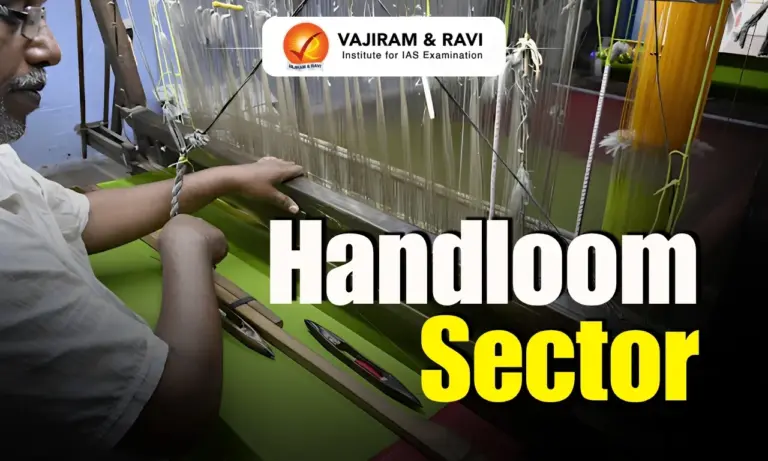
Handloom Sector Latest News
- National Handloom Day, observed on August 7, has drawn attention to the continuing economic significance of India’s handloom sector and the challenges of declining returns, fragmented markets, and vanishing weaving traditions.
Historical Background
- Handloom weaving in India has a legacy that stretches far beyond craft. Long before the Industrial Revolution transformed manufacturing in Europe, Indian handlooms were among the world’s greatest industrial enterprises.
- Indian textiles travelled across continents, powered global trade, and established India’s reputation as one of history’s foremost manufacturing economies.
- During the freedom struggle, weaving became an instrument of economic resistance and national identity.
- The Swadeshi Movement of 1905 called for a boycott of British textiles, and Mahatma Gandhi adopted the spinning wheel as a symbol of self-reliance.
- National Handloom Day, marked on August 7, commemorates the launch of the Swadeshi Movement and honours generations of Indian weavers.


Economic Significance of Handloom
- The handloom sector is often viewed as a small artisanal activity, culturally important but economically peripheral. The data suggests otherwise.
- It provides livelihoods to more than 35 lakh weavers and allied workers.
- These workers belong to over 31 lakh households.
- Women constitute nearly 70% of the workforce.
- It remains one of rural India’s largest sources of non-farm employment.
- It produces nearly 15% of the country’s cloth, despite relying largely on manual technology.
- This makes handloom particularly valuable in a country where employment generation remains a central policy challenge.
Challenges Facing the Sector
- While a few celebrated weaving traditions continue to enjoy strong recognition, hundreds of lesser-known traditions face gradual extinction.
- The main pressures include declining returns for weavers, fragmented markets that limit access to buyers, and the breakdown of skill transmission within families.
- Younger generations are leaving the profession as incomes fall and the work is no longer seen as viable or aspirational.
- Every disappearing weave represents more than the loss of a product. It marks the disappearance of centuries of accumulated knowledge, a distinctive design vocabulary, and a form of cultural identity.
- Protecting handloom heritage is therefore both an economic necessity and a civilisational responsibility.
Government Support and Recent Progress
- Policy and programme support appears to be making a difference.
- The National Handloom Development Programme has focused on skill development, design innovation, technology adoption, branding, and improved market access.
- Greater integration with e-commerce platforms and expanding export opportunities have enabled many artisan clusters to reach consumers who were previously inaccessible.
- The Office of the Development Commissioner for Handlooms, in collaboration with UNESCO, has begun identifying and documenting India’s languishing and endangered weaves. There is a case for extending this documentation across every region of the country.
- Alongside this, there is a policy focus on promoting Geographical Indication (GI)-tagged handloom and handicraft products and strengthening their presence in both domestic and international markets.
Success Stories
- The revival of Tangaliya weaving in Gujarat shows how a near-forgotten tradition can be brought back into circulation.
- The transformation of Badturang village in Odisha’s Sambalpur district demonstrates the impact of cluster-level support.
- The growing popularity of Siddipet Gollabhama sarees reflects how design and market access can create fresh demand.
- These cases share a common pattern: traditional crafts thrive when design, market access, and institutional support converge.
- The global visibility of Indian weaves has also grown. When a handcrafted shirt in the traditional Tangaliya weave appeared in an international film, it was more than a fashion statement, it signalled the global appeal such crafts can command.
Making Handloom Aspirational
- The next phase of policy must shift from preservation to aspiration.
- For younger consumers, particularly Gen Z, handloom needs to be seen as contemporary, fashionable, and aspirational rather than merely traditional.
- Celebrity ambassadors, collaborations with leading designers, limited-edition collections, digital storytelling, and partnerships with influencers can reposition India’s weaves as premium lifestyle products.
- The objective should not be to celebrate handloom because it is old, but because it represents craftsmanship, sustainability, and exclusivity.
- Limited production, often treated as a constraint, should be repositioned as a premium feature.
Expanding Global Reach
- India must also think beyond domestic markets. Global consumers increasingly value authenticity, sustainability, and handcrafted luxury, all areas where Indian handlooms enjoy a natural competitive advantage.
- Expanding exports, however, will require consistent quality standards, stronger branding, better GI protection, and vigilant action against cultural misappropriation.
- India can also leverage its traditional weaves, which for some global markets are ancient imports, to build its soft power.
Need for Better Measurement
- Unlike most manufacturing sectors, India’s handloom economy is inadequately measured.
- Policymakers need reliable data on its contribution to GDP, exports, tax revenues, employment, and household incomes.
- Better measurement will enable better policy and allow the sector to be recognised for the economic value it already creates.
- Establishing a national platform through which States, producer organisations, and cooperatives can exchange successful practices would also accelerate innovation across the sector.
Source: TH

 Last updated on Oct, 2026
→ UPSC 2027 Notification will be released on 13 January 2027 at upsconline.nic.in.
→ Check Nobel Prize 2026 Winners List here.
→ Download PIB PRiSM Monthly Magazine 2026 here.
→ Check UPSC Monthly Current Affairs Magazine The Recitals here.
→ Check out the latest UPSC Syllabus here.
→ Download UPSC Model Answers for Mains 2026
→ UPSC Mains Question Paper 2026 is out now for Essay & GS Paper 1, 2, 3 & 4.
→ UPSC Calendar 2027 has been released.
→ Enroll in Vajiram & Ravi’s UPSC Mains Test Series 2027 for structured answer writing practice, expert evaluation, and exam-oriented feedback.
→ Join Vajiram & Ravi’s UPSC Mentorship Program 2027 for personalized guidance, strategy planning, and one-to-one support from experienced mentors.
→ Go through the UPSC Mains Previous Year Papers to enhance your preparation.
→ UPSC has released UPSC Toppers List 2025 with the Civil Services final result on its official website.
→ Also check Best UPSC Coaching in India
Handloom Sector FAQs
Q1. When is National Handloom Day observed and why?+
Q2. How many people depend on the handloom sector for livelihood?+
Q3. What share of India's cloth production comes from handloom?+
Q4. What is the share of women in the handloom workforce?+
Q5. Which programme supports handloom development in India?+
Tags: handloom sector mains articles upsc current affairs upsc mains current affairs