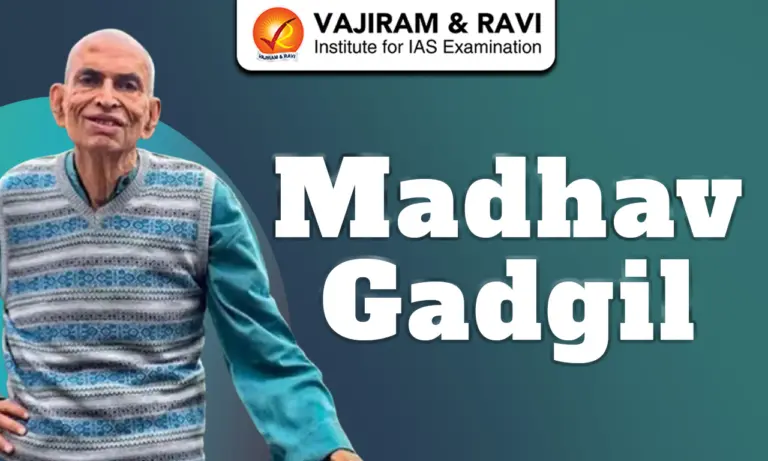
Madhav Gadgil was a noted Indian environmentalist and ecologist known for his contributions to biodiversity conservation and sustainable development. He played an important role in shaping India’s environmental policies and raising awareness about protecting natural resources. Gadgil strongly advocates for a balance between development and environmental protection. His work highlights the importance of preserving ecosystems while ensuring human well-being.
Madhav Gadgil (1942-2026)
- Madhav Gadgil was a leading Indian ecologist and environmentalist, widely respected for his lifelong work in protecting nature and promoting sustainable development in India.
- He came from an intellectual background, his father Dhananjay Gadgil was a noted economist, which influenced his academic and research-oriented approach.
- Over a career spanning more than six decades, Gadgil became known as a “people’s scientist”, focusing on protecting marginalized communities and promoting community-based conservation of forests, wetlands, and biodiversity.
- He was an important institution builder, having founded the Centre for Ecological Sciences (CES) at Indian Institute of Science in 1982, which became a major center for ecological research.
- His work also showed how local knowledge and participation can solve real problems, for example, villages working together to reduce pollution and restore biodiversity in rivers and forests.
- His work played a key role in the creation of the Nilgiri Biosphere Reserve (1986) and also contributed to important laws like the Biological Diversity Act (2002) and the Forest Rights Act (2006).
- He gained national attention as the chairman of the Western Ghats Ecology Expert Panel (WGEEP), also known as the Gadgil Committee, where he recommended protecting the Western Ghats through graded ecological zones.
- Apart from research, he also made strong literary contributions, co-authoring books like This Fissured Land and Ecology and Equity with Ramachandra Guha, explaining the link between environment and society.
- For his contributions, he received several prestigious awards including the Padma Shri, Padma Bhushan, Shanti Swarup Bhatnagar Award, Tyler Prize, and the UNEP Champions of the Earth Award, recognizing his impact on environmental conservation.
Western Ghats Ecology Expert Panel (WGEEP) / Gadgil Committee
- The Western Ghats Ecology Expert Panel (WGEEP), also known as the Gadgil Committee, was set up in 2010 by the Ministry of Environment Forest and Climate Change under the chairmanship of Madhav Gadgil to study and protect the Western Ghats, a UNESCO World Heritage Site and major biodiversity hotspot.
- Its main aim was to assess the ecological condition of the region, identify ecologically sensitive areas (ESAs), and suggest ways for conservation along with sustainable development.
- Key Recommendations of WGEEP
-
- The panel declared the entire Western Ghats (about 1.29 lakh sq km) as an Ecologically Sensitive Area (ESA) due to its fragile ecosystem.
- It divided the region into three zones based on sensitivity: ESZ-1 (highly sensitive), ESZ-2 (moderately sensitive), and ESZ-3 (less sensitive), with different levels of restrictions.
- It suggested strict controls on development, including:
- No new mining activities and phasing out existing mines in highly sensitive zones.
- Ban on genetically modified crops, new hill stations, and Special Economic Zones (SEZs).
- Restrictions on large infrastructure projects like major roads, railways, and dams in sensitive areas unless absolutely necessary.
- The report also proposed creating a special body called the Western Ghats Ecology Authority (WGEA) under the Environment Protection Act, 1986 to manage and regulate activities across the six states (Gujarat, Goa, Maharashtra, Karnataka, Kerala, Tamil Nadu).
- A key feature was its focus on inclusive and decentralized governance, recommending that Gram Sabhas and local communities should play a major role in decision-making.


Issues and Controversy related to Gadgil Committee
- The report faced strong opposition, especially from states like Kerala and Maharashtra, due to fears that strict rules would harm agriculture, mining, and development projects.
- Many critics argued that the recommendations were too environment-focused and could negatively impact livelihoods.
- Due to these concerns, the report was not accepted by the central government.
Kasturirangan Committee (Follow-up Panel)
- After the rejection of the Gadgil report, a new panel led by K Kasturirangan was formed in 2013 to review it.
- The Kasturirangan committee suggested a smaller Ecologically Sensitive Area (about 56,825 sq km) instead of covering the entire Western Ghats.
- It took a more balanced approach, allowing some development while still restricting polluting industries, mining, and large projects.
- Unlike Gadgil’s approach, it identified specific villages to be included in ESAs rather than the whole region.

 Last updated on August, 2026
→ UPSC Mains Question Paper 2026 is out now for Essay & GS Paper 1, 2, 3 & 4.
→ UPSC Mains GS Paper 1 2026 is out now.
→ UPSC Mains GS Paper 2 2026 is out now.
→ UPSC Mains GS Paper 3 2026 is out now.
→ UPSC Mains GS Paper 4 2026 is out now.
→ UPSC Mains Indian Language Paper & English Compulsory Paper are out now.
→ Check out the latest UPSC Syllabus 2026 here.
→ UPSC Mains Admit Card 2026 is now out.
→ Enroll in Vajiram & Ravi’s UPSC Mains Test Series 2027 for structured answer writing practice, expert evaluation, and exam-oriented feedback.
→ Join Vajiram & Ravi’s UPSC Mentorship Program 2027 for personalized guidance, strategy planning, and one-to-one support from experienced mentors.
→ Go through the UPSC Mains Previous Year Papers to enhance your preparation.
→ Download UPSC Mains Essay Paper 2025, UPSC Mains GS Paper-I 2025, UPSC Mains GS Paper-II 2025, UPSC Mains GS Paper-III 2025, UPSC Mains GS Paper-IV 2025, UPSC Mains English (Compulsory) Paper 2025, UPSC Mains Hindi (Qualifying) Paper 2025 here.
→ UPSC has released UPSC Toppers List 2025 with the Civil Services final result on its official website.
→ UPSC Calendar 2027 has been released.
→ Also check Best UPSC Coaching in India
Madhav Gadgil FAQs
Q1. Who was Madhav Gadgil?+
Q2. Why was Madhav Gadgil called a “people’s scientist”?+
Q3. What was the Western Ghats Ecology Expert Panel (WGEEP)?+
Q4. What were the key recommendations of the Gadgil Committee?+
Q5. What was the difference between the Gadgil Committee and Kasturirangan Committee?+
Q6. What were Madhav Gadgil’s major contributions?+
Tags: environment environment notes madhav gadgil