Radio Telemetry Latest News
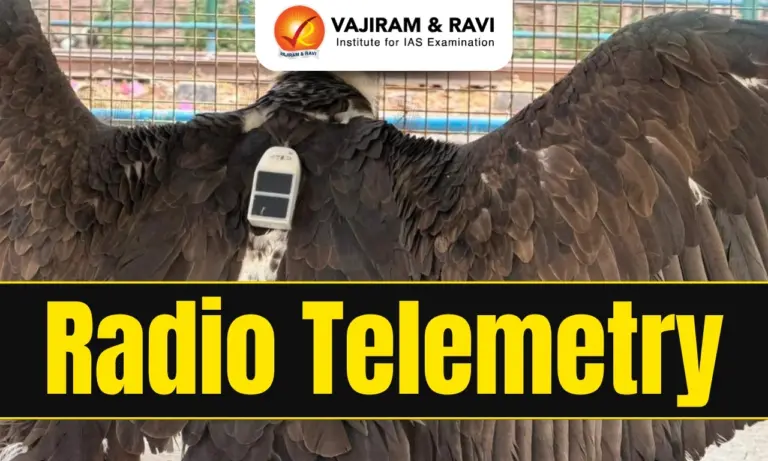
Radio telemetry data helped conservationists repeatedly protect the radio-tagged White-rumped vulture Z25, but the bird was ultimately killed in a collision with a power transmission line.
About Radio Telemetry
- Radio telemetry involves using radio waves to automatically transmit data from remote or inaccessible sources to a receiving station for monitoring and analysis.
- It is commonly used in wildlife tracking, weather monitoring, industrial process control, and medical monitoring to gather data without needing physical access to the source.


Radio Telemetry in Wildlife Tracking
- Since the 1960s, scientists have been using radio telemetry to track wildlife, studying their migration patterns, behaviors, and habits.
- Radio telemetry uses radio signals, which are made up of invisible and silent electromagnetic waves, to determine location.
- A radio telemetry system is made up of three parts: a radio transmitter, a radio antenna, and a radio receiver.
- The transmitter can be attached or tagged to the subject using a collar, an ear tag, or a wing tag for birds in particular. It is the part that transmits, or sends, the radio signal.
- The operator uses an antenna, attached to a receiver, which is programmed to the transmitter’s frequency, to pick up the radio signals given off by the transmitter affixed to the target animal.
- Receiver antennas may be hand-held, mounted on an object, or affixed to towers to avoid interference from buildings and trees.
- They may also be fixed to a vehicle, boat, or aircraft to allow the operator to exploit larger areas.
- The radio signals are then transformed into a beeping sound by the receiver.
- As the receiver gets closer to the transmitter, the beeps get louder, meaning the animal wearing the transmitter is close by.
- The researcher can use this audible clue to locate and follow the animal wearing the transmitter.
- Limitations:
- However, unlike GPS satellite tracking, radio telemetry requires researchers to remain within the signal range of the transmitter to locate the tagged animal.
- The other limitation is the size and lifespan of the battery required to power the transmitter.
News: TH

 Last updated on Sep, 2026
→ UPSC Mains Question Paper 2026 is out now for Essay & GS Paper 1, 2, 3 & 4.
→ UPSC Mains GS Paper 1 2026 is out now.
→ UPSC Mains GS Paper 2 2026 is out now.
→ UPSC Mains GS Paper 3 2026 is out now.
→ UPSC Mains GS Paper 4 2026 is out now.
→ UPSC Mains Indian Language Paper & English Compulsory Paper are out now.
→ Check out the latest UPSC Syllabus 2026 here.
→ UPSC Mains Admit Card 2026 is now out.
→ Enroll in Vajiram & Ravi’s UPSC Mains Test Series 2027 for structured answer writing practice, expert evaluation, and exam-oriented feedback.
→ Join Vajiram & Ravi’s UPSC Mentorship Program 2027 for personalized guidance, strategy planning, and one-to-one support from experienced mentors.
→ Go through the UPSC Mains Previous Year Papers to enhance your preparation.
→ Download UPSC Mains Essay Paper 2025, UPSC Mains GS Paper-I 2025, UPSC Mains GS Paper-II 2025, UPSC Mains GS Paper-III 2025, UPSC Mains GS Paper-IV 2025, UPSC Mains English (Compulsory) Paper 2025, UPSC Mains Hindi (Qualifying) Paper 2025 here.
→ UPSC has released UPSC Toppers List 2025 with the Civil Services final result on its official website.
→ UPSC Calendar 2027 has been released.
→ Also check Best UPSC Coaching in India
Radio Telemetry FAQs
Q1. What is radio telemetry?+
Q2. What are the three main components of a radio telemetry system?+
Q3. What is the primary purpose of radio telemetry in wildlife tracking?+
Q4. How does radio telemetry determine the location of an animal?+
Q5. What is the major limitation of radio telemetry compared to GPS satellite tracking?+
Tags: radio telemetry