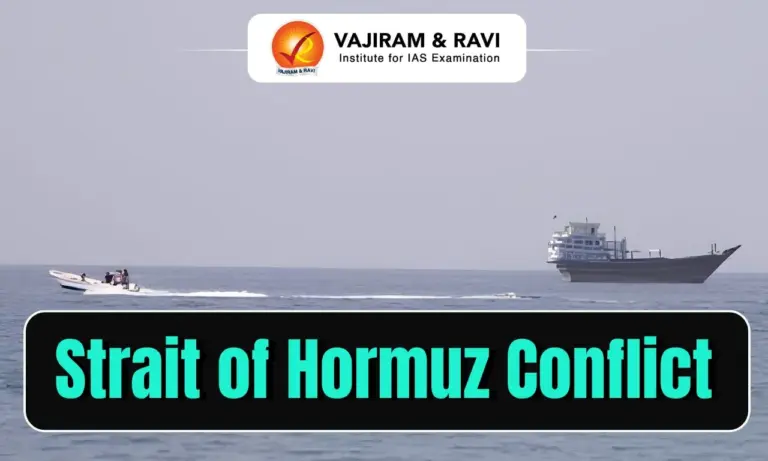
Strait of Hormuz Conflict Latest News
- Fighting between the US and Iran has resumed after a fragile ceasefire, with the conflict’s second phase centred almost entirely on control of the Strait of Hormuz, the strategic waterway through which 20% of the world’s energy supply flows.
- The renewed hostilities have significant stakes for India, given its large expatriate population in West Asia and its dependence on energy imports through the strait.
Background: The Ceasefire and MoU
- The US and Iran agreed to a ceasefire on June 14, followed by a Memorandum of Understanding (MoU) signed on June 17. Key terms included:
- Iran would allow ships free passage for 60 days through the Strait of Hormuz.
- Iran would work with Oman to define the strait’s future administration and maritime services.
- However, tensions emerged almost immediately, suggesting the two sides never truly agreed on the strait’s long-term status.


How Iran Asserted Control
- Two days after the MoU, Iran’s Persian Gulf Strait Authority (PGSA), established in May, circulated terms reasserting itself as the nodal transit authority, requiring vessels to hold passage permits and PGSA-approved insurance.
- Though free initially, fees were reserved for later, effectively formalising Iran’s stake in the strait’s management.
- While US-Iran delegations met in Switzerland on June 21 and sanctions were lifted the next day. But the PGSA, already sanctioned, was never explicitly relieved — leaving shipping firms wary of dealing with it.
The Omani Route Controversy
- Later, the International Maritime Organization (IMO), working with Oman, announced a temporary corridor: a southern route via Oman alongside Iran’s preferred northern route.
- This effectively formalised the Omani route without Iran’s consultation, prompting Tehran to call any route other than its own “unauthorised and dangerous.”
Breakdown of Doha Talks
- Later, US and Iranian officials met in Doha, where Iran and Oman reportedly proposed a voluntary toll modelled on the Malacca-Singapore Straits. The US rejected this in favour of restoring the pre-war status quo.
- Notably, the Maritime and Port Authority of Singapore clarified that the Malacca and Singapore Straits, like Hormuz, are “Straits Used for International Navigation,” where no fees or tolls are levied on transit passage.
- A voluntary Aids to Navigation Fund exists but is explicitly not a toll.
- Talks in Doha ultimately broke down over US resistance to any formal management arrangement for Hormuz.
- As a result, fighting resumed in mid-July.
- On July 7, Iran struck three ships on the Omani route, including the India-bound Al Rekayyat, one of the largest LNG carriers built, an incident considered one of shipping’s worst-case scenarios.
- Trump declared the ceasefire over.
Why Iran Won’t Back Down
- In the second phase, Iran has also targeted alternatives to the strait, hitting ship-to-ship transfers off UAE’s Fujairah pipeline and pushing the Houthis to disrupt Saudi Arabia’s East-West pipeline route via Red Sea attacks.
- Despite the MoU’s promise of economic relief for a sanctions-hit economy, Iran’s resistance stems from two factors:
- Distrust of US commitments — new leader Ayatollah Mojtaba Khamenei called Trump’s signature “utterly worthless and devoid of credibility” after alleged repeated breaches.
- The imperative to retain control over Hormuz, its most significant strategic leverage.
- Iran has also continued pushing for a formal transit fee, an Iranian Environmental Protection Agency official reportedly sought “environmental services” charges from ships, citing UNCLOS provisions, according to the Institute for the Study of War (ISW).
Military Lessons from the Conflict
- According to ISW, Iran has adapted its tactics, deploying high-speed, manoeuvrable missiles and increasingly using cluster munitions to compensate for accuracy issues seen in earlier strikes against Israel.
- For the US, the conflict has reinforced lessons from Afghanistan and Iraq: excessive, poorly targeted firepower tends to generate more adversaries rather than resolve conflict.
Stakes for India
- India faces both humanitarian and economic risks from the conflict:
- Human cost: Fourteen Indians have died and two remain missing since the war began on February 28, mostly seafarers and workers in the Gulf. New Delhi has protested the loss of lives to both Iran and the US.
- Economic impact: Rising energy prices linked to the conflict are already having an inflationary and market impact on India’s economy.
- India has urged both parties to return to dialogue and diplomacy, cautioning against a global economic slowdown that would disproportionately hurt the Global South.
Conclusion
- The US-Iran conflict’s second phase shows that control over the Strait of Hormuz, not broader territorial ambitions, is now the central battleground.
- With insurers pricing in continued risk and both sides digging in, a durable resolution remains elusive, leaving India exposed to rising energy costs and continued risk to its citizens working across the Gulf and at sea.

 Last updated on Sep, 2026
→ UPSC 2027 Notification will be released on 13 January 2027 at upsconline.nic.in.
→ Check out the latest UPSC Syllabus here.
→ Download UPSC Model Answers for Mains 2026
→ UPSC Mains Question Paper 2026 is out now for Essay & GS Paper 1, 2, 3 & 4.
→ UPSC Calendar 2027 has been released.
→ Enroll in Vajiram & Ravi’s UPSC Mains Test Series 2027 for structured answer writing practice, expert evaluation, and exam-oriented feedback.
→ Join Vajiram & Ravi’s UPSC Mentorship Program 2027 for personalized guidance, strategy planning, and one-to-one support from experienced mentors.
→ Go through the UPSC Mains Previous Year Papers to enhance your preparation.
→ UPSC has released UPSC Toppers List 2025 with the Civil Services final result on its official website.
→ Also check Best UPSC Coaching in India
Strait of Hormuz Conflict FAQs
Q1. Why is the Strait of Hormuz Conflict central to the second phase of the US-Iran war?+
Q2. How did the Doha talks influence the Strait of Hormuz Conflict?+
Q3. Why is the Strait of Hormuz Conflict significant for India?+
Q4. What military lessons have emerged from the Strait of Hormuz Conflict?+
Q5. What broader geopolitical challenge does the Strait of Hormuz Conflict highlight?+
Tags: Strait of Hormuz Conflict upsc current affairs upsc mains current affairs