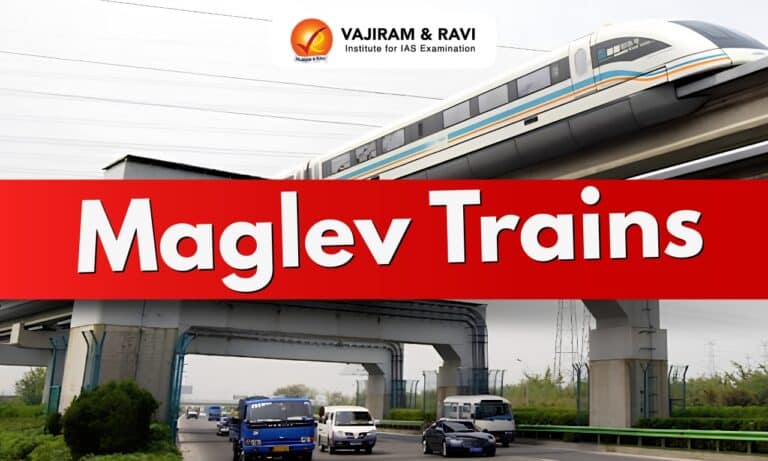
Maglev Trains Latest News
- Magnetic levitation (maglev) technology has drawn renewed global interest as countries explore high-speed rail options that use magnetic fields to lift and propel trains at speeds exceeding 400 km/hr.
About Magnetic Levitation
- Maglev is a portmanteau of “magnetic levitation.” Instead of running on wheels like conventional trains, maglev technology uses strong magnetic fields to lift the train and move it forward. Since the train floats above the track:
- No rolling friction during normal operations
- Not affected by weather conditions like rain or snow
- Extremely high speeds possible, topping 400 km/hr
- Smooth ride for passengers with minimal vibration
- The Physics Behind Levitation
- Nature has four fundamental forces:
- Two nuclear forces (strong and weak)
- Electromagnetic force
- Gravity
- Gravity is the weakest by far, around 10³⁹ times weaker than the electromagnetic force. This is why a small magnet can stick to a fridge despite the entire gravitational pull of the Earth.
- The same principle enables lifting trains weighing 150 to 500 tonnes using magnetic forces.
- Nature has four fundamental forces:


How Maglev Trains Are Lifted
- Electromagnetic Suspension (EMS)
- The most common maglev technology uses Electromagnetic Suspension (EMS):
- The train has two “arms” that wrap around the guideway.
- Strong electromagnets on these arms point magnetic fields upward toward protruding parts of the guideway.
- The train’s arms wrap only halfway around the guideway, similar to how fingers wrap around a bag’s strap.
- When electromagnets are turned on, they attract the train toward the guideway, pushing it upward.
- Sensors ensure the train floats at around 10 mm above the guideway at all times.
- Electrodynamic Suspension (EDS)
- A related technology called Electrodynamic Suspension (EDS) uses:
- Superconducting magnets on the train, cooled to very low temperatures.
- As the train moves, the magnets induce an electric current in coils built into the sides of the tracks (electromagnetic induction).
- This creates a repulsive force that pushes the train up.
- The train hovers higher, at around 100 mm above the track.
- Requires the train to reach around 100 km/hr using wheels before the effect kicks in.
- Can support higher speeds; Japan’s SCMAGLEV EDS system achieved 603 km/hr during testing in 2015.
- EMS systems typically operate at around or under 500 km/hr.
How Maglev Trains Move Forward
- The propulsion system works as follows:
- The walls of the guideway are lined with coils carrying an alternating current (AC).
- This current creates a magnetic field that constantly shifts its poles (north to south) along the track.
- The magnets on the train are attracted to the opposite pole ahead and repelled by the like pole behind.
- The train is simultaneously pulled forward from the front and pushed forward from the back.
- To increase speed, engineers just need to increase the frequency of the AC.
- To slow down or stop, the current direction is switched to reverse the magnetic field.
- Regenerative braking can divert energy saved by braking back to the electric grid.
- Maintaining Stability
-
- Side magnets ensure the train stays centred by repelling/attracting as needed.
- For emergencies or magnetic brake failure, friction brakes are also fitted.
- Auxiliary wheels with braking systems similar to those of regular trains.
- Braking pads between the guideway and train apply friction.
Downsides of Maglev Technology
- Infrastructure Requirements
- Dedicated guideways are required; they cannot reuse existing rail infrastructure or stations.
- Precision engineering is needed for magnets and coils in the guideway.
- Very expensive infrastructure, the Shanghai Maglev (completed in 2004) cost Rs. 580 crore to Rs. 720 crore per kilometre (inflation-adjusted).
- This excludes the cost of preparing local terrain and ongoing operational costs.
- Economic Viability
- Requires very high and consistent passenger demand to justify costs.
- High maintenance and operational expenses.
- Limited scalability compared to conventional rail.
- Engineering Challenges
- Trains moving over 300 km/hr experience significant aerodynamic resistance.
- This requires aerodynamic designs, including bird-beak-shaped front portions.
- Additional design considerations add to the overall costs.
Applications Beyond Trains
- Industrial Applications
- High-speed turbines and compressors suspend rotating shafts in magnetic fields instead of conventional bearings
- Aircraft carriers use linear motor technology (similar to maglev propulsion) to accelerate aircraft on runways
- Factory automation systems achieve rapid, precise motion for:
- Semiconductor manufacturing
- Food and medicine packaging
- CNC machining
- Inspection cameras with lasers or X-rays
- DNA sequencing
- Scientific Research
- Biological samples
- Liquid droplets
- Molten metals
- Small animals for experiments
Global Maglev Systems
- Notable Operational Systems
- Shanghai Maglev (China): Commercial service since 2004, top speed of 431 km/hr
- Linimo (Japan): Low-speed maglev, operational since 2005
- SCMAGLEV (Japan): Under construction, achieved 603 km/hr in testing
- Incheon Airport Maglev (South Korea): Low-speed maglev
- Future Prospects
- Several countries are exploring maglev for high-speed intercity travel, though the high infrastructure costs remain a significant barrier to widespread adoption.
Significance of Maglev Technology
- Transportation Revolution
- Faster travel times for intercity connectivity
- Reduced dependence on air travel for short-to-medium distance journeys
- Environmentally friendly as it can run on renewable electricity
- Reduced noise pollution compared to conventional trains
- Technological Innovation
- Demonstrates advanced applications of electromagnetism
- Drives innovation in superconducting technologies
- Contributes to precision engineering capabilities
- Enables spin-off technologies for various industries
- Economic Considerations
- High initial investment but potential long-term benefits
- Creates specialised manufacturing and engineering jobs
- Requires skilled workforce development
- Can spur regional economic development along corridors
Relevance for India
- While India currently does not have operational maglev systems, the technology has been discussed in the context of:
- High-speed rail projects like the Mumbai-Ahmedabad bullet train (which uses conventional Shinkansen technology).
- Future connectivity between major metropolitan areas.
- Semiconductor manufacturing benefiting from maglev-based automation.
- Research and development in advanced transportation technologies.
- The technology’s high cost remains a significant consideration for a country balancing multiple infrastructure priorities.
Source: TH

 Last updated on Sep, 2026
→ UPSC 2027 Notification will be released on 13 January 2027 at upsconline.nic.in.
→ Check out the latest UPSC Syllabus here.
→ Download UPSC Model Answers for Mains 2026
→ UPSC Mains Question Paper 2026 is out now for Essay & GS Paper 1, 2, 3 & 4.
→ UPSC Calendar 2027 has been released.
→ Enroll in Vajiram & Ravi’s UPSC Mains Test Series 2027 for structured answer writing practice, expert evaluation, and exam-oriented feedback.
→ Join Vajiram & Ravi’s UPSC Mentorship Program 2027 for personalized guidance, strategy planning, and one-to-one support from experienced mentors.
→ Go through the UPSC Mains Previous Year Papers to enhance your preparation.
→ UPSC has released UPSC Toppers List 2025 with the Civil Services final result on its official website.
→ Also check Best UPSC Coaching in India
Maglev Trains FAQs
Q1. What is maglev technology?+
Q2. How fast can maglev trains travel?+
Q3. What are the two main types of magnetic suspension used in maglev trains?+
Q4. Why are maglev trains expensive to build?+
Q5. What was the famous frog levitation experiment?+
Tags: maglev trains mains articles upsc current affairs upsc mains current affairs