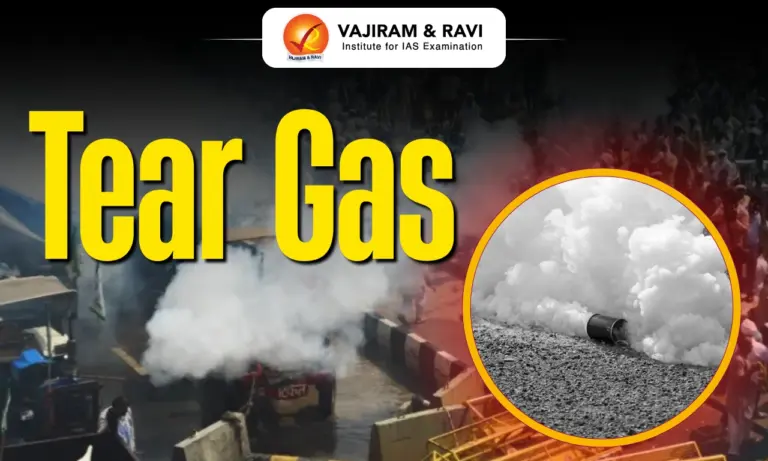
Tear gas, also known as a lachrymator, is a chemical irritant widely used by law enforcement agencies for crowd control, riot management, and self-defense. Although commonly called a “gas,” it is actually a fine aerosol or solid particles dispersed into the air. Tear gas temporarily affects the eyes, skin, and respiratory system, causing intense irritation that forces people to move away from the affected area.
What Is Tear Gas Made Of?
Tear gas was recently in the news after Delhi Police used tear gas shells and baton charges to disperse protesters during the “Chalo Sansad” march organised by the youth-led Cockroach Janta Party (CJP) on 20 July 2026.
How Does Tear Gas Work?
Tear gas consists of chemical irritants that stimulate the body’s sensory nerves. These chemicals are packaged in grenades, cartridges, spray canisters, or projectiles and released as fine airborne particles.
The most commonly used tear gas agents include:
- CS (2-Chlorobenzalmalononitrile): The most widely used riot control agent globally.
- CN (Chloroacetophenone): An older agent that is generally more toxic than CS.
- CR (Dibenzoxazepine): A highly potent irritant effective even at low concentrations.
- OC (Oleoresin Capsicum): A natural extract from chili peppers, commonly known as pepper spray.
- Other components may include propellants, solvents, and pyrotechnic compounds that help disperse the chemical.


Types of Tear Gas Agents (CS, CN, CR, and OC)
Different tear gas agents vary in their chemical composition, strength, and duration of effects. While all are designed to temporarily incapacitate individuals by irritating the eyes, skin, and respiratory system, they differ in toxicity and common applications.
1. CS (2-Chlorobenzalmalononitrile)
- Most widely used tear gas agent for riot control.
- Causes intense eye irritation, coughing, and breathing discomfort.
- Effective for dispersing crowds within seconds.
- Considered less toxic than CN when used appropriately.
2. CN (Chloroacetophenone)
- One of the earliest tear gas agents developed.
- Produces severe eye, skin, and respiratory irritation.
- More toxic than CS and may cause prolonged effects.
- Its use has declined in many countries due to health concerns.
3. CR (Dibenzoxazepine)
- A highly potent riot control agent effective in very small quantities.
- Causes intense burning of the eyes, skin, and respiratory tract.
- More resistant to removal with water than CS or CN.
- Can produce longer-lasting irritation after exposure.
4. OC (Oleoresin Capsicum)
- A natural extract derived from chili peppers (capsaicin).
- Commonly known as pepper spray.
- Frequently used by police and individuals for self-defense.
- Causes temporary burning, excessive tearing, coughing, and temporary blindness.
Uses of Tear Gas in Law Enforcement
Tear gas is used by law enforcement agencies as a less-lethal crowd control tool to maintain public order and manage situations where there is a risk of violence. It is intended to temporarily disperse individuals while reducing the need for more forceful methods.
- Dispersing violent crowds during protests, riots, and unlawful assemblies.
- Controlling public disturbances to restore law and order.
- Managing prison riots and preventing escalation within correctional facilities.
- Supporting high-risk arrests by temporarily incapacitating suspects.
- Assisting hostage rescue and tactical operations in confined or high-risk environments.
- Creating safe evacuation routes during emergencies or security incidents.
- Protecting law enforcement personnel by maintaining a safe distance from aggressive individuals.
- Reducing reliance on lethal force in situations where non-lethal measures are appropriate.
- Supporting border security and checkpoint operations in certain high-risk situations, as permitted by law.
- Used under legal and operational guidelines, with emphasis on necessity, proportionality, and minimum force.
Health Effects of Tear Gas Exposure
Tear gas exposure mainly affects the eyes, skin, and respiratory system, causing immediate irritation that is usually temporary. However, prolonged exposure or exposure in enclosed spaces can result in serious health complications, particularly for vulnerable individuals.
- Causes burning, redness, excessive tearing, eye pain, and blurred vision.
- Triggers coughing, sneezing, sore throat, chest tightness, and difficulty breathing.
- Leads to skin irritation, burning sensation, redness, itching, and rashes.
- May cause temporary disorientation, dizziness, nausea, and vomiting.
- Can worsen asthma, COPD, and other chronic respiratory conditions.
- Prolonged or high-dose exposure may result in chemical burns, corneal injuries, and severe respiratory distress.
- Children, older adults, pregnant women, and people with pre-existing respiratory or eye conditions are at higher risk of complications.
- Moving to fresh air, rinsing the eyes with clean water, washing exposed skin, and removing contaminated clothing can help reduce the effects.
- Medical attention should be sought if symptoms persist or breathing difficulties become severe.
Is Tear Gas Banned Under International Law?
Tear gas is not completely banned under international law, but its use is subject to strict legal restrictions. While it is prohibited as a method of warfare, it is generally permitted for domestic law enforcement purposes, including crowd control, under national laws and international human rights standards.
- The Chemical Weapons Convention (CWC) prohibits the use of tear gas and other riot control agents as a method of warfare.
- The CWC allows the use of tear gas for domestic law enforcement, including riot control and public order management.
- Countries may use tear gas only in accordance with their national laws and operational guidelines.
- International human rights standards require that its use be necessary, proportionate, and lawful.
- Law enforcement agencies are expected to minimize harm and avoid excessive or indiscriminate use.
- Misuse of tear gas, particularly in confined spaces or against peaceful demonstrators, may raise human rights concerns and attract international scrutiny.
- The legality of tear gas depends on the context in which it is used, rather than the chemical agent itself.

 Last updated on Sep, 2026
→ UPSC 2027 Notification will be released on 13 January 2027 at upsconline.nic.in.
→ Check out the latest UPSC Syllabus here.
→ Download UPSC Model Answers for Mains 2026
→ UPSC Mains Question Paper 2026 is out now for Essay & GS Paper 1, 2, 3 & 4.
→ UPSC Calendar 2027 has been released.
→ Enroll in Vajiram & Ravi’s UPSC Mains Test Series 2027 for structured answer writing practice, expert evaluation, and exam-oriented feedback.
→ Join Vajiram & Ravi’s UPSC Mentorship Program 2027 for personalized guidance, strategy planning, and one-to-one support from experienced mentors.
→ Go through the UPSC Mains Previous Year Papers to enhance your preparation.
→ UPSC has released UPSC Toppers List 2025 with the Civil Services final result on its official website.
→ Also check Best UPSC Coaching in India
Tear Gas FAQs
Q1. What is tear gas?+
Q2. Is tear gas actually a gas?+
Q3. What are the main types of tear gas?+
Q4. How long do the effects of tear gas last?+
Q5. What are the common health effects of tear gas?+