Key features MTHL
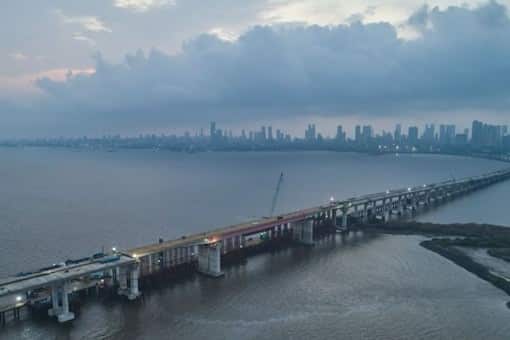
- It connects Mumbai to the mainland:
- It starts from Sewri in Mumbai to Chirle in Navi The 22-km-long sea link is the longest in the country and the tenth longest in the world.
- The project cost is Rs 17,843 crore.
- Use of Orthotropic Steel Deck technology for the first time in India:
- The sea link passes through one of the busiest navigational channels leading to Nhava Sheva Port. Orthotropic Steel Decks are special steel decks that enable a span (distance between two piers) that is up to three times longer than the norm.
- Reverse Circulation Drilling:
- This is the first time this technology was used in India. This is used for laying the pile foundation.
- Usually, a vertical drilling method is used to lay a pile foundation. This creates a lot of noise, disturbing the surroundings. This was one of the major reasons for environmentalists to oppose the project. Instead, Reverse Circulation Technology has made a difference.
- High Containment Crash Barriers: MMRDA plans to use these on the MTHL. These are special crash barriers that will push the car back on the road in case of a crash. Normal crash barriers only take the impact of a crash.
MTHL will achieve:
- Physical and economic development of Navi Mumbai and Raigad district
- Faster connectivity with the proposed Navi Mumbai International Airport
- Faster connectivity of Mumbai Port and Jawaharlal Nehru Port
- Saving in fuel, saving in travel time by about 1 hour due to reduction of distance of about 15 km between Mumbai and Navi Mumbai, Mumbai-Pune Expressway, Mumbai-Goa highway
- Help decongest traffic in Mumbai city
Q1) What is orthotropic steel?
An “orthotropic bridge” is one in which all superstructure components are made completely of steel. An “orthotropic deck bridge” is a welded, all-steel superstructure that acts as a single, integral unit. Main members may be plate, box, or other girders.
Source: En Route to Many Firsts for India: Here’s Why Mumbai Trans Harbour Link Is An Engineering Marvel


 Last updated on Sep, 2026
→ UPSC 2027 Notification will be released on 13 January 2027 at upsconline.nic.in.
→ Asian Games 2026 are being held in Aichi-Nagoya, Japan, from 19 September to 4 October.
→ Check out the latest UPSC Syllabus here.
→ Download UPSC Model Answers for Mains 2026
→ UPSC Mains Question Paper 2026 is out now for Essay & GS Paper 1, 2, 3 & 4.
→ UPSC Calendar 2027 has been released.
→ Enroll in Vajiram & Ravi’s UPSC Mains Test Series 2027 for structured answer writing practice, expert evaluation, and exam-oriented feedback.
→ Join Vajiram & Ravi’s UPSC Mentorship Program 2027 for personalized guidance, strategy planning, and one-to-one support from experienced mentors.
→ Go through the UPSC Mains Previous Year Papers to enhance your preparation.
→ UPSC has released UPSC Toppers List 2025 with the Civil Services final result on its official website.
→ Also check Best UPSC Coaching in India