The alleged use of pellet guns during a protest in Delhi in July 2026 has renewed attention on pellet guns, their working, use by security forces and the need for safer crowd-control methods.
Pellet Guns Meaning
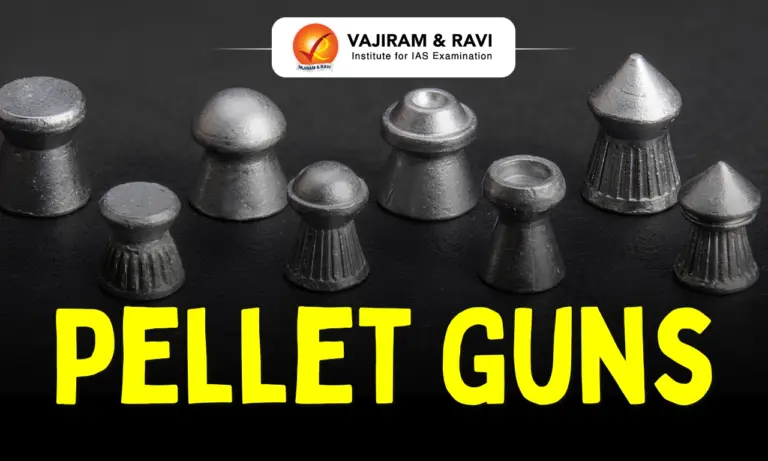
Pellet guns used by security forces are generally modified pump-action shotguns that fire cartridges containing hundreds of small pellets.
- The pellets are generally made of metal, commonly lead and may be spherical or irregular in shape.
- They are classified as less-lethal weapons, as they are intended to reduce the possibility of death compared to conventional firearms.
- However, they can cause serious injuries, particularly to the eyes, face and head.
- Their effective range depends on the weapon and ammunition; some pellet guns have been described as effective up to 500 yards.
- In India, such weapons and ammunition have been associated with production at Ordnance Factory, Ishapore.
Pellet Guns Working Mechanism
Pellet guns used for crowd control generally fire cartridges containing hundreds of small metallic pellets. Their working mechanism follows a simple sequence:
- A cartridge containing multiple pellets is loaded into the gun.
- When the trigger is pulled, the propellant inside the cartridge burns and produces high-pressure gases.
- The pressure generated by these gases propels the pellets out through the barrel.
- Unlike a conventional bullet, which generally travels as a single projectile, the pellets spread out over an area after leaving the barrel.
- This allows the weapon to cover a wider area, but also makes it difficult to control the exact point of impact of each individual pellet.


Pellet Guns Use in India
Pellet guns became particularly associated with crowd control in Jammu and Kashmir.
- They were introduced as a less-lethal alternative to conventional firearms following violent unrest and fatalities caused by police firing during the 2010 unrest.
- Their use became especially prominent during the 2016 unrest in the Kashmir Valley following the killing of Hizbul Mujahideen commander Burhan Wani.
- They have been associated with specialised crowd-control units such as the Rapid Action Force (RAF) of the CRPF.
- Their use has also been reported in other public-order situations, including Manipur in 2023 and the Punjab-Haryana farmers’ protests in 2024, though their use has sometimes been denied by authorities.
Pellet Guns Concerns
The main concern is that pellet guns can cause serious and permanent injuries despite being classified as less-lethal weapons. Major concerns include:
- Eye injuries: Pellets can cause permanent vision loss or blindness.
- Serious bodily injuries: Pellets can penetrate soft tissues.
- Wide-area impact: A single cartridge releases many pellets, making precise targeting difficult.
- Risk to bystanders: Pellets may hit people who are not directly involved in violence.
- Close-range danger: The risk of serious injury increases when fired from a short distance.
Pellet Guns Regulations in India
India does not have a single dedicated law exclusively governing the operational use of pellet guns in crowd control. Their use is regulated through a combination of laws, rules, SOPs and constitutional principles.
Arms Act, 1959 and Arms Rules, 2016: The Arms Act, 1959 and the Arms Rules, 2016 provide the broader legal framework governing arms and ammunition.The rules relating to civilian air weapons should not be confused with pump-action pellet guns used by security forces for crowd control.
Standard Operating Procedures: The use of pellet guns is also governed by operational protocols and Standard Operating Procedures (SOPs) of the concerned security forces. These require consideration of:
- The seriousness of the threat.
- The need to protect security personnel and civilians.
- The availability of less harmful alternatives.
- The necessity and proportionality of the use of force.
Constitutional Safeguards: The use of force by the State must be consistent with constitutional principles:
- Article 14: Protection against arbitrary state action.
- Article 19: Right to freedom of speech and peaceful assembly, subject to reasonable restrictions.
- Article 21: Protection of life and personal liberty.
Therefore, crowd-control measures must follow the principles of necessity, proportionality and reasonableness.
Pellet Guns Alternatives
Following concerns over injuries caused by pellet guns, the Ministry of Home Affairs constituted an Expert Committee headed by T.V.S.N. Prasad in 2016 to examine alternatives to pellet guns and recommend safer crowd-control technologies.
India has developed and explored several alternatives:
- Plastic bullets: Developed by the DRDO’s Terminal Ballistics Research Laboratory (TBRL), Chandigarh, as an alternative to metal pellets.
- PAVA-based devices: Use a chilli-based irritant to temporarily incapacitate or disperse violent crowds.
- Tear-smoke devices: Used to disperse crowds without using metal projectiles.
- STUN-LAC devices: Use a combination of sound, light and irritant effects.
- Water cannons: Used to create distance and disperse crowds.
- Rubber bullets and other less-lethal systems
Way Forward
- Graduated use of force: Begin with dialogue, warnings and persuasion before moving to stronger crowd-control measures.
- Clear SOPs: Clearly define when, how and under whose authority pellet guns may be used.
- Better training: Train personnel in de-escalation, crowd management and proportional use of force.
- Safer technology: Invest in alternatives that reduce the risk of permanent injuries.
- Accountability: Maintain records of the use of pellet guns and conduct independent reviews of serious incidents.
- Medical preparedness: Ensure immediate medical assistance during major crowd-control operations.

 Last updated on Sep, 2026
→ UPSC 2027 Notification will be released on 13 January 2027 at upsconline.nic.in.
→ Asian Games 2026 are being held in Aichi-Nagoya, Japan, from 19 September to 4 October.
→ Check out the latest UPSC Syllabus here.
→ Download UPSC Model Answers for Mains 2026
→ UPSC Mains Question Paper 2026 is out now for Essay & GS Paper 1, 2, 3 & 4.
→ UPSC Calendar 2027 has been released.
→ Enroll in Vajiram & Ravi’s UPSC Mains Test Series 2027 for structured answer writing practice, expert evaluation, and exam-oriented feedback.
→ Join Vajiram & Ravi’s UPSC Mentorship Program 2027 for personalized guidance, strategy planning, and one-to-one support from experienced mentors.
→ Go through the UPSC Mains Previous Year Papers to enhance your preparation.
→ UPSC has released UPSC Toppers List 2025 with the Civil Services final result on its official website.
→ Also check Best UPSC Coaching in India
Pellet Guns FAQs
Q1. What are Pellet Guns?+
Q2. How do Pellet Guns work?+
Q3. What are Pellets made up of?+
Q4. Why are Pellet Guns used for crowd control?+
Q5. What is the key concern regarding the use of Pellet Guns in India?+
Tags: pellet guns