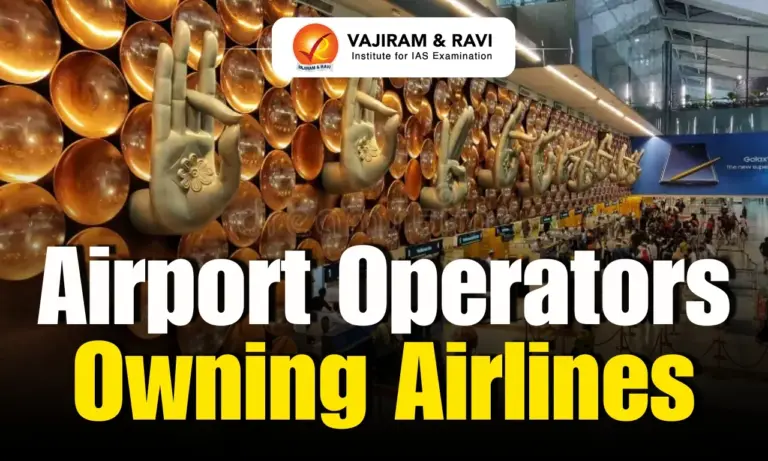
Airport Operators Owning Airlines Latest News
- The Centre is reportedly weighing policy relaxations that could allow Indian airport operators to own airlines. Preliminary internal discussions are underway, though nothing is finalised.
- Such a move could open the door for airport operators like the Adani group and GMR group to enter the airline business.
Background of the Discussion
- Initial talks on cross-ownership reportedly followed the Adani group’s request for an enabling policy environment, though Adani Enterprises has denied evaluating any airline entry proposal.
- The government has been pushing for more airlines in Indian skies, given that IndiGo and the Air India group together hold over 90% of the domestic market share — a near-duopoly.
- The stated objective behind exploring this policy shift is to foster greater competition in the aviation sector.


Current Regulatory Restrictions
- India currently imposes strict limits on cross-ownership between airports and airlines:
- Operators of India’s largest airports — Delhi (GMR, 74% stake) and Mumbai (Adani group, 74% stake) — are barred from owning more than 10% in any scheduled carrier.
- The reverse restriction also applies: airlines face strict limits on owning airports.
The Core Concern: Conflict of Interest
- Experts warned that allowing airport operators to run airlines would create a “massive conflict of interest” against consumer interests.
Key risk areas
- Slot allocation: If an airport operator also runs an airline, and is simultaneously the slot coordinator, there is inherent conflict in allocating prime slots between its own airline and competitors.
- Infrastructure access: Airlines depend on airports for critical facilities — parking bays, check-in counters, aircraft stands, boarding gates, and ground handling. Any perceived favouritism, even unintentional, could trigger anti-competitive practice allegations.
- Experts note that even without actual discrimination, the appearance of unequal treatment undermines stakeholder confidence — a key concern for anti-trust regulation, which focuses on maintaining a level playing field, not just proven wrongdoing.
The Counter-Argument: Capital and Efficiency
- Experts acknowledge the rationale behind considering this move:
- Capital access: New airlines often cannot sustain losses for years against dominant incumbents, but well-capitalised airport operators like Adani and GMR can absorb such risk.
- Efficiency argument: Since airport revenues increasingly depend on passenger footfall, an airport-owning-airline model could incentivise more flights at lower fares rather than fewer at higher fares.
Global Practices
- Aviation regulators worldwide have generally favoured keeping airports and airlines operationally separate:
- West Asia: In hubs like Dubai, Abu Dhabi, and Doha, airports and airlines are government-owned but remain distinct corporate entities (e.g., Dubai Airport and Emirates; Etihad and Abu Dhabi airport).
- Singapore: Changi Airport and Singapore Airlines are linked via state investment but maintain separate management and regulatory oversight.
- Key distinction: These hub models operate in markets with negligible domestic air traffic and no domestic competition — unlike India, where airlines are largely private and domestic competition is significant.
- European Union: Enforces some of the world’s strictest competition rules, mandating that airport slot coordinators remain functionally independent from any interested party.
- United States: Most major airports are owned by city/county governments or independent authorities. Federal Aviation Administration grant assurances prohibit airport discrimination among airlines and bar airport revenue from being invested in airlines.
- India’s market structure — dominated by private airlines and increasingly private airport operators — makes it structurally closer to Europe than to the West Asian or Singapore hub models.
Safeguards Needed, If Policy Changes
- Experts recommend a watertight regulatory framework, including:
- Structural separation between airport and airline businesses
- Independent boards and management teams for each entity
- Strict protection of carriers’ commercially sensitive information
- Independent airport slot coordinators
- Transparent gate and terminal allocation policies
- Enhanced oversight by regulators — the Airports Economic Regulatory Authority of India (AERA), Directorate General of Civil Aviation (DGCA), and the Competition Commission of India (CCI)
Conclusion
- Allowing airport operators to own airlines could inject much-needed capital and competition into India’s airline duopoly, but it risks compromising the neutrality airports must maintain as shared infrastructure.
- Any policy shift will need robust structural and regulatory safeguards to prevent the natural monopoly of airports from tilting the competitive playing field in aviation.

 Last updated on Sep, 2026
→ UPSC 2027 Notification will be released on 13 January 2027 at upsconline.nic.in.
→ Asian Games 2026 are being held in Aichi-Nagoya, Japan, from 19 September to 4 October.
→ Check out the latest UPSC Syllabus here.
→ Download UPSC Model Answers for Mains 2026
→ UPSC Mains Question Paper 2026 is out now for Essay & GS Paper 1, 2, 3 & 4.
→ UPSC Calendar 2027 has been released.
→ Enroll in Vajiram & Ravi’s UPSC Mains Test Series 2027 for structured answer writing practice, expert evaluation, and exam-oriented feedback.
→ Join Vajiram & Ravi’s UPSC Mentorship Program 2027 for personalized guidance, strategy planning, and one-to-one support from experienced mentors.
→ Go through the UPSC Mains Previous Year Papers to enhance your preparation.
→ UPSC has released UPSC Toppers List 2025 with the Civil Services final result on its official website.
→ Also check Best UPSC Coaching in India
Airport Operators Owning Airlines FAQs
Q1. Why is the proposal on Airport Operators Owning Airlines being considered?+
Q2. What is the biggest concern regarding Airport Operators Owning Airlines?+
Q3. How do global aviation markets regulate Airport Operators Owning Airlines?+
Q4. What safeguards are needed if Airport Operators Owning Airlines is permitted?+
Q5. Why is Airport Operators Owning Airlines significant for India's aviation sector?+
Tags: Airport Operators Owning Airlines mains articles upsc current affairs upsc mains current affairs