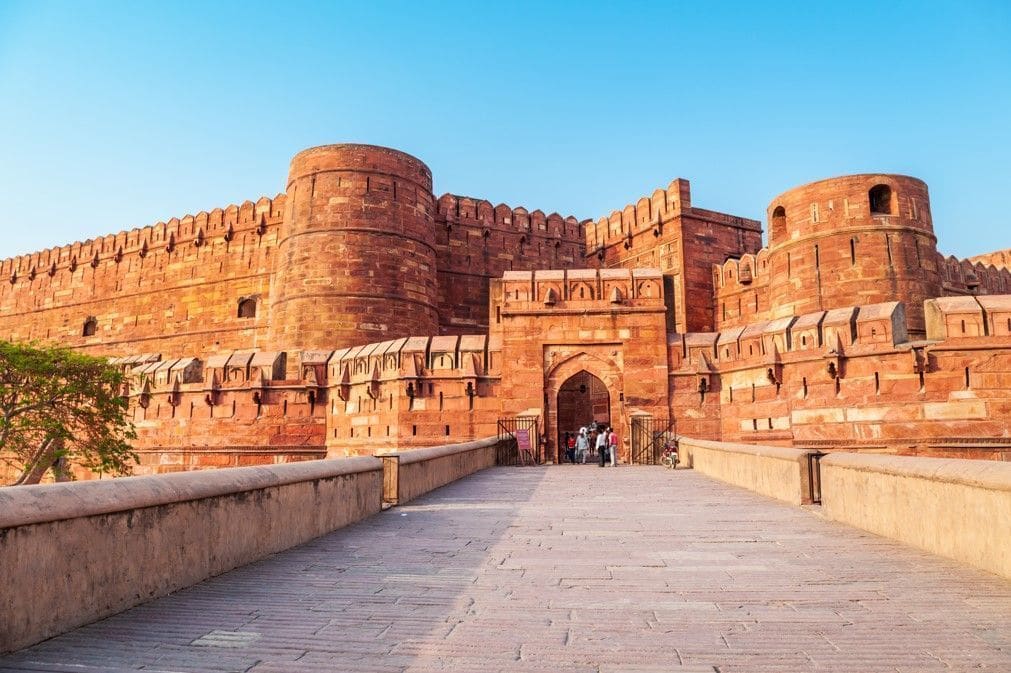
About Agra Fort:
- Location:
- It is a large 16th-century fortress of red sandstone located on the banks of Yamuna River in the historic city of Agra, west-central Uttar Pradesh.
- It is about 5 km northwest of its more famous sister monument, the Taj Mahal.
- History:
- It was built under the commission of Emperor Akbar in 1565.
- It was only during the reign of Akbar’s grandson, Shah Jahan, that the site took on its current state.
- It was the main residence of the emperors of the Mughal Dynasty till 1638, when the capital was shifted from Agra to Delhi.
- The fort was invaded and captured by the Maratha Empire in the early 18th century. Thereafter, it changed hands between the Marathas and their foes many times.
- After their catastrophic defeat at Third Battle of Panipat by Ahmad Shah Abdali in 1761, Marathas remained out of the region for the next decade. Finally Mahadji Shinde took the fort in 1785.
- It was lost by the Marathas to the British during the Second Anglo-Maratha War, in 1803.
- The fort was the site of a battle during the Indian rebellion of 1857, which caused the end of the British East India Company’s rule in India, and led to a century of direct rule of India by Britain.
- Features:
- The fort is crescent-shaped, with a long, nearly straight wall facing the Yamuna river on the east side.
- The fort houses a maze of buildings, including vast underground sections.
- The outer wall is surrounded by a wide and deep moat on three sides.
- The Agra Fort has four main gateways- the Khizri Gate, Amar Singh Gate, Delhi Gate and Ghazni Gate.
- Among the major attractions in the fort is Jahāngīr’s Palace (Jahāngīri Mahal), built by Akbar as a private palace for his son Jahāngir.
- The fort complex was designated a UNESCO World Heritage site in 1983.
Q1) What is the Archaeological Survey of India (ASI)?
The Archaeological Survey of India (ASI), under the Ministry of Culture, was established in the year 1861 as the premier organization for the archaeological research and protection of the cultural heritage of the nation.
Source: Who built the Agra Fort? ASI doesn’t know


 Last updated on Oct, 2026
→ UPSC 2027 Notification will be released on 13 January 2027 at upsconline.nic.in.
→ Check Nobel Prize 2026 Winners List here.
→ Download PIB PRiSM Monthly Magazine 2026 here.
→ Check UPSC Monthly Current Affairs Magazine The Recitals here.
→ Check out the latest UPSC Syllabus here.
→ Download UPSC Model Answers for Mains 2026
→ UPSC Mains Question Paper 2026 is out now for Essay & GS Paper 1, 2, 3 & 4.
→ UPSC Calendar 2027 has been released.
→ Enroll in Vajiram & Ravi’s UPSC Mains Test Series 2027 for structured answer writing practice, expert evaluation, and exam-oriented feedback.
→ Join Vajiram & Ravi’s UPSC Mentorship Program 2027 for personalized guidance, strategy planning, and one-to-one support from experienced mentors.
→ Go through the UPSC Mains Previous Year Papers to enhance your preparation.
→ UPSC has released UPSC Toppers List 2025 with the Civil Services final result on its official website.
→ Also check Best UPSC Coaching in India