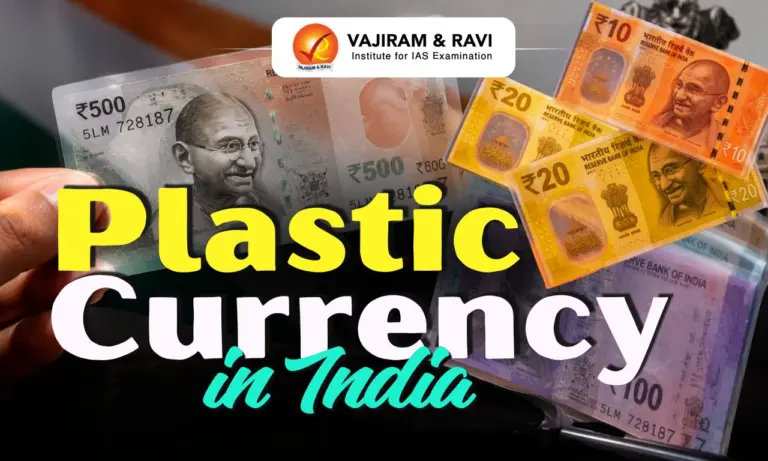
Plastic Currency in India has re-emerged as a major currency management reform after the Reserve Bank of India (RBI) revived its long pending proposal to introduce polymer banknotes. The initiative aims to improve the durability, security and efficiency of India’s currency system without replacing existing paper notes.
The government has approved field trials of ₹10 and ₹20 polymer notes, while making it clear that polymer and paper banknotes will circulate together.
Plastic Currency in India Latest News 2026
The RBI has revived its polymer currency proposal by initiating fresh procurement of polymer substrates for pilot testing. The government has approved field trials before any regular circulation begins.
- Approval for field trials: The Government of India approved the RBI’s proposal to conduct field trials using one billion ₹10 polymer notes and one billion ₹20 polymer notes. Regular issuance will begin only after successful evaluation of the pilot project under real circulation conditions.
- No replacement of paper currency: The Ministry of Finance clarified that polymer banknotes will be issued alongside existing cotton-paper banknotes. There is currently no proposal to completely replace India’s paper currency with polymer based notes.
- Global Expression of Interest (EOI): RBI’s currency printing company, Bharatiya Reserve Bank Note Mudran Pvt. Ltd. (BRBNMPL), has invited global Expressions of Interest for supplying Biaxially Oriented Polypropylene (BOPP) polymer substrates equipped with advanced security features for future polymer banknotes.
What is a Polymer Note?
Polymer notes are banknotes manufactured using Biaxially Oriented Polypropylene (BOPP) instead of traditional cotton based paper. They are designed for longer circulation and stronger security.
- Durability: International studies cited by the RBI show that polymer notes generally remain in circulation 2.5 to 4 times longer than paper notes, especially for lower denominations that experience heavy handling.
- Damage Resistance: Polymer notes are more resistant to moisture, dirt, folding and tearing, reducing the number of damaged notes that require replacement under the RBI’s Clean Note Policy.
- Advanced features: Polymer notes can incorporate transparent windows, metallic numerals, magnetic pseudo-threads, holograms, shadow images, iridescent patterns and durable tactile markings for visually impaired persons, making counterfeiting significantly more difficult.


Need for Plastic Currency in India
Plastic currency is being considered in India to improve note durability, reduce costs, strengthen security and make currency management more efficient.
- Reduce replacement of damaged notes: Under the RBI’s Clean Note Policy, around 20 to 24 billion soiled banknotes are destroyed every year. Polymer notes last much longer, reducing the need for frequent replacement.
- Lower long term currency management costs: The RBI spends thousands of crores on printing and managing currency. Longer lasting notes can reduce repeated printing, transportation and destruction costs.
- Improving counterfeit protection: RBI detected around 2.3 lakh counterfeit banknotes during 2025-26. Polymer notes support advanced security features that are more difficult to copy than conventional paper currency.
- Increase the life of frequently used notes: ₹10 and ₹20 notes are used the most in daily transactions and wear out quickly. Polymer notes are better suited for these denominations because they remain usable for a longer period.
Countries Using Plastic Currency
Many countries have adopted polymer banknotes after observing improvements in currency durability, security and lifecycle costs despite higher production expenses.
- Australia became the first country to introduce polymer currency in 1988 and has since completely shifted to polymer banknotes.
- Around 60 countries currently use polymer banknotes in some form, including Canada, the United Kingdom, New Zealand, Singapore, Malaysia, Vietnam, Mexico, Brazil, Saudi Arabia, Romania and Barbados.
Bharatiya Reserve Bank Note Mudran Pvt Ltd (BRBNMPL)
BRBNMPL is the RBI’s specialised currency printing company responsible for producing banknotes and supporting India’s currency management infrastructure.
- Establishment: BRBNMPL was established in 1995 under the Companies Act as a wholly owned subsidiary of the RBI to strengthen India’s secure banknote printing capacity.
- Headquarter: The organisation is headquartered in Bengaluru, Karnataka and operates two high security printing presses at Mysuru (1996) and Salboni (2000).
- Primary Responsibilities: BRBNMPL prints banknotes according to RBI requirements, procures specialised banknote paper, security inks and printing materials and applies advanced anti counterfeiting technologies.
- Role in Polymer Currency: The organisation has issued global Expressions of Interest for BOPP polymer substrates.
Plastic Currency in India Impacts
The launch of Polymer Currency in India can influence India’s currency management in the following manner:
- Reduced operational expenditure: Although polymer notes cost more to produce initially, their longer lifespan reduces frequent printing, transportation, storage, processing and destruction costs over time.
- Enhanced public confidence: Better durability and stronger protection against counterfeiting can improve confidence in physical currency while ensuring cleaner notes remain available for longer periods.
- Environmental advantages: A TERI study commissioned by the RBI found that polymer notes can reduce lifecycle carbon emissions because fewer notes need production and transport. Used notes can also be recycled into plastic products.
- Supports India’s cash economy: Despite UPI handling over 24,000 crore transactions annually and nearly 85% of retail digital payments, currency in circulation crossed ₹41 lakh crore in 2025-26, with the currency-to-GDP ratio remaining above 11%, highlighting the continued importance of cash.
Plastic Currency in India Challenges
Although Plastic Currency offers many advantages, its nationwide adoption in India faces several challenges as highlighted below:
- Higher manufacturing cost: Polymer banknotes cost around 30% to 60% more than paper notes to manufacture. In several countries, production costs for low value polymer notes have reached nearly 20% to 24% of their face value.
- Dependence on Import: Polymer notes require BOPP made from polypropylene. India imports nearly one-fifth of its polypropylene requirement, making production costs sensitive to crude oil prices, supply disruptions and geopolitical tensions, particularly in West Asia.
- Infrastructure transition expenses: Introducing polymer currency would require recalibration of ATMs, currency sorting machines, vending machines, cash processing systems and banking infrastructure, creating significant transition costs for financial institutions and businesses.
- Environmental and Recycling Challenges: Polymer notes are produced from petroleum based polypropylene, leading to a higher initial carbon footprint. Their disposal also requires specialised recycling facilities, making waste management an important policy challenge.
- Impact on Existing Currency Ecosystem: India has already invested substantially in domestic banknote paper production and indigenous security ink manufacturing. A rapid transition to plastic currency could reduce the effective use of these existing facilities before their planned economic life ends.

 Last updated on Sep, 2026
→ UPSC 2027 Notification will be released on 13 January 2027 at upsconline.nic.in.
→ Check out the latest UPSC Syllabus here.
→ Download UPSC Model Answers for Mains 2026
→ UPSC Mains Question Paper 2026 is out now for Essay & GS Paper 1, 2, 3 & 4.
→ UPSC Calendar 2027 has been released.
→ Enroll in Vajiram & Ravi’s UPSC Mains Test Series 2027 for structured answer writing practice, expert evaluation, and exam-oriented feedback.
→ Join Vajiram & Ravi’s UPSC Mentorship Program 2027 for personalized guidance, strategy planning, and one-to-one support from experienced mentors.
→ Go through the UPSC Mains Previous Year Papers to enhance your preparation.
→ UPSC has released UPSC Toppers List 2025 with the Civil Services final result on its official website.
→ Also check Best UPSC Coaching in India
Plastic Currency in India FAQs
Q1. Which Countries use Plastic Notes 2026?+
Q2. What is a Polymer Note?+
Q3. When will Plastic Currency launch in India 2026?+
Q4. Will Polymer Banknotes replace all paper currency in India?+
Q5. Why is RBI introducing Plastic Notes in India?+
Tags: plastic currency plastic currency in india plastic note plastic notes