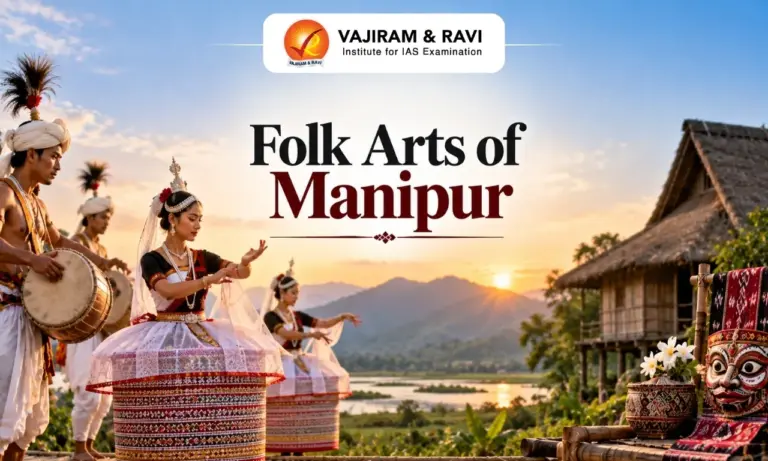
Manipur has a rich tradition of folk arts shaped by religious beliefs, community life, festivals and traditional occupations. Its cultural expressions include dance, music, storytelling, pottery, textiles, bamboo work, reed mats, cloth dolls, bell metal craft and wood carving. These Folk Arts of Manipur tradition connect artistic practices with rituals, social customs and local livelihoods. Different ethnic communities also preserve distinct forms, making Manipur’s folk arts highly diverse and culturally significant.
Folk Arts of Manipur 2026
Folk Arts of Manipur reflect the close relationship between artistic expression, religious traditions and everyday life. Dance and music remain important in festivals and ceremonies. Pottery, textiles, bamboo products, reed mats and metal crafts show strong functional value. Traditional storytelling preserves historical memories and religious narratives. These arts also reflect the skills of Meitei and hill communities. Many practices are transmitted through generations and remain closely connected with local customs.
List of Famous Folk Arts of Manipur 2026
Famous Folk Arts of Manipur include traditional dances, folk music, storytelling, pottery, metalwork, textiles, bamboo crafts, reed mats, cloth dolls and wood carving.
Folk Dances of Manipur 2026
- Ras Leela: Ras Leela presents the spiritual relationship of Radha and Krishna through solo, duet and group movements. Its major forms include Basant Rasa, Kunja Rasa, Maharasa, Nitya Rasa, Goshtha or Gopa Rasa and Ulukhal Rasa.
- Lai-Haraoba: Lai-Haraoba means festival of gods and is associated with deities such as Pakhangba and Thangjing. It occurs during Kalen, April-May and traditionally continues for a week.
- Maibi Dance: Maibi dancers are priestesses and spiritual mediums who represent the Meitei concept of creation and traditional life. Their performance portrays house construction, occupations and social activities.
- Khamba Thoibi Dance: This duet features male and female performers representing Khamba and Thoibi. It is dedicated to Thangjing, the sylvan deity of Moirang and forms part of Moirang Lai-Haraoba.
- Nupa Pala: Also called Kartal Cholom or Cymbal Dance, Nupa Pala is performed by male dancers using cymbals and Pung. It works as a prologue to Ras Lila and also appears independently.
- Pung Cholom: Pung Cholom combines drum playing with vigorous dance movements. The Pung is the traditional Manipuri drum and forms an important part of Nata Sankirtana, social ceremonies and devotional performances.
- Kartal Cholam: Kartal Cholam is a Tandava dance performed with cymbals. Male dancers execute circular movements, jumps and rhythmic patterns inspired by the movements of birds such as peacock, swan and crane.
- Manjira Cholom: Manjira Cholom is a ritualistic dance performed in the mandapa of Govindjee temple before ceremonial images of Radha and Krishna. It remains connected with the Radha-Krishna devotional tradition.
- Khuba Kishei: Khuba Kishei is a clap dance performed by men and women during Ratha Yatra. Performers participate while carrying deities in a chariot procession.
- Thouble Chongba: Thouble Chongba means dancing by moonlight in a circle. Boys, girls and adults participate in this seasonal performance, which expresses community excitement through coordinated singing and dancing.
Also Read: Folk Dances of Manipur 2026
Folk Music of Manipur 2026
- Khullong Ishei: Khullong Ishei means community singing and is commonly performed by Meities in villages during fieldwork, fishing and other activities. Its themes are often based on love.
- Lai Haraoba Ishei: Lai Haraoba Ishei consists of songs performed during Lai Haraoba ceremonies. These songs are intended to please and honour the deity during the ritual festival.
- Pena Ishei: Pena Ishei is a love song associated with the Khamba-Thoibi story. It is performed with the Pena, a traditional stringed instrument made using bamboo, gourd or coconut shell and horse tail string.
- Khongjom Parva: Khongjom Parva is a musical narration of the Battle of Khongjom fought in April 1891 between Manipuris and the British. It glorifies warriors who sacrificed their lives for their homeland.
Storytelling of Manipur 2026
- Wari Liba: Wari Liba is an indigenous storytelling tradition recorded in Manipur since the 17th century. The Mahabharata and Ramayan are important themes, preserving religious stories and traditional narratives.
Pottery of Manipur 2026
- Manipuri Pottery: Manipuri pottery is traditionally made by women without using a potter’s wheel. It serves domestic and ritual purposes, while traditional firing commonly takes place in open spaces.
- Thongjao Pottery: Thongjao Village in Thoubal District is associated with ancient pottery making traditions. The craft uses hand forming, slabbing, shaping, burnishing and open kiln firing, producing distinctive scarlet tan coloured terracotta pottery.
- Chaphu: Chaphu is a small earthen pot used during childbirth. The placenta of a newborn is kept inside it and the vessel symbolises purity and sanctity.
- Blackware, Greyware and Redware: Manipur pottery is classified by colour into blackware, greyware and redware. Nungi, Oinam, Andro, Nangpok Sekmai, Chairel, Thongojao, Ningthemeha Karong and Leimaran are associated with different pottery traditions.
Bell Metal Work of Manipur 2026
- Bell Metal Work: Meitei craftsmen practise lost wax casting using an alloy of copper and tin. Products include ceremonial and domestic vessels such as bowl chaisel and shentakal shenga.
- Senjeng: Bell metal ware is known as senjeng and has a strong market in Manipur. Craftsmen finish cast products through lathe work, polishing, drilling, engraving, hammering and embossing.
Reed Craft of Manipur 2026
- Kauna Phak: Kauna Phak uses kauna, a local reed found in marshes and stagnant water. About 1000 craftspersons in Imphal Valley practise this craft and produce square, circular and rectangular mats.
- Kauna Cushions: Square cushions are made by weaving two mats consecutively in the same warp. One mat is folded over the other to create a durable double layered structure.
Bamboo Craft of Manipur 2026
- Traditional Bamboo Products: Meitei artisans make baskets, trays and containers for offerings and gifts during religious and wedding processions. These products are often carried on the head according to local customs.
- Phingaruk: Phingaruk is a bamboo basket with a dome shaped lid. Vegetable dyed strips are used for decoration, giving the functional basket a distinctive traditional appearance.
- Long: Long is a fishing basket made by deforming a flat bamboo mat into a dome shaped container. Bamboo rings help maintain its structure.
- Leephang: Maring communities make leephang, a low dining table from bamboo splits, whole cane and split cane binding. Shaikui tree bark provides plant dye, while smoking produces deep brown colour.
Cloth Doll Craft of Manipur 2026
- Laiphadibi: Laiphadibi is a traditional cloth doll craft. The name combines lai, meaning god, phadi, meaning a shabby cloth piece and bi, indicating feminine gender.
- Traditional Laiphadibi Making: Older women traditionally make Laiphadibi through boriba, a ritual involving permission and blessings from a teacher. Materials include cotton, colourful dress fabric, beads, sequins, net, lace and jewellery.
Textiles of Manipur 2026
- Ningthou Phee and Akoibi: Ningthou phee and akoibi feature snake motifs and were associated with royalty. Ningthou phee was regarded as a royal design with special ceremonial importance.
- Angami Naga: Angami Naga is a black shawl featuring thick and bold animal motifs. Royalty traditionally presented it to brave and distinguished warriors.
- Shamilami: Shamilami combines weaving and embroidery. It was once considered a status symbol, while its regional patterns, bold colours and geometric designs reflect Manipuri textile traditions.
- Lasingphee: Lasingphee is a quilted cotton material produced in Manipur. It is traditionally used as a winter covering, with natural sources such as wild indigo used for colouring.
- Morangfi Saris: Morangfi saris are generally woven in white or soft colours. Their borders feature a mandir shikhara design with dotted patterns traditionally believed to have been created by Goddess Morangfi.
Wood Carving of Manipur 2026
- Traditional Wood Carving: Manipuri artisans use wang and heijuga for wood carving. Wang is lightweight and resistant to cracking, while heijuga is heavier and requires proper seasoning to prevent warping.
- Traditional Motifs and Lacquer Work: Artisans carve traditional Manipuri motifs on wood. Lacquer work influenced by Myanmar traditions is also used for swords, scabbards, sword handles and leather belts.


Folk Arts of Manipur Significance
Folk Arts of Manipur preserve religious beliefs, historical memories, community traditions, traditional skills and local livelihoods through diverse performing and craft practices.
- Cultural Identity: Folk arts provide distinct cultural identity to Manipur through community specific dances, songs, crafts, rituals and customary practices preserved across generations.
- Religious Importance: Ras Leela, Lai-Haraoba, Pung Cholom, Nupa Pala and other forms connect artistic expression with devotional practices, temples, deities and ceremonial occasions.
- Historical Memory: Khongjom Parva preserves the memory of the April 1891 Battle of Khongjom and honours Manipuri warriors who sacrificed their lives during the conflict.
- Community Participation: Folk performances involve different sections of society. Thouble Chongba, Khullong Ishei and Lai-Haraoba demonstrate how music and dance remain linked with collective community activities.
- Traditional Knowledge: Pottery, bamboo work, reed weaving, textiles, metal casting and wood carving preserve specialised techniques passed through generations. Many crafts depend on locally available materials and traditional skills.
- Women’s Craft Traditions: Women play an important role in several traditional crafts. Manipuri pottery is practised by women, while older women traditionally make Laiphadibi through the boriba ritual.
- Economic Importance: Kauna Phak has reached export markets and supports around 1000 craftspersons in Imphal Valley. Bell metal ware also has a strong market within Manipur.
- Threats to Continuity: Manipuri pottery faces declining demand after the arrival of metal utensils in the 19th century. Unsuitable clay, shortage of skilled potters, seasonal production and difficult firing processes create additional challenges.
- Preservation Need: Several traditional practices face pressure from changing lifestyles, machines and modern products. Laiphadibi is slowly declining, while pottery requires financial assistance, suitable guidance and stronger support for continuity.
- Distinctive Cultural Expression: Folk Arts of Manipur combine artistic skill with social, religious and historical traditions. Their diversity reflects the cultural practices of Meitei and different hill communities across the state.

 Last updated on Oct, 2026
→ UPSC 2027 Notification will be released on 13 January 2027 at upsconline.nic.in.
→ Asian Games 2026 are being held in Aichi-Nagoya, Japan, from 19 September to 4 October.
→ Check Nobel Prize 2026 Winners List here.
→ Download PIB PRiSM Monthly Magazine 2026 here.
→ Check UPSC Monthly Current Affairs Magazine The Recitals here.
→ Check out the latest UPSC Syllabus here.
→ Download UPSC Model Answers for Mains 2026
→ UPSC Mains Question Paper 2026 is out now for Essay & GS Paper 1, 2, 3 & 4.
→ UPSC Calendar 2027 has been released.
→ Enroll in Vajiram & Ravi’s UPSC Mains Test Series 2027 for structured answer writing practice, expert evaluation, and exam-oriented feedback.
→ Join Vajiram & Ravi’s UPSC Mentorship Program 2027 for personalized guidance, strategy planning, and one-to-one support from experienced mentors.
→ Go through the UPSC Mains Previous Year Papers to enhance your preparation.
→ UPSC has released UPSC Toppers List 2025 with the Civil Services final result on its official website.
→ Also check Best UPSC Coaching in India
Folk Arts of Manipur 2026 FAQs
Q1. What are the famous Folk Arts of Manipur 2026?+
Q2. What is the most famous Folk Dance of Manipur?+
Q3. What is Lai-Haraoba in Manipur?+
Q4. What is Khongjom Parva of Manipur?+
Q5. What are the major Handicrafts of Manipur?+
Q6. What is the traditional pottery of Manipur?+
Q7. What is Kauna Phak of Manipur?+
Q8. What is Laiphadibi in Manipur?+
Q9. Which musical instrument is traditionally associated with Manipur?+
Q10. Which traditional art of Manipur is associated with the Battle of Khongjom?+
Tags: folk arts folk arts of manipur