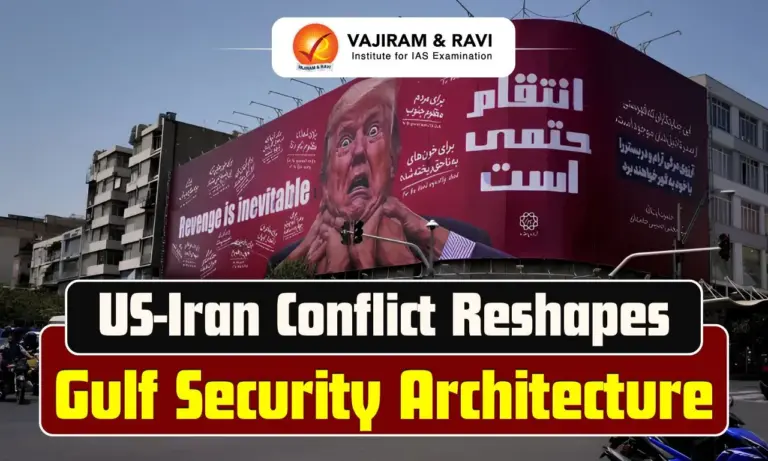
US-Iran Conflict Reshapes Gulf Security Architecture Latest News
- The US-Iran conflict has triggered significant strategic realignments among Gulf Arab states, ranging from renewed defence pacts with Pakistan to a rekindled Houthi-Saudi confrontation, with implications for regional stability and India’s energy security.
Background: The US-Iran Standoff
- US strikes targeted Iran’s capability to threaten shipping in the Strait of Hormuz, after Iran rejected American proposals for a new shipping channel through Omani waters and targeted non-compliant vessels.
- Despite the offensive, Iran retains control over Hormuz, and Tehran-Muscat talks to operationalise Article 5 (joint Iran-Oman administration of the Strait) continue — now expanded to include Saudi Arabia.
- This was seen in Iranian FM Araghchi’s talks with Saudi counterpart Faisal bin Farhan.
- Washington remains incentivised to strike Iranian nuclear and Hormuz-related targets again, as its self-defined objectives remain unmet.


Fallout One: Gulf States Deepen Ties with Pakistan
- Recently, Kuwait ratified a June 2023 Defence Cooperation Agreement (DCA) with Pakistan for five years, covering training, intelligence sharing, logistics, and defence technology exchange.
- Qatar committed to deepening security cooperation with Pakistan during bilateral talks in Doha.
- Unlike the Saudi-Pakistan Strategic Mutual Defence Agreement (SMDA) of September 2025, Kuwait’s DCA does not bind either side to defend the other if attacked.
- It should be noted that the SMDA has not translated into mutual military action (Pakistan has not struck Iran or Houthi territory; Saudi Arabia has not struck Afghanistan).
- This suggests its real purpose is entrenching Pakistan’s role in long-term capability-building rather than immediate collective defence.
- For Gulf states, securing dependable defence partners for domestic capability development outweighs intra-Gulf political differences.
- Pakistan’s economic dependence on these states adds a layer of leverage for the Gulf side.
Fallout Two: Resumption of Houthi-Saudi Hostilities
- Fighting resumed recently when the Saudi-backed Yemeni government-in-exile bombed Sana’a airport, reportedly to block an Iranian aircraft landing.
- The Houthis retaliated with ballistic missiles into Saudi territory and declared a naval blockade in the Bab-el-Mandeb strait — unprecedented since the 2022 truce.
- Saudi Arabia struck the Houthi-controlled Hodeida port, handling over 70% of Yemen’s trade and humanitarian aid, provoking Houthi strikes on Saudi Aramco facilities and a partial shutdown of the 400,000 bpd Jazan Refinery.
- For the first time, both the Red Sea and the Strait of Hormuz were simultaneously under conflict-related disruption.
- Riyadh, however, is unlikely to seek full-scale war, instead preferring engagement — evident in Saudi participation in US strikes on Iran-backed militias in Iraq rather than direct retaliation against the Houthis.
Why Saudi Arabia Seeks Stability
- Recently, Saudi Arabia signed a 123 Agreement with the US for civil nuclear cooperation — raising the stakes for regional calm, since a Houthi strike on a future nuclear facility would be far more dangerous than attacks on oil infrastructure.
- Recent drone strike on the UAE’s Barakah nuclear plant had already revived post-Fukushima safety concerns among Arab states.
- The 123 Agreement may also strengthen Iran’s own case for enrichment rights, potentially reducing its willingness to concede ground in nuclear talks.
- Preventing a “broken windows effect” on Arab economies remains a key regional priority even amid mounting US war fatigue.
- If the current conflict (Houthi attacks, US-Iran strikes, disruptions to oil facilities and shipping) is allowed to drag on and damage confidence, it could trigger a similar spiral:
- Investors start losing confidence
- Businesses and tourists stay away
- Oil and trade routes seem unsafe
- This damages the reputation and stability of the whole region, not just the areas directly hit.
- If the current conflict (Houthi attacks, US-Iran strikes, disruptions to oil facilities and shipping) is allowed to drag on and damage confidence, it could trigger a similar spiral:
Conclusion
- The US-Iran conflict has exposed the fragility of Gulf security, pushing states like Kuwait and Qatar toward Pakistan for capability-building, while Saudi Arabia balances renewed Houthi threats against its nuclear ambitions.
- For India, sustained instability in the Hormuz-Red Sea corridor threatens energy imports and regional equities.
Source: IE

 Last updated on Sep, 2026
→ UPSC 2027 Notification will be released on 13 January 2027 at upsconline.nic.in.
→ Asian Games 2026 are being held in Aichi-Nagoya, Japan, from 19 September to 4 October.
→ Check out the latest UPSC Syllabus here.
→ Download UPSC Model Answers for Mains 2026
→ UPSC Mains Question Paper 2026 is out now for Essay & GS Paper 1, 2, 3 & 4.
→ UPSC Calendar 2027 has been released.
→ Enroll in Vajiram & Ravi’s UPSC Mains Test Series 2027 for structured answer writing practice, expert evaluation, and exam-oriented feedback.
→ Join Vajiram & Ravi’s UPSC Mentorship Program 2027 for personalized guidance, strategy planning, and one-to-one support from experienced mentors.
→ Go through the UPSC Mains Previous Year Papers to enhance your preparation.
→ UPSC has released UPSC Toppers List 2025 with the Civil Services final result on its official website.
→ Also check Best UPSC Coaching in India
US-Iran Conflict Reshapes Gulf Security Architecture FAQs
Q1. How does US-Iran Conflict Reshapes Gulf Security Architecture affect Gulf countries?+
Q2. Why is Pakistan important in US-Iran Conflict Reshapes Gulf Security Architecture?+
Q3. How has the Houthi conflict influenced US-Iran Conflict Reshapes Gulf Security Architecture?+
Q4. Why does Saudi Arabia seek stability despite US-Iran Conflict Reshapes Gulf Security Architecture?+
Q5. How does US-Iran Conflict Reshapes Gulf Security Architecture impact India?+
Tags: mains articles upsc current affairs upsc mains current affairs US-Iran Conflict Reshapes Gulf Security Architecture