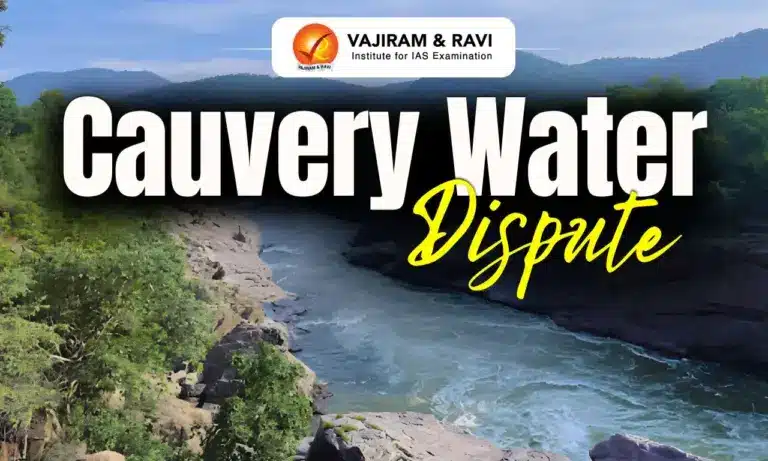
Cauvery Water Dispute Latest News
- The Cauvery Water Management Authority (CWMA) has endorsed the Cauvery Water Regulation Committee (CWRC) decision directing Karnataka to release 3,500 cusecs of water to Tamil Nadu for 15 days (July 29–August 12, 2026).
- This amounts to nearly 4.5 thousand million cubic feet (tmc ft).
- The decision comes amid deficient southwest monsoon rainfall and severe water shortages in the Cauvery basin, reviving concerns over equitable sharing of river waters during distress years.
Institutional Framework for Cauvery Water Management
- The CWRC functions under the CWMA, which was established in 2018 to implement the Cauvery Water Disputes Tribunal (CWDT) Award (2007) as modified by the Supreme Court (2018).
- Statutory body: The CWMA is formed under the Inter-State River Water Disputes Act, 1956, operating under the Union Ministry of Jal Shakti.
- Composition of CWRC:
- Headquartered in New Delhi, it is headed by the Member (Water Resources), CWMA.
- Members include –
- Chief Engineers of all Cauvery basin States.
- Representatives from the India Meteorological Department (IMD), Central Water Commission (CWC) and Ministry of Agriculture & Farmers’ Welfare.
- Mandate and functions of CWRC: The committee performs both regulatory and technical functions, including –
- Monitoring daily water levels, inflows and storage in eight major reservoirs –
- Karnataka: Hemavathy, Harangi, Krishnarajasagara (KRS), Kabini.
- Tamil Nadu: Mettur, Bhavanisagar, Amaravathy.
- Kerala: Banasurasagar.
- Ensuring scheduled daily and monthly water releases as directed by CWMA.
- Preparing seasonal (Southwest Monsoon, Northeast Monsoon, Hot Weather) and annual water accounts.
- Reviewing compliance with previous directions and reassessing basin conditions through fortnightly meetings during the monsoon.
- Monitoring daily water levels, inflows and storage in eight major reservoirs –
- CWDT: It was constituted by the Government of India on June 2, 1990, under the Inter-State River Water Disputes Act, 1956.
- Inter-State River Water Disputes Act, 1956: It is enacted under Article 262 of Constitution of India to resolve the water disputes that would arise in the use, control and distribution of an interstate river or river valley.


How does the CWRC Decide Water Releases?
- The committee relies on scientific hydro-meteorological assessment rather than fixed allocations during distress years.
- Key parameters include –
- Rainfall received and IMD’s forecast.
- Live storage in reservoirs.
- Reservoir inflows and outflows.
- The river flows at Biligundulu (inter-State measuring point).
- Water availability in intermediate catchments.
- Compliance with earlier release orders.
- This data-driven approach seeks to balance drinking water, irrigation requirements and ecological considerations.
Factors Behind the Latest Decision
- The CWRC considered multiple indicators before fixing the release at 3,500 cusecs –
- Net inflows into Karnataka reservoirs were nearly 60% below the 30-year average.
- River flow at Biligundulu showed a 90% deficit, indicating severe basin-wide stress.
- IMD forecasts suggested continued weak rainfall, limiting future inflows.
- Combined storage in Karnataka’s four major reservoirs stood at 64.15 tmc ft against a capacity of 114.57 tmc ft.
- Considering these distress conditions, the committee opted for a quantity that would be operationally feasible while partially meeting Tamil Nadu’s requirements.
Divergent Responses from the Riparian States
- Karnataka’s position:
- The State has not commenced irrigation releases due to inadequate rainfall.
- It considers the CWRC order burdensome under prevailing drought-like conditions.
- The government is examining the possibility of appealing before the CWMA.
- Farmers’ organisations have demanded application of a “distress-sharing formula” instead of fixed allocations.
- Tamil Nadu’s position:
- Tamil Nadu views the ordered release as insufficient.
- It argues Karnataka should release the entire deficit of 9.8 tmc ft calculated by the committee.
- The kuruvai cultivation season requires nearly 100 tmc ft of water for about 4 lakh acres.
- Mettur reservoir storage is around 36 tmc ft, of which nearly 10 tmc ft must be reserved for drinking water and dead storage.
Key Challenges and Way Forward
- Challenges:
- Absence of an agreed distress-sharing formula during deficient rainfall years.
- Conflicting priorities between drinking water, irrigation and reservoir conservation.
- Increasing uncertainty due to climate variability affecting monsoon reliability.
- Balancing legal water entitlements with ground-level hydrological realities.
- Recurring inter-State political tensions despite an institutional dispute-resolution mechanism.
- Way forward:
- Develop a mutually agreed distress-sharing formula to proportionately distribute shortages among basin States during drought years.
- Strengthen real-time hydrological monitoring, transparent data sharing and scientific forecasting.
- Promote cooperative federalism through continuous dialogue between Karnataka, Tamil Nadu and the CWMA.
- Encourage water-use efficiency, micro-irrigation, crop diversification and basin-level integrated water resources management.
- Institutionalise periodic reviews to ensure adaptive water allocation under changing climatic conditions.
Source: TH

 Last updated on Sep, 2026
→ UPSC 2027 Notification will be released on 13 January 2027 at upsconline.nic.in.
→ Asian Games 2026 are being held in Aichi-Nagoya, Japan, from 19 September to 4 October.
→ Check out the latest UPSC Syllabus here.
→ Download UPSC Model Answers for Mains 2026
→ UPSC Mains Question Paper 2026 is out now for Essay & GS Paper 1, 2, 3 & 4.
→ UPSC Calendar 2027 has been released.
→ Enroll in Vajiram & Ravi’s UPSC Mains Test Series 2027 for structured answer writing practice, expert evaluation, and exam-oriented feedback.
→ Join Vajiram & Ravi’s UPSC Mentorship Program 2027 for personalized guidance, strategy planning, and one-to-one support from experienced mentors.
→ Go through the UPSC Mains Previous Year Papers to enhance your preparation.
→ UPSC has released UPSC Toppers List 2025 with the Civil Services final result on its official website.
→ Also check Best UPSC Coaching in India
Cauvery Water Dispute FAQs
Q1. How does the Cauvery Water Regulation Committee (CWRC) determine water releases?+
Q2. What is the institutional role of the Cauvery Water Management Authority (CWMA)?+
Q3. Why is the absence of a distress-sharing formula a major challenge?+
Q4. How does climate variability complicate inter-State river water governance in India?+
Q5. What measures can improve long-term resolution of the Cauvery water dispute?+
Tags: cauvery water dispute