When “Quack” Is Wrongly Used Latest News
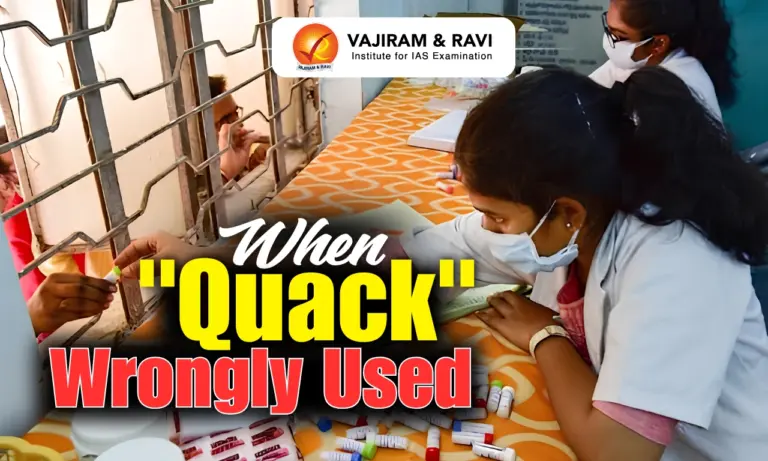
- Recently, the National Commission for Indian System of Medicine (NCISM) issued a circular clarifying that qualified, registered practitioners of India’s traditional medicine systems cannot legally be labelled “quacks” or “bogus doctors” merely for practising the Indian System of Medicine (ISM).
About National Commission for Indian System of Medicine
- National Commission for Indian System of Medicine (NCISM) is the statutory regulator established under the National Commission for Indian System of Medicine Act, 2020.
- It oversees medical education, professional standards, and registration of practitioners in India’s recognised traditional systems: Ayurveda, Unani, Siddha, and Sowa-Rigpa.
Autonomous Boards under NCISM
- There are four autonomous boards entrusted with conducting overall education of Ayurveda, under Board of Ayurveda and Unani, Siddha & Sowarigpa under Board of Unaini, Siddha and Sowarigpa.
- There are two common Boards namely:
- Board of assessment and rating to assess and grant permission to educational institutions of Indian systems of Medicine and
- Board of ethics and registration of practitioners of Indian systems of medicine to maintain National Register and ethical issues relating to practice under the National Commission for Indian Medicine.


What the Circular Says
- Practitioners holding recognised qualifications — Bachelor of Ayurvedic Medicine and Surgery (BAMS), Bachelor of Unani Medicine and Surgery (BUMS), Bachelor of Siddha Medicine and Surgery (BSMS), or Bachelor of Sowa-Rigpa Medicine and Surgery — and registered under the NCISM Act are legally recognised medical practitioners.
- Such practitioners cannot be called “quacks” or “bogus doctors.”
- The circular distinguishes between qualified, registered ISM practitioners and unqualified individuals falsely claiming to practise medicine.
Why the Clarification Was Needed
- NCISM received reports of registered ISM practitioners being labelled “quacks” or “fake doctors,” targeted through public notices, criticised in media, and harassed in public forums.
- The clarification aims to: affirm the legal status of registered practitioners, prevent misinformation, protect their professional standing, and ensure that action against genuinely fraudulent practice isn’t confused with lawful ISM practice.
Does This Make ISM Doctors Equivalent to MBBS Doctors?
- Not exactly. The circular:
- Recognises ISM practitioners as legally valid within their own systems of medicine.
- Does not erase distinctions between different systems of medical education.
- Does not automatically authorise ISM practitioners to practise modern (allopathic) medicine.
- Whether an ISM practitioner can prescribe allopathic medicines depends on State laws, statutory provisions, government notifications, and court rulings applicable in that jurisdiction.
Relevant Supreme Court Rulings
- Poonam Verma v. Ashwin Patel (1996): A homeopathic doctor treating a patient with allopathic medicine was held guilty of negligence — practising in a system one isn’t qualified for amounts to acting without authority.
- Dr. Mukhtiar Chand & Others v. State of Punjab (1998): Ayurveda, Siddha, and Unani practitioners cannot practise allopathic medicine solely on the strength of their ISM qualifications. Cross-practice is permitted only where specifically authorised by law, including State government notifications under the Drugs and Cosmetics Rules.
Who is a “Quack”?
- Commonly refers to someone who falsely claims medical qualification or practises medicine without required qualifications/legal registration.
- No official nationwide estimate exists of the number of quacks in India.
- Health being a State subject, identifying and acting against unqualified practitioners is the responsibility of State governments and State Medical Councils.
Significance of the Circular
- Reaffirms statutory recognition of Ayurveda, Unani, Siddha, and Sowa-Rigpa practitioners under the NCISM Act.
- Draws a clear line between registered ISM practitioners and unqualified individuals falsely claiming to practise medicine.
- Clarifies that legal recognition as an ISM practitioner does not automatically extend to practising modern medicine.
Conclusion
- NCISM’s circular reaffirms the legal standing of registered Ayurveda, Unani, Siddha, and Sowa-Rigpa practitioners while preserving the boundary between traditional and modern medicine.
- It seeks to curb the misuse of the term “quack” against legitimate ISM practitioners without diluting regulatory safeguards against unqualified practice or unauthorised cross-system prescriptions.

 Last updated on Sep, 2026
→ UPSC 2027 Notification will be released on 13 January 2027 at upsconline.nic.in.
→ Asian Games 2026 are being held in Aichi-Nagoya, Japan, from 19 September to 4 October.
→ Check out the latest UPSC Syllabus here.
→ Download UPSC Model Answers for Mains 2026
→ UPSC Mains Question Paper 2026 is out now for Essay & GS Paper 1, 2, 3 & 4.
→ UPSC Calendar 2027 has been released.
→ Enroll in Vajiram & Ravi’s UPSC Mains Test Series 2027 for structured answer writing practice, expert evaluation, and exam-oriented feedback.
→ Join Vajiram & Ravi’s UPSC Mentorship Program 2027 for personalized guidance, strategy planning, and one-to-one support from experienced mentors.
→ Go through the UPSC Mains Previous Year Papers to enhance your preparation.
→ UPSC has released UPSC Toppers List 2025 with the Civil Services final result on its official website.
→ Also check Best UPSC Coaching in India
When "Quack" Is Wrongly Used FAQs
Q1. What does When "Quack" Is Wrongly Used explain about the NCISM circular?+
Q2. Who is protected under When "Quack" Is Wrongly Used?+
Q3. Does When "Quack" Is Wrongly Used allow ISM practitioners to practise allopathic medicine?+
Q4. Which Supreme Court rulings are highlighted in When "Quack" Is Wrongly Used?+
Q5. Why is When "Quack" Is Wrongly Used significant for healthcare regulation?+
Tags: mains articles upsc current affairs upsc mains current affairs When "Quack" Is Wrongly Used