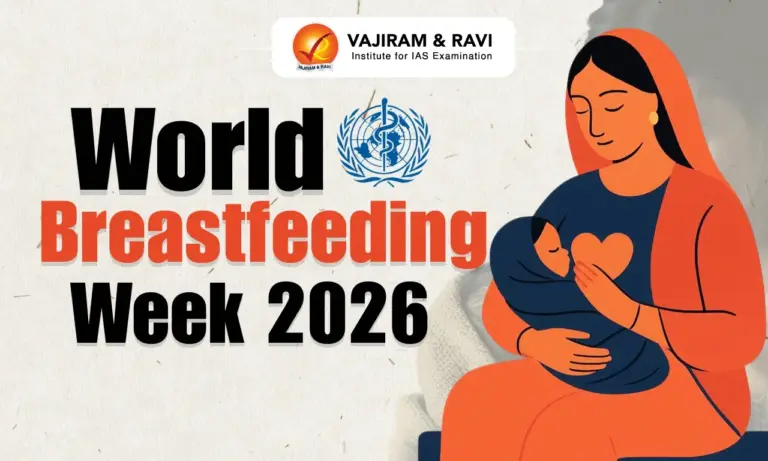
World Breastfeeding Week 2026 is observed from 1 August to 7 August 2026 across the globe to raise awareness about the importance of breastfeeding for the health and well-being of both babies and mothers. Supported by the World Health Organization (WHO), UNICEF, Ministries of Health, and civil society organizations, the campaign encourages governments, healthcare providers, workplaces, and communities to create a supportive environment for breastfeeding.
What is World Breastfeeding Week?
World Breastfeeding Week (WBW) is an annual global awareness campaign observed every year from 1 to 7 August to promote breastfeeding as the best source of nutrition for infants. The campaign highlights the need for families, healthcare professionals, employers, and governments to work together to create an environment where mothers can breastfeed successfully.
World Breastfeeding Week 2026 Theme
The World Breastfeeding Week 2026 theme, “Breastfeeding for a Sustainable Start in Life: Strengthen What Works,” emphasizes the importance of strengthening the policies, healthcare services, and community support systems that help mothers breastfeed successfully. It encourages governments, healthcare professionals, workplaces, and families to build on proven initiatives that promote breastfeeding and ensure every mother receives the support she needs.


World Breastfeeding Week History
World Breastfeeding Week has been observed annually since 1992 to promote breastfeeding and improve the health and well-being of mothers and children worldwide.
- 1990: The Innocenti Declaration was adopted to protect, promote, and support breastfeeding globally.
- 1991: The World Alliance for Breastfeeding Action (WABA) was established to coordinate global breastfeeding advocacy.
- 1992: The first World Breastfeeding Week was celebrated from 1-7 August in over 120 countries.
- The campaign commemorates the 1990 Innocenti Declaration, signed by WHO and UNICEF policymakers.
- Every year, a new theme is introduced to address emerging breastfeeding challenges and priorities.
- The campaign is supported by WHO, UNICEF, Ministries of Health, healthcare professionals, and civil society organizations.
- 2018: The World Health Assembly (WHA) officially endorsed World Breastfeeding Week as an important global health promotion strategy.
- Today, World Breastfeeding Week is observed in more than 170 countries, raising awareness about exclusive breastfeeding, maternal support, and child nutrition.
Benefits of Breastfeeding for Mothers & Babies
Breastfeeding offers lifelong health benefits for both mothers and babies by providing optimal nutrition, strengthening immunity, and supporting healthy growth and development.
Benefits for Babies
- Provides complete nutrition required for the first six months of life.
- Strengthens the immune system and protects against infections.
- Reduces the risk of diarrhoea, pneumonia, ear infections, and allergies.
- Supports healthy brain development and cognitive function.
- Lowers the risk of obesity, type 1 and type 2 diabetes, and certain childhood illnesses.
- Promotes healthy digestion and overall physical growth.
- Strengthens the emotional bond between mother and baby through skin-to-skin contact.
Benefits for Mothers
- Helps the uterus return to its normal size after childbirth.
- Reduces postpartum bleeding and supports faster recovery.
- Lowers the risk of breast and ovarian cancer.
- Reduces the risk of type 2 diabetes and cardiovascular diseases.
- Helps burn extra calories, supporting healthy postpartum weight loss.
- Promotes emotional bonding and may reduce the risk of postpartum depression.
- Offers a convenient, safe, and cost-effective way to feed infants while benefiting maternal health.
World Breastfeeding Week and Sustainable Development Goals (SDGs)
World Breastfeeding Week highlights how breastfeeding contributes to achieving several United Nations Sustainable Development Goals (SDGs) by improving health, nutrition, gender equality, and sustainable development.
- SDG 2 – Zero Hunger: Breastfeeding provides complete nutrition for infants and helps reduce malnutrition.
- SDG 3 – Good Health and Well-being: It lowers infant mortality, prevents diseases, and improves maternal health.
- SDG 5 – Gender Equality: Supportive maternity policies and breastfeeding-friendly workplaces empower women to balance motherhood and employment.
- SDG 8 – Decent Work and Economic Growth: Paid maternity leave and workplace breastfeeding support improve women’s participation in the workforce.
- SDG 10 – Reduced Inequalities: Equal access to breastfeeding support helps reduce health disparities among communities.
- SDG 12 – Responsible Consumption and Production: Breastfeeding is a natural, renewable source of nutrition that requires no packaging, manufacturing, or transportation.
- SDG 13 – Climate Action: Breastfeeding has a low environmental impact by reducing waste, energy use, and carbon emissions associated with infant formula production.
- SDG 17 – Partnerships for the Goals: WHO, UNICEF, governments, healthcare providers, and civil society organizations work together to promote breastfeeding worldwide.
WHO Recommendations on Breastfeeding
The World Health Organization (WHO) recommends breastfeeding as the ideal source of nutrition for infants and advises practices that support healthy growth, development, and long-term well-being.
- Initiate breastfeeding within one hour of birth.
- Exclusively breastfeed infants for the first six months, without giving water, formula, or other foods unless medically indicated.
- Introduce safe and nutritious complementary foods at six months while continuing breastfeeding.
- Continue breastfeeding up to two years of age or beyond, alongside appropriate complementary feeding.
- Encourage skin-to-skin contact immediately after birth to help establish breastfeeding.
- Feed babies on demand, whenever they show signs of hunger, rather than following a strict schedule.
- Avoid the unnecessary use of feeding bottles, teats, and pacifiers during the early months, as they may interfere with breastfeeding.
- Provide breastfeeding counselling and support through trained healthcare professionals to help mothers overcome challenges and continue breastfeeding successfully.
World Breastfeeding Week 2026 Significance
World Breastfeeding Week 2026 highlights the importance of breastfeeding in ensuring the healthy growth and development of children while improving maternal health and strengthening public health systems worldwide.
- Raises awareness about the benefits of exclusive breastfeeding for the first six months of life.
- Encourages governments to implement breastfeeding-friendly policies, including paid maternity leave and workplace support.
- Promotes maternal and child health by reducing the risk of infections, malnutrition, and infant mortality.
- Strengthens community and family support for breastfeeding mothers.
- Encourages healthcare providers to offer proper breastfeeding guidance and counselling.
- Supports the achievement of the United Nations Sustainable Development Goals (SDGs) related to health, nutrition, and gender equality.
- Helps combat misinformation and promotes evidence-based breastfeeding practices.
- Reinforces global collaboration among WHO, UNICEF, WABA, governments, and civil society organizations to improve breastfeeding rates.
About World Health Organisation (WHO)
The World Health Organization (WHO) is the specialized agency of the United Nations that works to promote global health, prevent diseases, and improve healthcare systems worldwide.
- Established on 7 April 1948, WHO is headquartered in Geneva, Switzerland and has 194 Member States.
- It develops international health guidelines and standards to help countries improve public health and healthcare services.
- WHO coordinates global efforts to prevent and control infectious diseases, respond to health emergencies, and combat pandemics.
- The organization promotes maternal, newborn, and child health, including nutrition, immunization, and breastfeeding initiatives.
- WHO recommends exclusive breastfeeding for the first six months, followed by continued breastfeeding up to two years or beyond with appropriate complementary feeding.
- It works closely with UNICEF, governments, healthcare institutions, and civil society organizations to improve health outcomes worldwide.
- WHO supports World Breastfeeding Week (1–7 August) every year to raise awareness about the importance of breastfeeding and encourage policies that protect and support breastfeeding mothers.

 Last updated on Sep, 2026
→ UPSC 2027 Notification will be released on 13 January 2027 at upsconline.nic.in.
→ Asian Games 2026 are being held in Aichi-Nagoya, Japan, from 19 September to 4 October.
→ Check out the latest UPSC Syllabus here.
→ Download UPSC Model Answers for Mains 2026
→ UPSC Mains Question Paper 2026 is out now for Essay & GS Paper 1, 2, 3 & 4.
→ UPSC Calendar 2027 has been released.
→ Enroll in Vajiram & Ravi’s UPSC Mains Test Series 2027 for structured answer writing practice, expert evaluation, and exam-oriented feedback.
→ Join Vajiram & Ravi’s UPSC Mentorship Program 2027 for personalized guidance, strategy planning, and one-to-one support from experienced mentors.
→ Go through the UPSC Mains Previous Year Papers to enhance your preparation.
→ UPSC has released UPSC Toppers List 2025 with the Civil Services final result on its official website.
→ Also check Best UPSC Coaching in India
World Breastfeeding Week 2026 FAQs
Q1. When is World Breastfeeding Week 2026 observed?+
Q2. Who organizes World Breastfeeding Week?+
Q3. What is the purpose of World Breastfeeding Week?+
Q4. Why is exclusive breastfeeding recommended for six months?+
Q5. What are the benefits of breastfeeding for mothers?+
Tags: important days in 2026 important days in august 2026 world breastfeeding week world breastfeeding week 2026 world breastfeeding week theme