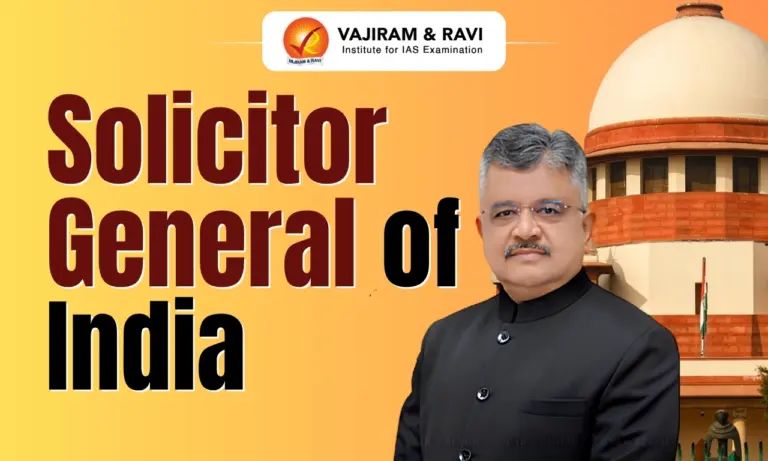
The Solicitor General of India is an important law officer of the Union Government who assists the Attorney General of India and represents the government in legal matters before courts.
About Solicitor General of India
The Solicitor General of India is the second-highest law officer of the Government of India, after the Attorney General of India. The office assists the Attorney General in legal matters and represents the Union Government before the Supreme Court, High Courts and other judicial forums. The office of Solicitor General was established in 1950. C.K. Daphtary became the first Solicitor General of India.
The hierarchy of Union Law Officers is: Attorney General of India → Solicitor General of India → Additional Solicitors General of India
Solicitor General of India Provisions
The provisions related to the Solicitor General of India are governed by executive rules rather than constitutional provisions.
- Non-Constitutional Office: The Solicitor General is not mentioned in the Constitution of India, unlike the Attorney General who is provided under Article 76. The office derives its authority from executive action of the Government of India.
- Legal Framework: The appointment and service conditions of the Solicitor General are governed by the Law Officers (Conditions of Service) Rules, 1987. These rules are framed under the proviso to Article 309 of the Constitution, which empowers regulation of service conditions of persons serving the Union.
- Appointment: The Solicitor General is appointed by the Appointments Committee of the Cabinet (ACC). The appointment process is carried out through the Department of Legal Affairs, Ministry of Law and Justice.
- Qualification: The Constitution does not prescribe specific qualifications for the Solicitor General. Generally, a senior advocate with expertise in constitutional and public law is appointed to the office.
- Tenure: The Solicitor General generally holds office for a term of three years. The tenure is not constitutionally fixed and the officer may be reappointed.
- Remuneration: The remuneration of the Solicitor General of India is governed by the Law Officers (Conditions of Service) Rules, 1987, as amended in 2026.
- The Solicitor General receives a monthly retainer of ₹96,000 (effective from 1 February 2026).
- The office also receives professional fees for appearances before courts, making it a fee-based remuneration system rather than a fixed salary.


Solicitor General of India Role and Functions
The role of the Solicitor General of India is to provide legal advice to the Union Government and represent it in important legal proceedings before courts.
- Legal Advice to Government: The Solicitor General advises the Government of India on constitutional, civil, criminal and administrative matters referred by ministries and departments.
- Representation Before Courts: The Solicitor General represents the Government of India before the Supreme Court, High Courts and other judicial forums in cases where the Union Government is a party or has an interest, including matters relating to constitutional interpretation, government policies, legislation and executive actions.
- Assistance to Attorney General: The Solicitor General assists the Attorney General of India in discharging official duties and handling important legal matters of national significance.
- Presidential References: The Solicitor General represents the Government of India in Presidential References made to the Supreme Court under Article 143 of the Constitution.
Restrictions on Solicitor General
The restrictions on the Solicitor General ensure professional integrity and prevent conflicts of interest
- The Solicitor General cannot appear against the Government of India or any State Government.
- The Solicitor General cannot advise or represent private parties in matters where the Government of India has an interest.
- The Solicitor General cannot defend an accused person in criminal proceedings without prior government permission.
- The Solicitor General cannot accept certain offices or directorships without government approval.
Difference Between Attorney General of India and Solicitor General of India
The Attorney General of India and the Solicitor General of India are the two highest law officers of the Union Government, but they differ in their constitutional status, powers and functions.
| Basis | Attorney General of India | Solicitor General of India |
|
Constitutional Status |
Constitutional office under Article 76 |
Non-constitutional office created through executive rules |
|
Position |
Highest law officer of India |
Second-highest law officer of India |
|
Legal Framework |
Constitution of India |
Law Officers (Conditions of Service) Rules, 1987 |
|
Appointment |
Appointed by the President of India |
Appointed by the Appointments Committee of the Cabinet (ACC). |
|
Tenure |
Holds office during the pleasure of the President |
Generally appointed for three years and holds office during the pleasure of the President |
|
Parliamentary Rights |
Can participate in the proceedings of Parliament and its Committees under Article 88, but cannot vote |
No right to participate in Parliament |
|
Primary Role |
Chief legal adviser to the Union Government |
Assists the Attorney General and represents the Union Government before courts |
|
Constitutional Duties |
Advises the Government and performs duties assigned under the Constitution and other laws |
Performs functions assigned under the Law Officers (Conditions of Service) Rules, 1987 |
List of Solicitors General of India (1950-Present)
The office of the Solicitor General of India has been held by several distinguished jurists since its establishment in 1950, reflecting its important role in representing the Union Government before courts. The present Solicitor General of India is Tushar Mehta, who has been holding the office since 2018.
| No. | Name | Tenure |
|
1 |
C.K. Daphtary |
1950-1963 |
|
2 |
H.N. Sanyal |
1963-1964 |
|
3 |
S.V. Gupte |
1964-1967 |
|
4 |
Niren De |
1967-1968 |
|
5 |
Jagadish Swarup |
1969-1972 |
|
6 |
Lal Narayan Sinha |
1972-1977 |
|
7 |
S.N. Kacker |
1977-1979 |
|
8 |
Soli Sorabjee |
1979-1980 |
|
9 |
K. Parasaran |
1980-1983 |
|
10 |
Milon K. Banerji |
1986-1989 |
|
11 |
Ashok Desai |
1989-1990 |
|
12 |
A.D. Giri |
1990-1991 |
|
13 |
Dipankar P. Gupta |
1992- 1997 |
|
14 |
T.R. Andhyarujina |
1997-1998 |
|
15 |
N. Santosh Hegde |
1998 – 1999 |
|
16 |
Harish Salve |
1999 – 2002 |
|
17 |
Kirit Rawal |
2002 – 2004 |
|
18 |
Goolam E. Vahanvati |
2004-2009 |
|
19 |
Gopal Subramaniam |
2009-2011 |
|
20 |
Rohinton F. Nariman |
2011-2013 |
|
21 |
Mohan Parasaran |
2013-2014 |
|
22 |
Ranjit Kumar |
2014-2017 |
|
23 |
Tushar Mehta |
2018-Present |

 Last updated on Sep, 2026
→ UPSC 2027 Notification will be released on 13 January 2027 at upsconline.nic.in.
→ Asian Games 2026 are being held in Aichi-Nagoya, Japan, from 19 September to 4 October.
→ Check out the latest UPSC Syllabus here.
→ Download UPSC Model Answers for Mains 2026
→ UPSC Mains Question Paper 2026 is out now for Essay & GS Paper 1, 2, 3 & 4.
→ UPSC Calendar 2027 has been released.
→ Enroll in Vajiram & Ravi’s UPSC Mains Test Series 2027 for structured answer writing practice, expert evaluation, and exam-oriented feedback.
→ Join Vajiram & Ravi’s UPSC Mentorship Program 2027 for personalized guidance, strategy planning, and one-to-one support from experienced mentors.
→ Go through the UPSC Mains Previous Year Papers to enhance your preparation.
→ UPSC has released UPSC Toppers List 2025 with the Civil Services final result on its official website.
→ Also check Best UPSC Coaching in India
Solicitor General of India FAQs
Q1. Who is the Solicitor General of India?+
Q2. Is the Solicitor General of India a constitutional office?+
Q3. Who appoints the Solicitor General of India?+
Q4. What are the main functions of the Solicitor General of India?+
Q5. Who is the present Solicitor General of India?+
Q6. Can the Solicitor General of India participate in Parliament?+
Tags: solicitor general of india