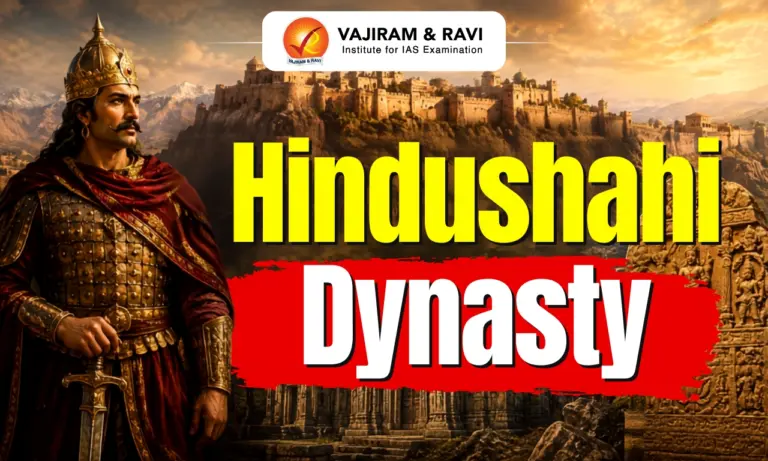
The Hindushahi Dynasty was one of the last major native kingdoms to rule the north-western frontier of the Indian subcontinent before the expansion of the Ghaznavids. It controlled Kabulistan, Gandhara and parts of Punjab between the 9th and early 11th centuries CE. The dynasty emerged after the decline of the Turk Shahis and defended the region against repeated invasions from Central Asia. Its rulers also supported Hindu and Buddhist traditions while preserving political authority over a culturally diverse population.
Hindushahi Dynasty
The Hindushahi Dynasty succeeded the Turk Shahi rulers and became a major political power across Kabul, Gandhara and western Punjab. It ruled from about the 9th century until 1026 CE and played an important role in resisting foreign invasions.
- Timeline: The Hindu Shahis ruled approximately from c. 822 CE to 1026 CE. Their rule followed the Turk Shahis and ended after continuous Ghaznavid campaigns led to the collapse of their kingdom.
- Founder: The dynasty was founded by Kallar or Kalarapala, a Brahmin minister of the last Turk Shahi ruler Lagaturman. He removed Lagaturman from power during the second half of the 9th century and established Hindu Shahi rule.
- Kingdom and Territory: The kingdom covered Kabulistan, Gandhara and parts of western Punjab. At different times it also controlled regions extending from Kabul to the Indus basin and parts of the upper Gangetic region.
- Capital: Kabul was the early capital during the Kabul Shahi period. After Arab and Saffarid pressure, the political centre shifted to Udabhanda or Hund near present day Rawalpindi on the banks of the Indus River.
- Political Importance: The Hindushahi rulers formed the last major indigenous barrier against Turkic expansion into north-western India. Their kingdom acted as a strategic frontier between Central Asia and the Indian subcontinent.
- Dynastic Transition: The dynasty represented the second phase of the Shahi rulers. The earlier phase consisted of the Buddhist Shahis, while the later phase became known as the Hindu Shahis after Kallar established Brahmin rule.
- Military Conflicts: The dynasty fought against the Abbasids, Saffarids, Samanids and especially the Ghaznavids. These continuous wars shaped its political history and gradually weakened its territorial control.
Hindushahi Dynasty Background
The Hindushahi Dynasty emerged during a period of major political changes in Afghanistan and north-western India. The weakening of earlier kingdoms created conditions for the rise of a new ruling house.
- Decline of Kabul Shahis: After the decline of the Kushana Empire, the Kabul Shahis ruled Kabul and Gandhara until around 870 CE. Internal weakness and external invasions eventually reduced their power.
- Abbasid Pressure: In 814-815 CE, Abbasid Caliph Al-Ma’mun defeated the Kabul Shahis. The defeated rulers accepted heavy tribute, reportedly including 1,500,000 dirhams annually and 2,000 slaves for the governor of Khorasan.
- Rise of Kallar: Political instability after Abbasid attacks weakened the Turk Shahis. Kallar, serving as the Brahmin minister of Lagaturman, replaced his ruler and established a new dynasty.
- Shift of Political Centre: The capital moved from Kabul to Udabhanda because it offered better security against repeated Arab and Central Asian attacks while maintaining access to Gandhara and Punjab.
- Strategic Position: The kingdom occupied important trade and military routes connecting Central Asia with the Indian plains, making it a key regional power despite constant external pressure.


Hindushahi Dynasty Historical Sources
Knowledge about the Hindushahi Dynasty comes mainly from inscriptions, coins, archaeological discoveries and writings produced outside the royal court because almost no court literature has survived.
- Literary Sources: Kalhana’s Rajatarangini, Al-Biruni’s Tarikh al-Hind, Al-Utbi’s Kitab-i-Yamini, Abu’l-Fazl Bayhaqi’s Tarikh-i Bayhaqi and Gardezi’s Zayn al-Akhbar provide valuable historical information.

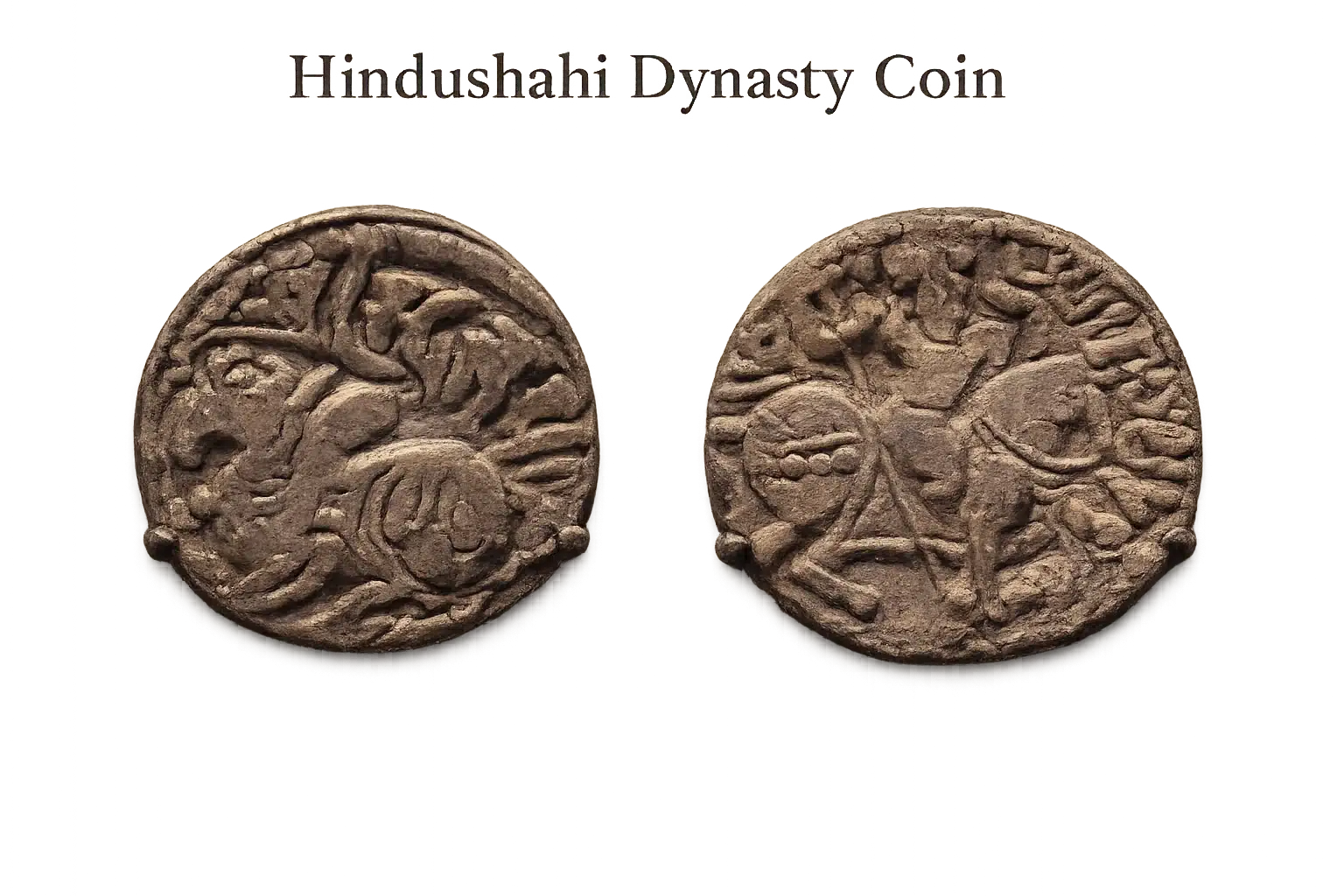
- Coins: The dynasty issued silver jital coins featuring a recumbent bull on one side and a horseman on the other. Early issues carried titles such as “Sri Spalapati” instead of personal names.
- Inscriptions: Important inscriptions include the Hund Stone Inscription, Mir Ali Inscription, Dewal Inscription, Ratnamanjari Inscription, Barikot Inscription and Kamesvaridevi Inscription. Most are written in the Sharada script.
- Archaeological Evidence: Excavations at Hund, Kafir Kot, Barikot and the Salt Range have revealed temples, forts and settlement remains that improve understanding of Hindu Shahi political and religious life.
- Scholarly Research: Modern studies by Abdur Rehman, Ahmad Hasan Dani and Michael W. Meister have significantly expanded knowledge about Hindu Shahi history, archaeology, architecture and coinage.
Hindushahi Dynasty Prominent Rulers
Several rulers strengthened the Hindushahi Dynasty kingdom through military campaigns, territorial expansion and resistance against foreign invasions despite increasing external pressure.
- Kallar (c. 890-895 CE): Kallar founded the dynasty after overthrowing Lagaturman. He shifted the capital to Udabhanda following defeat by Yaqub ibn al-Layth and established Brahmin rule over the former Turk Shahi kingdom.
- Lalliya: Rajatarangini describes him as a powerful ruler. He regained Kabul from the Saffarids, subdued Zabulistan, resisted Kashmir’s Utpala rulers and restored Hindu Shahi authority across important frontier regions.
- Bhimadeva: Bhimadeva defeated Abu Ishaq Ibrahim and briefly restored Shahi influence around Ghazni. The Hund Slab Inscription praises his courage and records his achievements as an outstanding ruler.
- Jayapala (c. 964-1001 CE): Jayapala repeatedly fought Sabuktigin and Mahmud of Ghazni. After successive defeats, especially the Battle of Peshawar in 1001 CE, he abdicated and performed self immolation according to historical accounts.
- Anandapala (c. 1001-1010 CE): Anandapala strongly resisted Mahmud of Ghazni. During the Battle of Chach, the Ghaznavids suffered heavy losses before ultimately winning. Some historians compare his determination with King Porus.
- Trilochanpala (c. 1010-1022 CE): Trilochanpala expanded into the Shivalik Hills and ruled from the Indus to parts of the upper Gangetic valley. He continued resistance against Mahmud before being assassinated by mutinous troops.
- Bheempala (c. 1022-1026 CE): Described by Al-Utbi as “the fearless”, Bheempala fought bravely at Nandana and reportedly wounded Ghaznavid commander Muhammad bin Ibrahim. He became the last Shahi emperor before the dynasty ended.
Hindushahi Dynasty Administration
The Hindushahi Dynasty rulers maintained an organised administration suited to a frontier kingdom that constantly faced military threats while governing different religious communities.
- Monarchical System: The king exercised supreme authority over administration, military affairs and diplomacy while regional officials managed local territories under royal supervision.
- Provincial Governance: Governors and subordinate chiefs controlled frontier districts, protected trade routes and defended strategic forts across Kabul, Gandhara and Punjab.
- Military Organisation: The army included local tribal groups such as the Gakhars and Khokhars. War elephants, cavalry and fortified positions formed important components of military defence.
- Political Alliances: Marriage alliances with Kashmir and neighbouring kingdoms strengthened diplomatic relations and helped create temporary coalitions against common external enemies.
- Royal Titles: The title “Shahi” continued earlier political traditions used by Sakas, Kushanas, Hunas and Bactrians, reflecting continuity in regional kingship rather than ethnic identity.
Hindushahi Dynasty Economy
The Hindushahi Dynasty economy depended on agriculture, trade, mining and coinage. Its location along major commercial routes supported economic activity despite repeated invasions.
- Trade Networks: Kabul connected Central Asia with the Indian plains. Trade routes carried textiles, precious metals and other goods between Khorasan, China and north-western India.
- Textile Production: Contemporary accounts mention high quality cotton and wool industries. Cotton cloth and indigo became important export commodities during Hindu Shahi rule.
- Mining Activities: Silver ore was processed in Andarab, while mining operations also functioned in the Panjshir region, providing valuable resources for the kingdom.
- Coinage: Silver jital coins circulated widely from Sindh to north-eastern Europe. Their gradual reduction in silver content helps historians establish the chronological sequence of rulers.
- Agricultural Base: River valleys around the Indus and surrounding fertile regions supported farming, taxation and the maintenance of forts, armies and administrative institutions.
Hindushahi Dynasty Art and Architecture
The Hindushahi Dynasty rulers promoted temple construction, fortification and regional architectural styles that combined local traditions with influences from neighbouring kingdoms. 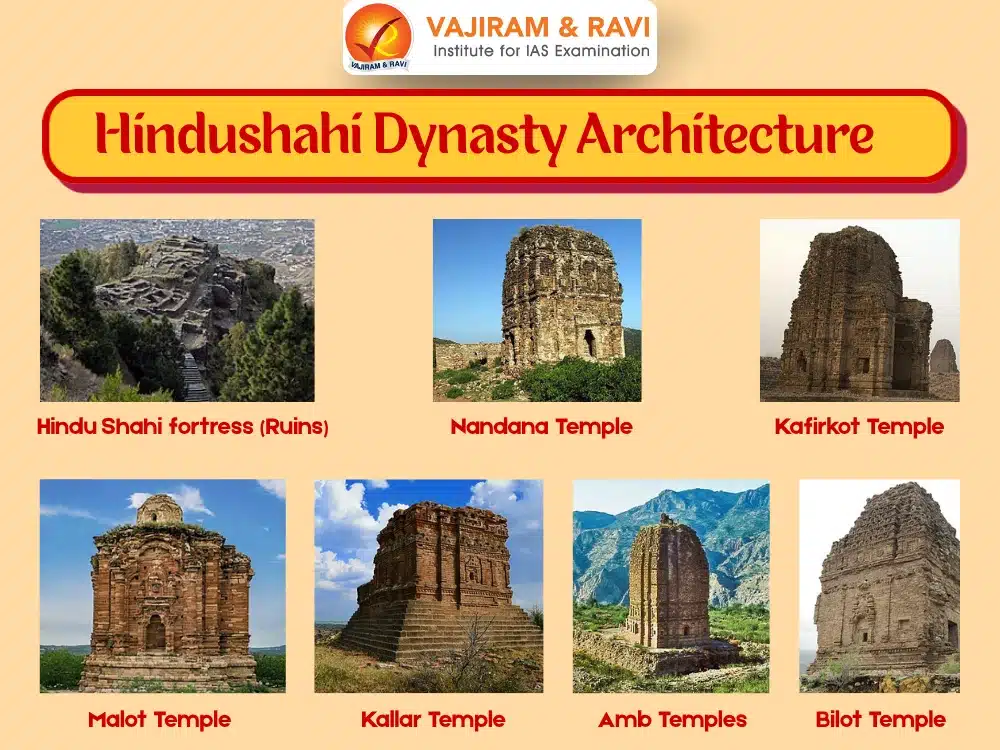
- Temple Architecture: New temples were built inside forts, while older religious structures were renovated. Hindu Shahi temples generally contained two ground level chambers beneath tall tower like superstructures.
- Architectural Style: The Gandhara-Nagara style evolved further under Hindu Shahi patronage and displayed distinctive features that separated it from earlier regional traditions.
- Major Temples: Kallar Temple, Amb Temples, Malot Temple, Nandana Temple, Kafirkot Temple and Bilot Temple represent important surviving examples linked with Hindu Shahi architecture.
- Cultural Exchange: The sandstone temples at Malot and Shiv-Ganga display a combination of Hindu Shahi and Kashmiri architectural features, showing close artistic interaction between neighbouring kingdoms.
- Fortifications: Forts at Hund, Odigram, Kafirkot and Barikot served both military and religious purposes. Excavations reveal that some earlier Buddhist sites were later converted into defensive centres.
Hindushahi Dynasty Culture and Religion
The Hindushahi Dynasty rulers governed a culturally diverse population and supported different religious traditions while encouraging regional artistic and linguistic developments.
- Religious Policy: Although the ruling family mainly followed Shaivism, Buddhism, Saura worship and Islam also existed within the kingdom. The rulers extended patronage to multiple religious communities.
- Language and Script: The Sharada script replaced the earlier Bactrian script for inscriptions, reflecting administrative and cultural changes under Hindu Shahi authority.
- Court Culture: Although royal literature has not survived, the rulers were recognised as patrons of scholars and maintained close intellectual links with neighbouring Kashmir.
- Dress and Society: Contemporary descriptions mention cotton garments, trousers and shoes. A gold coin of Bhimadeva depicts the ruler wearing a dhoti and uttariya.
- Religious Monuments: Temples, sculptures and inscriptions demonstrate continued patronage of Hindu religious traditions while preserving older Buddhist sacred centres within the kingdom.
Hindushahi Dynasty Decline
The Hindushahi Dynasty gradually weakened because of continuous invasions, territorial losses and internal instability before disappearing in the early 11th century.
- Continuous Warfare: Constant conflicts against the Saffarids, Samanids and Ghaznavids exhausted military strength and reduced the kingdom’s ability to defend frontier territories.
- Losses under Jayapala: Defeats against Sabuktigin and Mahmud of Ghazni resulted in the loss of territories west of the Indus and seriously weakened royal authority.
- Failure of Resistance: Anandapala and Trilochanpala continued resistance but repeated defeats, including the Battle of Chach and later Ghaznavid campaigns, caused heavy financial and territorial losses.
- Internal Weakness: Political instability increased after repeated wars. The assassination of Trilochanpala by mutinous troops reflected growing internal divisions within the kingdom.
- End of the Dynasty: Bheempala became the last Shahi ruler. By 1026 CE, the Hindushahi kingdom had collapsed under Ghaznavid expansion, bringing nearly two centuries of Hindu Shahi rule to an end.

 Last updated on Sep, 2026
→ UPSC 2027 Notification will be released on 13 January 2027 at upsconline.nic.in.
→ Asian Games 2026 are being held in Aichi-Nagoya, Japan, from 19 September to 4 October.
→ Check out the latest UPSC Syllabus here.
→ Download UPSC Model Answers for Mains 2026
→ UPSC Mains Question Paper 2026 is out now for Essay & GS Paper 1, 2, 3 & 4.
→ UPSC Calendar 2027 has been released.
→ Enroll in Vajiram & Ravi’s UPSC Mains Test Series 2027 for structured answer writing practice, expert evaluation, and exam-oriented feedback.
→ Join Vajiram & Ravi’s UPSC Mentorship Program 2027 for personalized guidance, strategy planning, and one-to-one support from experienced mentors.
→ Go through the UPSC Mains Previous Year Papers to enhance your preparation.
→ UPSC has released UPSC Toppers List 2025 with the Civil Services final result on its official website.
→ Also check Best UPSC Coaching in India
Hindushahi Dynasty FAQs
Q1. Who founded the Hindushahi Dynasty?+
Q2. Where was the capital of the Hindushahi Dynasty?+
Q3. Who was the most famous ruler of the Hindushahi Dynasty?+
Q4. What was the main religion of the Hindushahi rulers?+
Q5. When did the Hindushahi Dynasty end?+
Tags: dynasty geography geography notes hindushahi dynasty