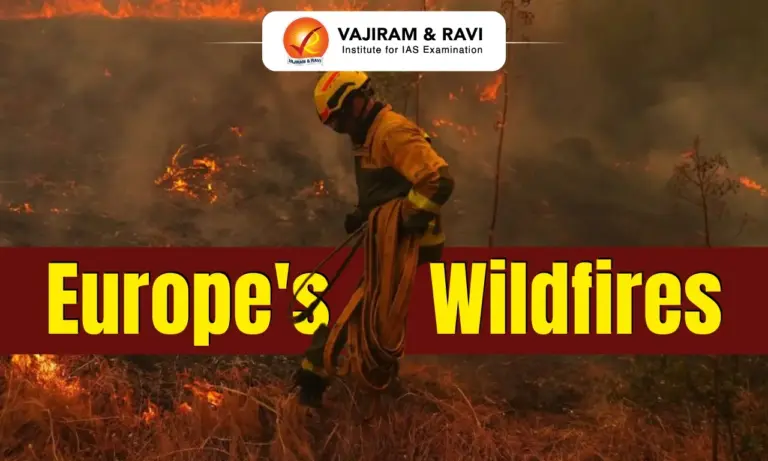
Europe’s Wildfires Latest News
- Wildfires raging across Europe have reached alarming intensity, with Greece witnessing some of its most severe fires yet.
- France saw its largest peace-time evacuation, Spain lost 172,000 hectares, and major blazes have hit Portugal, Italy, Cyprus, and Croatia — producing apocalyptic scenes of ash-covered forests, orange skies, and smoke plumes visible from space.
Climate Whiplash: The Wet-Then-Dry Trigger
- Climate whiplash refers to rapid swings between weather extremes.
- In western Europe, an unusually wet period earlier this year spurred explosive growth of grasses, shrubs, and undergrowth.
- This vegetation then dried out under successive heatwaves and drought, creating abundant fuel awaiting a spark.
- Researchers note this wet-then-dry sequence is becoming more common as climate change intensifies both ends of the weather spectrum — the same pattern that fuelled last year’s California wildfires.


Fire Clouds: Why Some Blazes Become Unstoppable
- A striking feature of this year’s fires is the emergence of pyrocumulonimbus clouds (pyroCb), or “fire clouds.
How They Form and Why are They Dangerous
- Large wildfires release intense heat; hot air, smoke, ash, and moisture rise rapidly, cool, and condense around smoke particles to form towering clouds.
- These clouds can grow into full thunderstorms reaching 10-15 km into the atmosphere, even penetrating the stratosphere.
- Collisions between ice crystals, water droplets, and ash inside these clouds generate lightning, which can ignite new fires kilometres from the original blaze.
- The storms also create powerful, erratic winds that can suddenly shift a fire’s direction or speed — trapping firefighters and residents.
- In extreme cases, a wildfire effectively creates its own weather system.
- Experts warn that intensifying heatwaves and droughts are enabling “sixth-generation wildfires” — extremely intense events that destroy biodiversity and release massive carbon dioxide, further fuelling global warming.
Beyond Climate Change: The Land-Use Factor
- Decades of rural-to-urban migration across Europe have led to abandoned farms and declining livestock grazing.
- Areas once kept open through agriculture are now covered with dense shrubs, young trees, and dry vegetation, creating a continuous layer of combustible fuel that lets fires spread faster and farther.
- A 2023 OECD report notes that land abandonment in the Mediterranean has caused significant fuel buildup, contributing to rising wildfire risk over the past century.
Economic and Environmental Consequences
- As per the UNECE (July 30 report): wildfires threaten lives, destroy homes and infrastructure, and force community evacuations.
- Wildfires cost the European Union around EUR 2.5 billion annually through infrastructure damage, lost tourism revenue, and disrupted economic activity.
- Long-term costs include ecosystem degradation, biodiversity loss, reduced agricultural productivity, and public health impacts.
The Way Ahead: Shifting Emergency Management Strategy
- Experts note that while the overall number of fires has declined due to improved suppression capabilities, fires that escape initial control now develop with unprecedented intensity and speed.
- This calls for a fundamental shift: protecting people, not just suppressing fires, must become the central objective — with greater focus on risk communication, public preparedness, and timely evacuation.
- Long-term resilience requires actively managing agroforestry landscapes, addressing rural abandonment, and building diverse, resilient ecosystems — not just firefighting.
Wildfires in India
- India also faces a growing wildfire risk, with the Forest Survey of India detecting thousands of fire incidents annually.
- Highest fire-prone regions: parts of the Northeast, pockets of Odisha, Chhattisgarh, and central/southern India; Himalayan states like Uttarakhand and Himachal Pradesh battle severe summer fires.
- Top 5 states by forest fire detections (2025-26): Maharashtra, Madhya Pradesh, Chhattisgarh, Andhra Pradesh, and Odisha.
- Key distinction: Unlike Europe’s frequently lightning-triggered fires, most Indian forest fires are linked to human activity — agricultural burning, forest produce collection, or accidental ignition.
Conclusion
- Europe’s wildfires are no longer just a weather phenomenon — they represent the convergence of climate change-driven weather extremes, self-sustaining fire cloud dynamics, and decades of land-use change from rural abandonment.
- As fires grow increasingly unpredictable and destructive, experts stress a shift from pure suppression toward comprehensive risk management, landscape stewardship, and public preparedness — lessons equally relevant for fire-prone regions in India.

 Last updated on Oct, 2026
→ UPSC 2027 Notification will be released on 13 January 2027 at upsconline.nic.in.
→ Asian Games 2026 are being held in Aichi-Nagoya, Japan, from 19 September to 4 October.
→ Check Nobel Prize 2026 Winners List here.
→ Download PIB PRiSM Monthly Magazine 2026 here.
→ Check UPSC Monthly Current Affairs Magazine The Recitals here.
→ Check out the latest UPSC Syllabus here.
→ Download UPSC Model Answers for Mains 2026
→ UPSC Mains Question Paper 2026 is out now for Essay & GS Paper 1, 2, 3 & 4.
→ UPSC Calendar 2027 has been released.
→ Enroll in Vajiram & Ravi’s UPSC Mains Test Series 2027 for structured answer writing practice, expert evaluation, and exam-oriented feedback.
→ Join Vajiram & Ravi’s UPSC Mentorship Program 2027 for personalized guidance, strategy planning, and one-to-one support from experienced mentors.
→ Go through the UPSC Mains Previous Year Papers to enhance your preparation.
→ UPSC has released UPSC Toppers List 2025 with the Civil Services final result on its official website.
→ Also check Best UPSC Coaching in India
Europe's Wildfires FAQs
Q1. Why are Europe's Wildfires becoming bigger, hotter, and harder to control?+
Q2. What are fire clouds discussed in Europe's Wildfires?+
Q3. How does land-use change contribute to Europe's Wildfires?+
Q4. What are the economic and environmental impacts of Europe's Wildfires?+
Q5. What lessons does Europe's Wildfires offer for India?+
Tags: Europe's Wildfires mains articles upsc current affairs upsc mains current affairs