TRAI MyCall Latest News
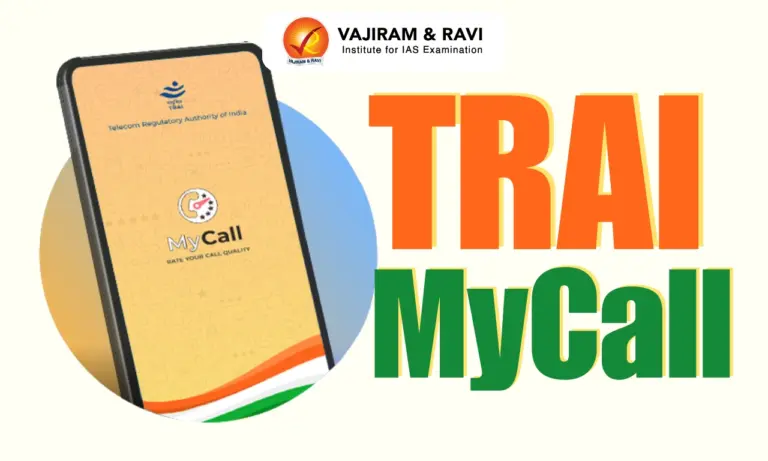
The Telecom Regulatory Authority of India (TRAI) recently launched a revamped version of “TRAI MyCall’, a mobile application that enables telecom consumers to directly assess and report the voice-calling experience.
About TRAI MyCall
- It is a mobile application launched by the Telecom Regulatory Authority of India (TRAI).
- It is a citizen-centric digital platform that empowers telecom consumers to share real-time feedback on their voice-calling experience, along with relevant network parameters.
- The feedback provided by consumers is visible to Telecom Service Providers (TSPs) as well as TRAI in an anonymised form.
- This feedback provides valuable insights to TSPs, helping them identify areas where network performance needs improvement and take targeted corrective measures.
- This consumer-driven approach is expected to enhance the overall Quality of Service (QoS).
- The platform also strengthens evidence-based regulatory oversight by enabling TRAI to assess the Quality of Experience (QoE) across telecom networks based on real consumer feedback.
- While network performance is evaluated using technical Quality of Service (QoS) parameters, the QoE perceived by consumers also provides an important perspective on service performance.
- The revamped TRAI MyCall application offers several consumer-friendly features, including:
- Instant rating of voice calls through a simple 1-5 star feedback system.
- Reporting of specific issues such as call drops, echo during calls, audio delay, cross connection, voice breaking, one party unable to hear the other, and calls taking too long to connect, which shall be available to the respective service provider for corrective action.
- Automatic post-call feedback prompts for seamless participation.
- Rating and feedback history on interactive map.
- Coverage Test feature to assess signal strength.
- Multilingual support with Bhashini.


Key Facts about Telecom Regulatory Authority of India
- It is a regulatory body responsible for overseeing the telecommunications industry in India.
- It was established under the Telecom Regulatory Authority of India Act, 1997, passed by Parliament.
- Objectives:
- To stimulate the growth and development of the telecommunication sector by creating favorable conditions.
- To provide a fair and transparent environment for telcos.
- To come up with different regulatory directions/mandates on tariffs, DTH, portability of mobile numbers, and so on.
- Roles and Functions:
- It sets fair pricing standards for telecom services, such as calls, SMS, and data, to make sure they are affordable to the consumers.
- TRAI monitors the telcos and makes sure they provide high-quality services when it comes to network coverage, stability, and customer satisfaction/support.
- It recommends guidelines pertaining to licenses and permissions for new services providers as well as existing ones.
- TRAI addresses complaints and ensures the companies abide by the consumer protection laws.
- It ensures that the businesses providing telecommunication services do not engage in deceptive practices, such as false advertising and hidden charges.
- Also, it oversees that its regulations are implemented by telcos and enforces penalties on them in case of violation of regulations.
- TRAI fixes and regulates tariffs provided by telcos, which were earlier vested in the Central Government.
- Composition:
- It consists of a Chairperson, a maximum of two full-time members, and two part-time members.
- Tenure: Members serve for three years or until the age of 65 years, whichever is earlier.
- Appointments are made by the Central Government.
- Telecom Disputes Settlement And Appellate Tribunal (TDSAT):
- The TRAI Act was amended, establishing a TDSAT to take over the adjudicatory and dispute functions from TRAI.
- TDSAT was set up to adjudicate any dispute between a licensor and a licensee, between two or more service providers, between a service provider and a group of consumers, and to hear and dispose of appeals against any direction, decision, or order of TRAI.
News: PIB

 Last updated on Sep, 2026
→ UPSC 2027 Notification will be released on 13 January 2027 at upsconline.nic.in.
→ Asian Games 2026 are being held in Aichi-Nagoya, Japan, from 19 September to 4 October.
→ Check out the latest UPSC Syllabus here.
→ Download UPSC Model Answers for Mains 2026
→ UPSC Mains Question Paper 2026 is out now for Essay & GS Paper 1, 2, 3 & 4.
→ UPSC Calendar 2027 has been released.
→ Enroll in Vajiram & Ravi’s UPSC Mains Test Series 2027 for structured answer writing practice, expert evaluation, and exam-oriented feedback.
→ Join Vajiram & Ravi’s UPSC Mentorship Program 2027 for personalized guidance, strategy planning, and one-to-one support from experienced mentors.
→ Go through the UPSC Mains Previous Year Papers to enhance your preparation.
→ UPSC has released UPSC Toppers List 2025 with the Civil Services final result on its official website.
→ Also check Best UPSC Coaching in India
TRAI MyCall FAQs
Q1. What is TRAI MyCall?+
Q2. What is the primary purpose of the TRAI MyCall app?+
Q3. Who can view the feedback submitted through the TRAI MyCall app?+
Q4. How does the feedback collected through TRAI MyCall help Telecom Service Providers?+
Tags: prelims pointers trai mycall upsc current affairs upsc prelims current affairs