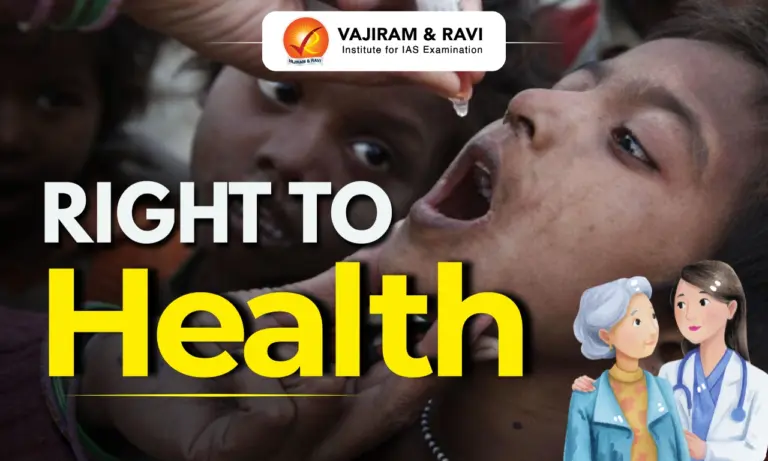
The Right to Health means that every person has the right to attain the highest possible standard of physical, mental and social well being. It is a fundamental human right closely linked with dignity, equality and development. Although the Constitution of India does not explicitly mention it as a Fundamental Right. However Judicial Interpretation, Directive Principles of State Policy (DPSPs) and International Commitments have gradually strengthened its legal and policy framework in India.
Right to Health in India 2026
The Right to Health ensures access to healthcare services, medicines, sanitation, safe drinking water, health information and preventive and emergency medical care without discrimination. It also includes equal opportunities to achieve the highest attainable standard of health.
- Human Dignity: Health is considered an essential part of the right to live with dignity. Governments have the responsibility to provide accessible, affordable and quality healthcare irrespective of gender, religion, race, ethnicity, or economic status.
- Rajasthan Right to Health Act: Rajasthan became the first Indian state to enact a Right to Health law. It provides every resident free consultation, medicines, diagnostics, emergency transport, procedures and emergency treatment in all public health institutions and selected private hospitals as prescribed under rules.
Right to Health Constitutional and Legal Provisions
The constitutional framework and judicial interpretation together provide a strong legal basis for recognising healthcare as an essential right in India.
- Article 21: The Supreme Court has interpreted Article 21, which guarantees the Right to Life and Personal Liberty, to include the Right to Health because a life with dignity cannot exist without adequate healthcare.
- Directive Principles of State Policy: Articles 38, 39, 42, 43 and 47 under the Part 4 of Indian Constitution require the State to promote social justice, improve nutrition, raise the standard of living, ensure humane working conditions and improve public health.
- Universal Declaration of Human Rights: India is a signatory to Article 25 of the Universal Declaration of Human Rights (1948), which recognises every person’s right to an adequate standard of living, including food, housing, clothing, medical care and essential social services.


Right to Health Case Laws
Indian courts have significantly expanded the scope of the Right to Health through landmark judgments that established healthcare as a constitutional obligation.
- Parmanand Katara vs Union of India (1989): The Supreme Court ruled that every doctor, whether working in a government or private hospital, has a professional duty to provide immediate medical assistance to save human life without delay.
- Paschim Banga Khet Mazdoor Samity vs State of West Bengal (1996): The Supreme Court held that providing adequate medical facilities is a constitutional responsibility of a welfare state and governments cannot deny timely medical treatment because of administrative shortcomings.
- Menstrual Hygiene Judgment: The Supreme Court held that menstrual hygiene forms an integral part of Article 21. It directed all States, Union Territories and both government and private schools to provide free biodegradable sanitary napkins, hygienic separate toilets and implement the National Menstrual Hygiene Policy for schoolgirls from Classes VI to XII.
Right to Health International Recognition
The Right to Health is recognised globally through international human rights instruments that promote universal and equitable healthcare.
- WHO Recognition: The concept gained international recognition in 1946 with the establishment of the World Health Organization (WHO), which recognised health as a basic human right and promoted universal access to healthcare.
- Universal Declaration of Human Rights (1948): Article 25 recognises the right to an adequate standard of living, including medical care, nutrition, housing, clothing and social security necessary for health and well being.
- International Covenant on Economic, Social and Cultural Rights: Article 12 recognises the right of every individual to enjoy the highest attainable standard of physical and mental health and encourages governments to strengthen public health systems.
- Global Human Rights Framework: Regional human rights instruments, including the African Charter on Human and Peoples’ Rights and the American Convention on Human Rights, also recognise healthcare as a fundamental human right.
Right to Health Challenges
Despite policy improvements, several structural and financial barriers continue to limit universal access to quality healthcare across India.
- Weak Healthcare Infrastructure: India has only 1.4 hospital beds per 1,000 people, one doctor for every 811 people and 1.7 nurses per 1,000 people. More than 75% of healthcare infrastructure is located in metro cities, while 73% of the population lives outside them.
- High Disease Burden: India faces both communicable and non communicable diseases, including tuberculosis, HIV/ AIDS, malaria and diabetes. According to Frontiers in Public Health, over 33% of the ailing population still suffers from infectious diseases.
- High Out of Pocket Expenditure: Per capita out of pocket expenditure on infectious diseases is ₹7.28 for inpatient care and ₹29.38 for outpatient care, increasing the financial burden on households and raising the risk of poverty.
- Gender Inequality: The World Economic Forum 2021 placed India among the five lowest ranked countries for female health and survival. Between 2017 and 2019, women from poor households recorded more than 2,25,000 fewer hospital visits than men for nephrology, cardiology and oncology services.
- Low Public Health Financing: The allocation under Union Budget on healthcare was only 0.26% of GDP in FY26, significantly below the average of around 1.8 to 1.9% of GDP public spending, limiting investments in infrastructure and healthcare personnel.
Right to Health Significance
The Right to Health strengthens inclusive development by ensuring healthcare becomes an enforceable public responsibility rather than merely a welfare service.
- Rights Based Healthcare: A legal right creates accountability and compels governments to ensure accessible, affordable and quality healthcare for every citizen instead of relying only on welfare schemes.
- Universal Access: It promotes equal availability of consultation, medicines, diagnostics, emergency services, sanitation and preventive healthcare, reducing disparities between different regions and social groups.
- Financial Protection: Expanding free and affordable healthcare reduces out of pocket expenditure, prevents medical poverty and improves financial security for economically weaker households.
- Better Public Health Outcomes: Improved healthcare access supports disease prevention, early diagnosis, timely treatment, lower mortality, stronger workforce productivity and sustainable social and economic development.
- Greater Transparency and Accountability: Legal recognition of health rights improves patient awareness, strengthens institutional responsibility, enhances transparency in treatment and encourages responsive healthcare governance.

 Last updated on Sep, 2026
→ UPSC 2027 Notification will be released on 13 January 2027 at upsconline.nic.in.
→ Asian Games 2026 are being held in Aichi-Nagoya, Japan, from 19 September to 4 October.
→ Check out the latest UPSC Syllabus here.
→ Download UPSC Model Answers for Mains 2026
→ UPSC Mains Question Paper 2026 is out now for Essay & GS Paper 1, 2, 3 & 4.
→ UPSC Calendar 2027 has been released.
→ Enroll in Vajiram & Ravi’s UPSC Mains Test Series 2027 for structured answer writing practice, expert evaluation, and exam-oriented feedback.
→ Join Vajiram & Ravi’s UPSC Mentorship Program 2027 for personalized guidance, strategy planning, and one-to-one support from experienced mentors.
→ Go through the UPSC Mains Previous Year Papers to enhance your preparation.
→ UPSC has released UPSC Toppers List 2025 with the Civil Services final result on its official website.
→ Also check Best UPSC Coaching in India
Right to Health FAQs
Q1. What is the Right to Health?+
Q2. Is the Right to Health a Fundamental Right in India?+
Q3. Which state became the first to pass a Right to Health law?+
Q4. Which constitutional provisions support the Right to Health in India?+
Q5. What are the major challenges to ensuring the Right to Health in India?+
Q6. Is the Right to Health a Fundamental Right in India?+
Tags: health for all right to health